 |
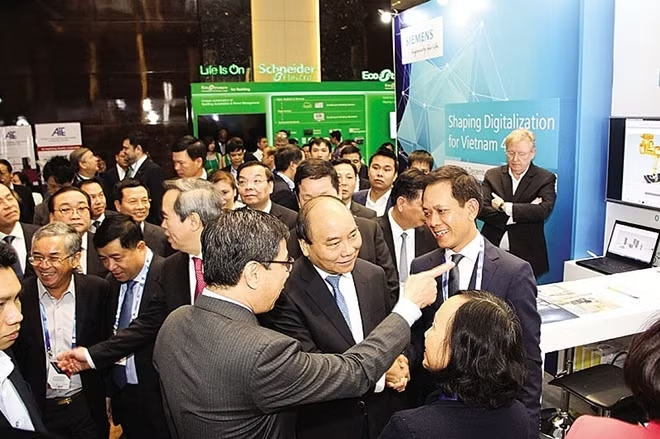
Prime Minister Nguyen Xuan Phuc visited Siemens’ booth at Smart Industry World 2017 in Hanoi
Digitalisation is a megatrend and is changing the world dramatically. In your opinion, what does digitalisation offer medium-sized enterprises?
Let’s take a global aspect in the first instance. Siemens Financial Services recently surveyed managers at 60 international manufacturing firms in eleven countries.
They anticipate digitalisation will enable productivity gains of up to 10 per cent of total sales. In Germany, every fifth mid-sized firm is a digital pioneer, already using Industry 4.0 technologies today.
Also, the German Federal Ministry for Economic Affairs and Energy is expecting €153 billion ($189 billion) in additional growth from Industry 4.0 by 2020. There’s also lots of potential in Europe.
Digital business models and the digital design of value chains in particular offer new opportunities for medium-sized enterprises. The important thing is to start in the right place and then to design the transformation in a commercially viable manner with a forward-looking migration programme.
So are there any limits to digitalisation?
Regarding time zones, locations, companies, or countries, there are initially no limits. That is precisely what makes digitalisation so special: The fact that the entire value chain can be completely digitalised and integrated, from product design through to on-site customer service.
On the one hand, even if production processes are easier and easier to optimise digitally and production environments can be adjusted and improved for variable operational sequences ever more independently, at the same time, even in Industry 4.0, humans will continue to play a crucial role in the complex interdependencies, planning, and controlling of digital systems.
What can medium-sized enterprises expect to gain from digitalisation in collaborating with Siemens?
They can expect quite a lot. Digitalisation will allow us to implement specific customer requirements more and more quickly, efficiently, and flexibly.
We strive to complete configuration of a given system together with our customer within two days, so that clear processes and modules are in place and development can begin quickly.
That is why we rely on consistent digitalisation of the entire value chain; from design, structuring, simulation, and optimisation at our in-house virtualisation centre, right down to commissioning and service.
By 2020, we anticipate engineering efficiency gains of at least 30 per cent, also due to being able to do virtual commissioning.
In addition to NX software for CAD design and Teamcenter as the data backbone, we are now also relying on TIA Portal, which substantially increases our engineering efficiency.
We are able to offer customers more comprehensive services than ever before and provide even better support in day-to-day operations.
Even after construction and delivery, the digital twin continues to exist in each machine and collects data to, for example, enable predictive maintenance or increase system availability.
This allows us to prevent downtime and cut costs by optimising energy consumption – a genuine competitive edge.
What does management need to consider so a company can keep up?
Managers need to make clear strategic decisions as they transform into a digital enterprise. Digitalisation must be a top management priority on two levels: On the one hand, companies need to align what they offer to reflect Industry 4.0 and add digital solutions and services to their portfolio. On the other hand, they must undergo a transformation and gear their internal processes to meet the requirements for digitalisation.
It takes a considerable amount of creativity and courage to generate disruptive ideas and implement them. What’s more, we need to interconnect more strongly on a global basis. Only then will it be possible, for example, for a mid-sized enterprise in Germany to successfully roll out an innovation on Vietnam’s market. For me, one thing is certain: The slow cycles of change are a thing of the past. We all need to learn how to continuously reinvent our companies.
What would be your advice to a medium-sized company interested in or having to implement cloud applications?
Have a clear strategy and communicate it within your company. Thanks to plug-and-play technology, it often only takes an hour to connect a company to MindSphere so it can tap into the benefits of open data analysis. Also, the costs are frequently lower than an exclusive mobile phone plan. However, the path to Industry 4.0 is long and takes several years, and it calls for a deliberate decision to invest.
At Siemens, we worked on our digital twin for over 10 years and invested nearly €10 billion ($12.5 billion) in our software portfolio being used by our customers today.
It is a large amount, but our customers do not need to invest the same amount of money, of course. They can rely on our experience. There is, after all, no one-size-fits-all solution. For medium-sized companies in particular, it makes sense to analyse your company’s requirements and to gradually move forward with digitalisation with targeted investments.
Every industry and every company is different and requires solutions it can integrate into existing processes and the production structure step by step, while not restricting operations due to downtime. Today, this naturally implies that not only greenfield plants are built based on the new concept, but also brownfield plants can be retrofitted during normal operations.
You mentioned MindSphere several times. Is it Siemens’ newest IoT technology?
Yes, it is. MindSphere is the open, cloud-based IoT operating system by Siemens that lets you connect your machines and physical infrastructure to the digital world. It lets you harness big data from billions of intelligent devices, enabling you to uncover transformational insights across your entire business. Moreover, MindSphere provides customers and developers with the capability to develop applications and digital services, apply them and make them available to other users. In this way, totally new service and business models are possible.
MindSphere features a robust development environment with open APIs (Application Programming Interfaces) with advanced analytics. MindSphere also extends its open connectivity with machines from other manufacturers with the addition of more industrial protocols and third-party gateways.
Has MindSphere been introduced to Vietnam?
Yes, we are in the middle of introducing it to our Vietnamese customers. In fact, I had the honour to make a brief introduction of MindSphere to Prime Minister Nguyen Xuan Phuc when he visited Siemens’ booth at the Smart Industry World 2017 event in December 2017, which was organised by the Central Economic Commission in Hanoi.
More great news is that Vietnam’s FPT Corporation has officially become Siemens’ first global partner for MindSphere. FPT also becomes our official partner in Vietnam for product lifecycle management (PLM). Together, we will support Vietnamese enterprises, especially medium-sized enterprises, on their way to Industry 4.0. Their future is digital.