Ba Ria-Vung Tau to develop logistics sector

The southern province of Ba Ria-Vung Tau has set a goal to develop logistics into a major service sector with a focus on seaport development.

ba ria-vung tau to develop logistics sector hinh 0
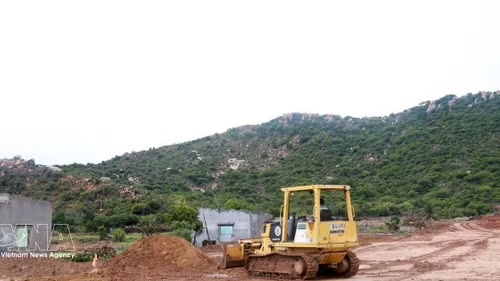
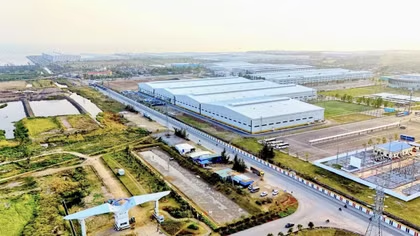
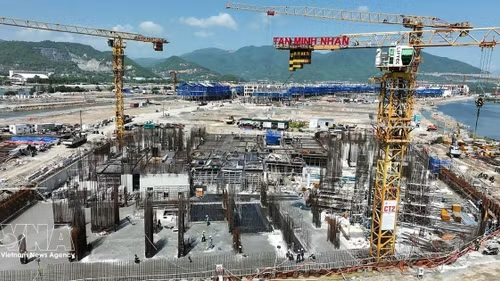
A groundbreaking ceremony held by the Vina-Japan Shirogane Logistics Company at the Phu My 3 Specialised Industrial Park in Ba Ria-Vung Tau province

The Vung Tau Shipbuilding and Oil Services Joint-Stock Company will invest in the new logistics centre and container port. Located in Phu My commune, the Cai Mep Ha logistics centre will have a total area of 1,200ha, with an estimated investment of VND40 trillion (US$1.72 billion).

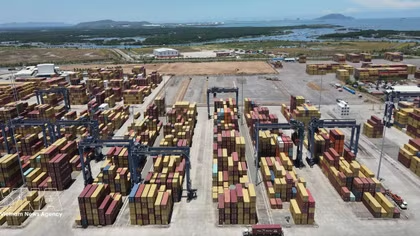
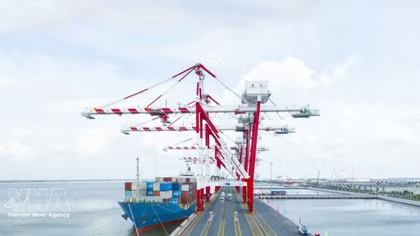
The Cai Mep Ha container port will be developed on an area of 86.6ha with total investment of VND10 trillion (US$430 million). As a sea-based economy, the province wants to increase the current capacity of its seaports, improve international transshipment services, and achieve throughput capacity of more than 100 million tonnes in coming years. 

The province will also continue to upgrade roads to improve connectivity and enhance goods and service circulation, local authorities have said. By 2020, the province is expected to have 18 port operators and 219 logistics companies, contributing around VND94 trillion (US$4.04 billion) to GDP and 47.1% to the service sector. 

Seaports in Vung Tau city by 2030 will be capable of handling 140 to 275 million tonnes of goods, according to authorities. Under a master plan for the logistics industry, the province will create favourable conditions for seaport and logistics service providers to meet regional standards. 

The master plan calls for businesses in service and market development sectors to join the supply chains of key products like oil and gas, energy, industrial equipment, supporting industries, and building materials, among others.

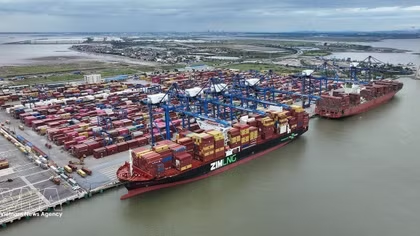
Ba Ria-Vung Tau province is a major gateway for international shipments in Southeast Asia, especially because of the Cai Mep-Thi Vai port complex, one of the key ports in the region.

The port system is one of only 19 in the world capable of handling 190,000 deadweight tonnage (DWT) vessels. Container ships from the port complex are capable of transporting goods to Europe and North America. In addition, the province is only 70km from HCM City’s Cat Lai port. To improve connectivity, efficiency and port capacity, the province also plans to increase investment in terminals and road infrastructure.

Infrastructure investments in recent years have increased connectivity within the province and with neighbouring economic hubs like HCM City and Dong Nai province.

By the end of last year, the province had 315 foreign direct investment (FDI) projects with total registered capital of US$27 billion, and 450 domestic projects with total registered capital of more than US$11 billion.

Last year, FDI flow reached US$1.5 billion in 29 new and seven existing projects. In the first seven months, the province emerged as the third largest destination of foreign investment, just behind Hanoi and HCM City. 

Total registered capital reached US$2.15 billion, accounting for 9.4% of total FDI investment in Vietnam. The province aims to attract US$4 billion in FDI by 2020. 

To meet its target, the provincial government plans on more investor-friendly reforms in many areas. 

In addition, it also plans to increase investment in distribution networks, technology transfer, skill development, and funding for small- and medium-sized enterprises.

The four key sectors in the province include seaport logistics, high-tech industrial production, tourism, and high-tech agriculture. Other areas of opportunities for investors include food processing, shipbuilding, traffic infrastructure, and metallurgy-mechanical engineering.

Located in the southern key economic zone, which contributes nearly 8 percent to the national GDP and 10% to State revenues, Ba Ria-Vung Tau is one of the country’s major investment destinations. 

In the last decade, rapid economic growth has resulted in the province having the highest GDP per capita and the third highest living standard in Vietnam.
VNA

Other News

SBV raises short-term capital lending cap to 40%

SBV raises short-term capital lending cap to 40%

The new circular will help credit institutions have more room to provide capital to businesses and investment projects to support high economic growth in the next few years, while increasing flexibility in the SBV’s monetary policy management.

Business confidence in Vietnam rebounds strongly: UOB

Business confidence in Vietnam rebounds strongly: UOB

The study found that 85% of Vietnamese enterprises reported positive business sentiment, a sharp increase from 48% in 2025, when business confidence was weighed down by uncertainties surrounding US tariff policies and related trade developments.

Bac Ninh seeks high-quality foreign investment for sustainable growth

Bac Ninh seeks high-quality foreign investment for sustainable growth

According to Vice Chairman of the provincial People’s Committee Pham Van Thinh, the province aims to maintain stable and sustainable growth, improve the competitiveness of both the economy and local businesses, and make better use of free trade agreements (FTAs) to expand and diversify export markets.

Green building trend flourishes in Ho Chi Minh City's real estate landscape

Green building trend flourishes in Ho Chi Minh City's real estate landscape

The International Finance Corporation (IFC) highlighted the city's dominance in green-certified building floor space in Vietnam, reflecting the rapid expansion of the green building market with 780 completed green buildings encompassing over 18.69 million sq.m by 2025, predominantly certified by EDGE and LEED.

UK supports Vietnam in wind power and green finance development

UK supports Vietnam in wind power and green finance development

The United Kingdom officially announced two new climate cooperation initiatives to support Vietnam in its energy transition and green growth journey. These programs focus on offshore wind power development and the creation of a sustainable green financial ecosystem.

Ample room remains for Vietnam–India logistics cooperation

Ample room remains for Vietnam–India logistics cooperation

The GTTCI expert noted that alongside logistics and integrated warehousing, e-commerce is expected to be a particularly high-growth sector in the coming years. He described it as a multi-billion-dollar market with significant untapped opportunities for cooperation between Vietnam and India.

Exports gain momentum from high-tech growth drivers

Exports gain momentum from high-tech growth drivers

According to the Ministry of Industry and Trade, Vietnam’s exports reached 215.66 billion USD in the first five months of 2026, up 19.5% year-on-year. Twenty-six export items generated more than 1 billion USD in revenue each, including seven with turnover exceeding 10 billion USD.

Vietnam–China crossings see spike in ASEAN fresh produce

Vietnam–China crossings see spike in ASEAN fresh produce

Since the start of the summer harvest season, China's two major border gates with Vietnam, Youyi Guan in Pingxiang and Beilun 2 Bridge in Dongxing, have entered their peak period for handling imports of fresh agricultural and seafood products from member states of the Association of Southeast Asian Nations (ASEAN).

Cargo handling operations at Berths 3 and 4 of the Hai Phong International Gateway Port. (Photo: VNA)

AI reshapes logistics, raising bar for workforce skills

According to the Vietnam Logistics Business Association (VLA), the logistics sector will require around 2.2 million workers by 2030, including 1.6 million employees for logistics service providers and nearly 600,000 personnel supporting logistics operations in manufacturing and trading enterprises.

Robust dispute resolution framework key to Vietnam's IFC ambitions

Robust dispute resolution framework key to Vietnam's IFC ambitions

The development strategy for VIFC-HCMC envisions a comprehensive financial ecosystem encompassing green finance, carbon credits, financial technology (fintech), blockchain technology, digital assets, digital banking and other innovative business models. These highly internationalised sectors involve complex cross-border transactions and sophisticated legal structures.