Decree sets requirements for foreign-invested vocational institutions

The Vietnamese Government has issued a series of conditions required to set up a foreign-invested vocational training institution in Vietnam, expected to take effect from March 20.

The conditions were itemised in Decree 15/2019/ND-CP, which offers detailed instructions on the implementation of the law on vocational training.

Accordingly, the investor’s project would need to be in line with the national planning of vocational training network in the country.

The investor would also need to make sure to obtain at least 1,000 sq.m of land for a basic vocational training centre; 10,000 sq.m for a secondary-level vocational training school in urban areas or 20,000 sq.m if the school is located in the suburbs or rural areas; 20,000 sq.m for college-level vocational training schools in urban areas, or 40,000 sq.m outside urban areas.

The investor would also need to possess at least 5 billion VND (216,000 USD) in investment capital to open a vocational training centre, and 50 billion VND and 100 billion VND to open a secondary vocational training school and vocational college, respectively.

The planned training curricula needs to meet the requirements of Item 1, Article 34 of the Law on Vocational Training, and does not contain content that might threaten national defence and security or public interests, propagate religious ideologies or present warped views of the history and cause negative influences on Vietnamese morals, culture and customs.

The institutions would also need to make sure that its Vietnamese student body would be taught obligatory subjects as per regulations by the Ministry of Labour, Invalids and Social Affairs.

The Decree also specifies the conditions for the establishment of a branch or another campus of a foreign-invested secondary vocational school and college, which include a detailed project to establish said branch, with statements clarifying the necessity for such establishment; the name and scope of operation of the branch; a development plan, the planned vocational fields and subjects.

The investors who wish to establish another branch of vocational training institution would need to present a contract or agreement on the lease of infrastructure and facilities for minimum five years, with its investment capital reaching at least 25 percent of the capital required to establish full-fledged vocational training institutions of corresponding levels mentioned above.
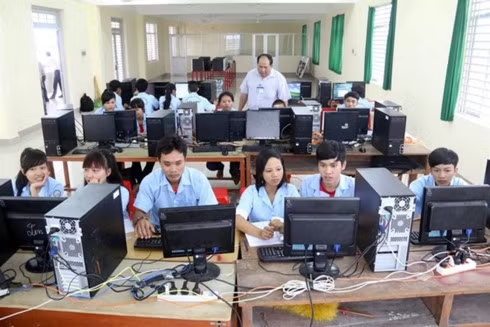
Computer practice hours at the secondary vocational school for ethnic minority groups of Kien Giang province.
VNS/VNA

Other News

Hanoi ready to implement Capital Law 2026, unlocking new development momentum

Hanoi ready to implement Capital Law 2026, unlocking new development momentum

The effectiveness of the Capital Law 2026 will be measured not by the number of legal documents issued but by tangible improvements in governance and public administration, better services for people and businesses, faster administrative procedures, stronger investment attraction and higher economic growth.

Vietnamese students earn honours at ROBOG Asia Cup 2026

Vietnamese students earn honours at ROBOG Asia Cup 2026

Three teams from Chu Van An Secondary School in Vietnam’s Thai Nguyen province have earned First Prize honours and advanced to the quarterfinals at the ROBOG Asia Cup 2026, a regional robotics and artificial intelligence (AI) competition for students held in Hong Kong, China.

Hanoi sets out new investment blueprint with century-long development vision

Hanoi sets out new investment blueprint with century-long development vision

As of early June, Hanoi had attracted 74.6 billion USD in foreign direct investment (FDI) through more than 9,250 valid projects. FDI inflows in the first six months were projected at 3.2 billion USD, surpassing the annual target by 116%, while nearly 16,000 new businesses were established in the first five months, up 34.4% year-on-year.

Vietnam promotes legal cooperation and rule of law at global forum

Vietnam promotes legal cooperation and rule of law at global forum

Vietnam’s development and international integration have gone hand in hand with the improvement of its legal system, the incorporation of international commitments into domestic legislation, and legal reforms aimed at fostering development, openness and global integration. The country regards international law as an essential instrument for building fair, mutually beneficial relations among nations.

Hanoi to hold investment promotion event on June 29

Hanoi to hold investment promotion event on June 29

At the event, Hanoi authorities plan to grant investment policy decisions and investment registration certificates to 20 exemplary projects in the fields of transportation infrastructure, industrial parks, urban development, social housing, environment, science and technology, and foreign investment attraction.

Hanoi's Red River urban area development draws widespread attention

Hanoi's Red River urban area development draws widespread attention

Located south of the Red River and extending from the historic inner city to newly developing areas in the south and the west, the central urban area along Red River’s right bank covers approximately 45,317 hectares and is projected to accommodate around 6.365 million residents by 2045 and 6.455 million by 2065.

Hanoi's Red River urban area development draws widespread attention

Hanoi's Red River urban area development draws widespread attention

Located south of the Red River and extending from the historic inner city to newly developing areas in the south and the west, the central urban area along Red River’s right bank covers approximately 45,317 hectares and is projected to accommodate around 6.365 million residents by 2045 and 6.455 million by 2065.

Regional cooperation strengthened to combat cross-border drug crime

Regional cooperation strengthened to combat cross-border drug crime

Vietnam, China, Laos and Myanmar face common challenges as drug syndicates increasingly exploit the Mekong River, cross-border transport networks, e-commerce platforms, international logistics services, cyberspace and cryptocurrencies to organise drug transactions and smuggling operations.