One year after the implementation of the two-tier local administration model, alongside efforts to streamline the apparatus, a significant shift has begun to emerge across many localities: public assets are no longer viewed solely through the lens of management and preservation, but are increasingly being regarded as a valuable resource for development.
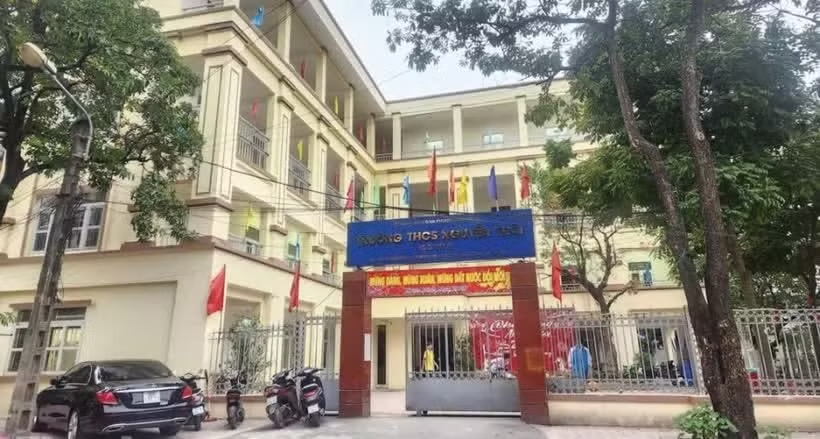
From surplus office buildings to fragmented land and property holdings left after administrative restructuring, many localities have started to reorganize public spaces, creating new opportunities for infrastructure investment, public services and socio-economic development.
According to the Ministry of Finance's one-year review report on the restructuring of administrative units and the operation of the two-tier local administration model, the first phase of handling 25,885 state-owned land and property facilities has been completed nationwide. Of the more than 11,000 surplus facilities recovered and transferred to local authorities, over 5,000 have already been processed or put into use. Significantly, behind these figures lies not merely the disposal of redundant assets, but a large-scale reallocation of public resources.
In Hanoi, for example, many properties and land plots made available through administrative restructuring are being reviewed for allocation to education, healthcare and public works projects, at a time when urban land resources are becoming increasingly scarce. The capital is also promoting the shared use of government office buildings to reduce dispersed investment and free up land for social infrastructure development.
Hai Phong is regarded as one of the localities that has proactively linked the management of public assets with urban and logistics planning. Several land plots released through restructuring are being assessed for industrial infrastructure, warehousing and port-related services – sectors that are key drivers of the northern port city's economic growth.
Experts note that, if managed in a coordinated manner and integrated closely with development planning, public assets made available through restructuring could become vital seed capital for future infrastructure, public service and urban development projects. In this context, the effectiveness of the two-tier model will be measured not only by administrative efficiency but also by its ability to unlock and regenerate resources for national development.
In the northern province of Bac Ninh, where urbanisation and industrial expansion are progressing rapidly, authorities are also reviewing surplus land and property assets to create clean land reserves for expanding industrial infrastructure and urban services. Some former administrative facilities are being considered for conversion into community cultural and educational centres.
Beyond major urban centres, several provinces in central Vietnam are using the administrative restructuring process as an opportunity to reorganise public spaces. In Ha Tinh, for instance, former commune offices merged under the new model are being assessed for use as grassroots healthcare facilities, commune police stations or community centres, rather than being left vacant or falling into disrepair. Other localities are exploring the auction of surplus land to generate funding for transport infrastructure, schools and public welfare projects.
A notable outcome of the restructuring is that many previously fragmented public land parcels have been consolidated into larger sites, making comprehensive planning and long-term utilisation more feasible. Such consolidation was difficult to achieve in the past when public assets were divided among multiple administrative levels and agencies.
Beyond changes in scale and organisation, perhaps the most important development is the shift in thinking regarding public asset management. Assets made available through restructuring are no longer regarded as residual matters requiring administrative disposal; instead, they are increasingly seen as strategic reserves for development.
According to the Ministry of Finance, the restructuring of administrative units and government organisations has generated substantial land and property resources that can be prioritised for healthcare, education, culture, sports and other public projects. This approach helps reduce compensation, land clearance and infrastructure development costs.
At the same time, a number of these land reserves are being entrusted to local land development organisations or housing management agencies for further utilisation, creating additional budget revenues through land allocation and leasing in accordance with the law.
Experts also point out that centralising management responsibilities helps curb fragmented and inefficient investment practices, which have long been a source of budgetary pressure in many localities./.