Foreign real estate developers return as crisis is over

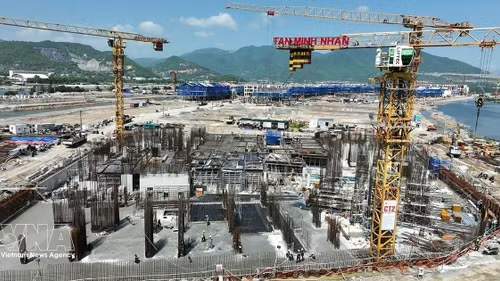
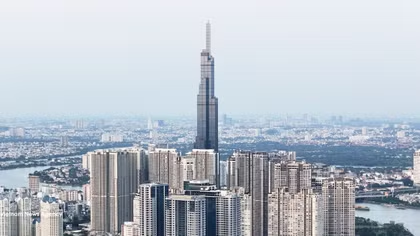
Vietnam attracted US$3 billion worth of foreign direct and portfolio investments to the real estate sector in 2017, a sharp increase of 80% over the year before.

foreign real estate developers return as crisis is over hinh 0

Why Vietnam?

Besides profits, there are other reasons for foreign investors to eye the Vietnamese market, including a desire to expand in the international market or diversify investment portfolios in Asia.

Vietnam, with a high growth rate, population and demand for housing, has become a destination for many foreign investors. 

Singaporeans are the traditional investors in Vietnam’s real estate market, developing villas, apartments and high-end office and shopping malls.  

But investors from Malaysia, Hong Kong, the Republic of Korea and Japan who scaled down their operations in the real estate crisis between 2011 and 2013 have returned.

The market has also seen many newcomers from China, who are believed to have powerful financial capability.

High-end market targeted

Though Vietnam is known as an attractive market with a strong rise of the urban middle class, most foreign investors in Vietnam target the high-end market segment. 

Analysts say this is the segment where foreign investors have experience and advantages, while they face competition from domestic investors in low-cost and mid-end projects.

However, in some cases, foreign investors are also looking for opportunities in the mid-end market segment. Japanese investors, for example, have joined forces with Vietnamese real estate firms to develop apartments targeting middle-income earners, young couples and migrants in HCM City.

Japanese investors have experience in designing small apartments at low costs.

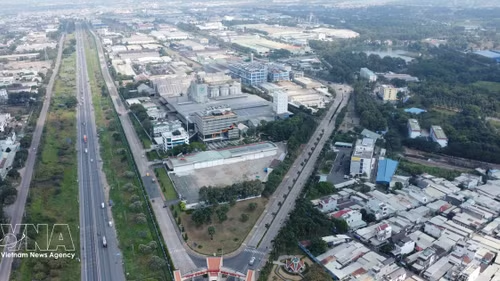
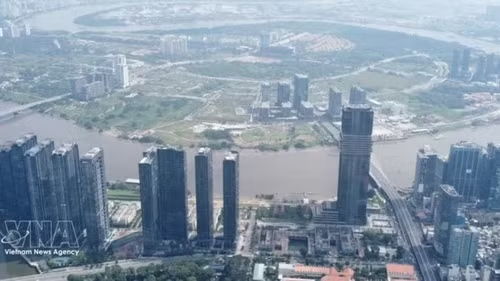
Foreign investors are also interested in developing large urban areas and cities. Smart urban areas using advanced technologies is one investment trend.

Difficulties in seeking land 

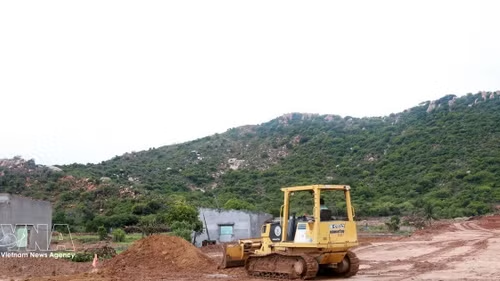
With the 2013 Land Law, real estate developers, however, are having problems finding land. The State no longer implements site clearance, except in some special cases.

As a result, real estate developers have to compensate residents for site clearance. In many cases, investors and local residents cannot reach agreement on compensation methods. 

This is why foreign investors often cooperate with Vietnamese firms to develop projects. 

Under the most popular cooperation model, foreign investors take major responsibility developing projects, while Vietnamese companies are in charge of the land fund and legal procedures.

Forecasts about the real estate market in 2018 are all inclined towards optimism. The market is expected to witness further growth in many market segments thanks to strong demand.

Vietnamnet

Other News

SBV raises short-term capital lending cap to 40%

SBV raises short-term capital lending cap to 40%

The new circular will help credit institutions have more room to provide capital to businesses and investment projects to support high economic growth in the next few years, while increasing flexibility in the SBV’s monetary policy management.

Business confidence in Vietnam rebounds strongly: UOB

Business confidence in Vietnam rebounds strongly: UOB

The study found that 85% of Vietnamese enterprises reported positive business sentiment, a sharp increase from 48% in 2025, when business confidence was weighed down by uncertainties surrounding US tariff policies and related trade developments.

Bac Ninh seeks high-quality foreign investment for sustainable growth

Bac Ninh seeks high-quality foreign investment for sustainable growth

According to Vice Chairman of the provincial People’s Committee Pham Van Thinh, the province aims to maintain stable and sustainable growth, improve the competitiveness of both the economy and local businesses, and make better use of free trade agreements (FTAs) to expand and diversify export markets.

Green building trend flourishes in Ho Chi Minh City's real estate landscape

Green building trend flourishes in Ho Chi Minh City's real estate landscape

The International Finance Corporation (IFC) highlighted the city's dominance in green-certified building floor space in Vietnam, reflecting the rapid expansion of the green building market with 780 completed green buildings encompassing over 18.69 million sq.m by 2025, predominantly certified by EDGE and LEED.

UK supports Vietnam in wind power and green finance development

UK supports Vietnam in wind power and green finance development

The United Kingdom officially announced two new climate cooperation initiatives to support Vietnam in its energy transition and green growth journey. These programs focus on offshore wind power development and the creation of a sustainable green financial ecosystem.

Ample room remains for Vietnam–India logistics cooperation

Ample room remains for Vietnam–India logistics cooperation

The GTTCI expert noted that alongside logistics and integrated warehousing, e-commerce is expected to be a particularly high-growth sector in the coming years. He described it as a multi-billion-dollar market with significant untapped opportunities for cooperation between Vietnam and India.

Exports gain momentum from high-tech growth drivers

Exports gain momentum from high-tech growth drivers

According to the Ministry of Industry and Trade, Vietnam’s exports reached 215.66 billion USD in the first five months of 2026, up 19.5% year-on-year. Twenty-six export items generated more than 1 billion USD in revenue each, including seven with turnover exceeding 10 billion USD.

Vietnam–China crossings see spike in ASEAN fresh produce

Vietnam–China crossings see spike in ASEAN fresh produce

Since the start of the summer harvest season, China's two major border gates with Vietnam, Youyi Guan in Pingxiang and Beilun 2 Bridge in Dongxing, have entered their peak period for handling imports of fresh agricultural and seafood products from member states of the Association of Southeast Asian Nations (ASEAN).

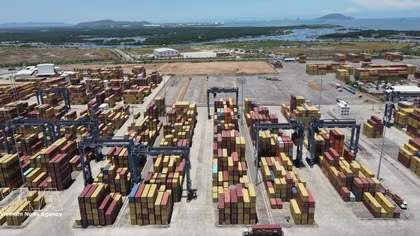
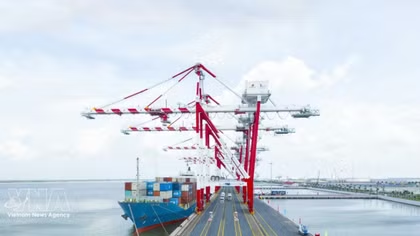
Cargo handling operations at Berths 3 and 4 of the Hai Phong International Gateway Port. (Photo: VNA)

AI reshapes logistics, raising bar for workforce skills

According to the Vietnam Logistics Business Association (VLA), the logistics sector will require around 2.2 million workers by 2030, including 1.6 million employees for logistics service providers and nearly 600,000 personnel supporting logistics operations in manufacturing and trading enterprises.

Robust dispute resolution framework key to Vietnam's IFC ambitions

Robust dispute resolution framework key to Vietnam's IFC ambitions

The development strategy for VIFC-HCMC envisions a comprehensive financial ecosystem encompassing green finance, carbon credits, financial technology (fintech), blockchain technology, digital assets, digital banking and other innovative business models. These highly internationalised sectors involve complex cross-border transactions and sophisticated legal structures.