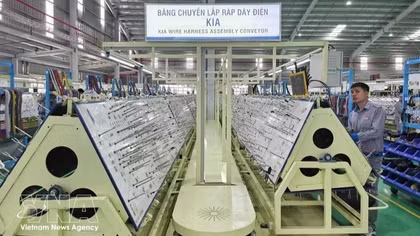
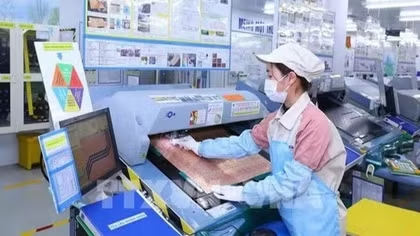
German firms continue to invest in Vietnam with upbeat prospect

PSNews - The majority of German companies are upbeat about the prospect of doing business in Vietnam with many expressing an intention to maintain investment in the country.

Almost 93 percent of German companies already operating in Vietnam will continue to invest in the country and over 64 percent of them expect their business to develop better in the next 12 months, a survey from AHK World Business Outlook–Spring 2022 has revealed.

The survey was conducted by the German Chambers of Commerce Abroad, Delegations and Representative Offices (AHKs). Vietnam’s border reopening and the Government’s drastic and timely policies have created a boost for post-pandemic economic recovery, said the survey.
German firms continue to invest in Vietnam with upbeat prospect -0
German businesses are more optimistic about economic development in Vietnam over the next 12 months than they were in the autumn of last year.

Over 46 percent of them plan to recruit more employees in the coming year. The surveyed businesses also demonstrate that the most important factors for their trade and investment decisions in Vietnam are political stability, availability of skilled workers in technical and non-technical fields, and transport and logistics.

Thanks to Vietnam’s participation in free trade agreements (FTAs), the country has favourable conditions to attract foreign direct investment (FDI) flows.

More than 73 percent of German businesses believe that the implementation of the EVFTA from August 2020 increases their competitiveness in Vietnam. They regularly leverage the ASEAN-China FTA (ACFTA) and the Comprehensive and Progressive Agreement for Trans-Pacific Partnership (CPTPP).

Implementing their business activities in Vietnam, German businesses evaluate the most important factors are the availability of skilled labour in technical fields (58.3 percent), quality of education in technical fields (58.3 percent), and tariff trade barriers (56.5 percent).

Currently, they regard the greatest risk as the price of raw materials, followed by energy prices, and a shortage of skilled labour. The Russia-Ukraine conflict has also had an economic impact on their companies.

Higher costs for energy, raw materials and supply chain and logistics disruptions are their most worrying issue. This results in changes to their international business investment activities, such as adjusted risk assessment on locations and economic decoupling of world regions.

In the context of restrictions from the COVID-19 pandemic and supply chain disruptions, allocating and diversifying investment and production activities has become a top priority of German businesses, said Marko Walde, Chief Representative of AHK, at the press conference announcing the survey in Hanoi on June 8.

“Instead of focusing on a specific market and production base, German businesses are expanding their supply chains, and 95 percent are looking at Southeast Asia, specifically Thailand and Vietnam,” he said. At the present time, Walde said that Vietnam has an important position in the flow of international trade.

“Among the 10 ASEAN member states, Vietnam is one of the four countries participating in the CPTPP, and together with Singapore, it is the only two countries with a free trade agreement with the EU so far,” he emphasised.

More importantly, the advantage with Vietnam as a production base also lies in the fact that German and European enterprises could set up enterprises with 100-percent-foreign capital, hardworking and inquisitive workers, as well as the close economic, social and cultural connections between the two countries.

To further promote investment capital from Germany into Vietnam, Walde emphasised the importance of Vietnam in developing a production supply network and high-quality human resources, which were capable of meeting investors’ demand.

By L.B

Other News

Vietnam – one of most attractive destinations for leading US semiconductor companies: expert

Vietnam – one of most attractive destinations for leading US semiconductor companies: expert

Vietnam has built a solid semiconductor and electronics industry before joining ITSI, attracting major US semiconductor companies. Intel Products Vietnam is one of Intel's largest assembly and testing facilities worldwide, while chip design companies such as Synopsys, Cadence, Marvell and Qualcomm have established engineering and research centres in the Southeast Asian country.

Vietnam targets higher-quality FDI under Resolution 10

Vietnam targets higher-quality FDI under Resolution 10

During the first seven months of 2026, Vietnam attracted more than 38 billion USD in registered FDI, up nearly 58% year-on-year. More importantly, the increase was driven by large-scale, high-tech projects rather than a surge in the number of new investments, signalling a significant improvement in the quality of capital inflows.

Manufacturing, engineering drive hiring growth in H1: report

Manufacturing, engineering drive hiring growth in H1: report

Manufacturing and engineering posted the strongest recruitment growth, with hiring demand surging 70% year-on-year, driven by production expansion, supply chain restructuring and sustained investment inflows in high-tech manufacturing.

Government proposes special mechanisms to unblock APEC 2027 projects in Phu Quoc

Government proposes special mechanisms to unblock APEC 2027 projects in Phu Quoc

The projects in Phu Quoc have been implemented under tight deadlines. Since May 2025, the Prime Minister has directed preparations for APEC 2027, including accelerated infrastructure development on the special zone. An Giang province and investors have subsequently launched a number of major projects involving complex technical requirements and demanding construction schedules.

Financial market reform plan targets high, sustained growth through 2045

Financial market reform plan targets high, sustained growth through 2045

The plan seeks to develop a balanced and modern financial market that is closely integrated with regional and global markets, strengthens the mobilisation and allocation of domestic and foreign capital, and enhances the market’s role as a key provider of medium- and long-term capital for the economy and as a major driver of sustained high economic growth.

An Giang aims to become leading maritime economic hub

An Giang aims to become leading maritime economic hub

Under the province's master plan for 2021–2030 with a vision to 2050, An Giang will prioritise investment in five strategic sectors: strategic infrastructure; processing industries and clean energy; trade, services, logistics and border-gate economy; high-quality tourism; and high-tech agriculture, ecological development and the circular economy.

Lien Khuong International Airport set to reopen on August 19

Lien Khuong International Airport set to reopen on August 19

Once operations stabilise, Lien Khuong International Airport in the Central Highlands province of Lam Dong is projected to serve approximately 6,800 passengers a day, nearly 1,000 more than before its temporary closure. Passenger throughput during the final four months of 2026 is forecast to reach around 816,000.

Global buyers turn to Ho Chi Minh City for sourcing

Global buyers turn to Ho Chi Minh City for sourcing

The growing number of international retailers and importers choosing Ho Chi Minh City as a sourcing destination underscores the city's transformation from a trade promotion venue into a regional procurement hub.

PM's conclusions set to clear bottlenecks, spur corporate growth

PM's conclusions set to clear bottlenecks, spur corporate growth

The PM called on the business community, business associations and the Vietnam Chamber of Commerce and Industry (VCCI) to strengthen self-reliance, innovation and competitiveness by improving governance, adopting advanced technologies, enhancing product quality and using capital more efficiently.

Incentive policies for high-tech agricultural zones

Incentive policies for high-tech agricultural zones

Under Decree No. 263/2026/ND-CP, qualified projects are given priority to participate in State support programmes as well as funds and policies on research and development, technological innovation, technology transfer, human resource training, investment promotion and trade promotion.