- More promising offshore energy
- Energy Drinks Linked to Aggression, Hurt PTSD Therapy in Soldiers - Study
- Ninh Thuan speeds up renewable energy projects
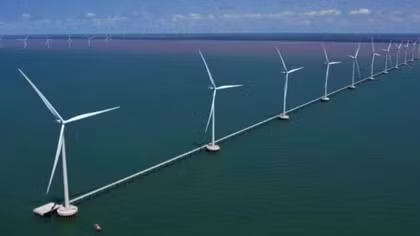
Ambassador of the European Union to Vietnam, Bruno Angelet, said that the Vietnamese renewable energy market is becoming increasingly attractive because of positive investment in renewable energy resulting from the revision of the feed-in-tariffs (FiTs) for wind power to 8.5 US cent per kilowatt-hour (kWh) for inland projects, and 9.8 US cent per kWh for offshore projects, as well as 9.35 US cent per kWh for solar power.
The developments in both wind and solar power show Vietnam’s efforts to meet the targets set in the Revised Power Development Master Plan VII (PDP 7) to produce 10.7% of its electricity from renewable sources by 2030.

As an early bird in the wind power sector, Bui Van Thinh, chairman and CEO of Thuan Binh Wind Power JSC, brought Phase 1 of the Phu Lac wind plant in the south-central province of Binh Thuan into commercial operation and connected it to the national grid in 2016. He said the company is going to continue to develop another wind power project in Ninh Thuan next year.
As the solar energy sector witnesses a gold rush, the list of renewable energy projects registered by both overseas and domestic financiers in Vietnam has been growing.
Jakob Stenby Lundsager, a member of the technical working group of the Vietnam Energy Partnership Group (VEPG), told VIR, “The current FiT is not considered to be a barrier. It is high enough. However, the uncertainties of the tariff increase risks for investors: it has been changed many times, and if it can be increased then it can be decreased as well. Furthermore, the conditions of the power purchase agreement (PPA) essentially provide uncertainties about the tariff since a signed PPA can be cancelled.
According to Lundsager, experience from Denmark suggests that stable policy framework conditions are crucial to attract investors and reduce the price of renewable energy.
A series of proposals, including PPAs, mechanisms for the future of wind and solar support, and integration of fluctuating renewable energy in the national grid, are to be discussed in order to lobby the revision of Vietnam’s sustainable energy development and reduce gas emissions.
Nguyen Ninh Hai, head of the Renewable Energy Division at the Ministry of Industry and Trade (MoIT), said there is wide consensus that the standard PPA does not correspond to international standards by putting major financial risks on renewable projects and that several issues should be revised.
A VEPG document noted that under the current PPA, there is no compensation payment available if state-run Electricity of Vietnam (EVN) is unable to take the electricity, regardless of whether the issue arises out of EVN’s failure to co-operate with the implementation of solar and wind projects, which causes concerns for investors.
The most critical features include transmission distribution risk, a limited off-taker obligation, termination clause, dispute resolution, off-taker payment risk, and future compatibility with the Vietnamese wholesale power market.
Few studies are available that thoroughly assess the impact of fluctuating renewables on the stability of the national grid, but on avoiding specific bottlenecks, the VEPG said it requires “comprehensive monitoring of application, approvals, and a transparent system prioritising project applications as opposed to the first come, first served basis.”
“Investment in grid expansion should take into consideration the potential development of renewable energy generation in regions with high generation potential. Investments should be included in medium- and long-term investment plans to mobilise sufficient public funding and concessional loan financing,” the VEPG noted.
In a similar vein, Hai stressed that that the review of the grid code should take into account fluctuating renewables and specifically address rooftop projects and the related challenges of grid connection and grid integration at the lower and medium voltage level.
“There should be a clear and long-term procurement strategy or target that guides investors as it will lead to significant cost reductions. In case of a parallel application of different support mechanisms, such as FiT and auctioning, clear delineation should be ensured between different instruments,” Hai said, adding that a long-term procurement strategy should be in place as well as a transitional mechanism in case a change applies for specific technology or project types.