Hanoi plans solutions to increase public transport use

Authorities in Hanoi have announced a plan to charge vehicles in downtown areas to increase the use of public transport, according to a decision signed by Chairman of the Hanoi People's Committee Nguyen Duc Chung recently.

Authorities in Hanoi have announced a plan to charge vehicles in downtown areas to increase the use of public transport, according to a decision signed by Chairman of the Hanoi People's Committee Nguyen Duc Chung recently.

Motorbikes would also be banned from inner-city districts by 2030, the paper said.

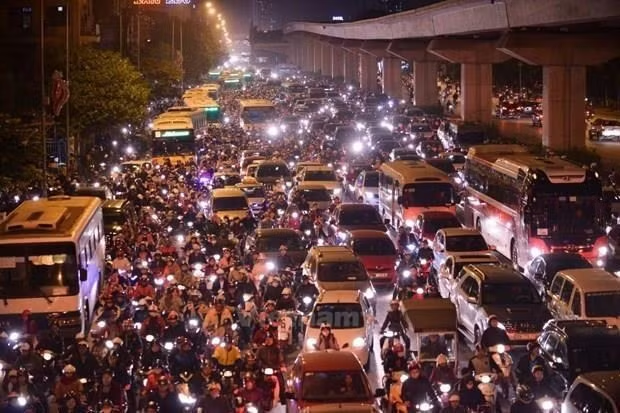
These were some of the solutions put forward to develop the public transport network so as to reduce the percentage of individual vehicles by 20-25 percent by next year, thus increasing the use of public transport and bicycles.

The collection of fees would also reduce traffic congestion and pollution.

Under the plan issued by the municipal authority, the city would continue to expand bus routes to outlying and popular areas such as new urban developments, shopping malls and entertainment centres.

The city will introduce between 46 and 51 new bus routes by next year, 21 of which would be established this year.

The city would also consider setting up priority lanes for buses while banning cars on some roads, to improve the service and attract more users.

According to figures by the Hanoi Traffic Management and Operation Centre, last year 180,000 buses had to skip stops or change routes due to traffic congestion, accounting for 3.5 percent of services.

This was impacting public opinion on buses in the city.

In fact, the number of passengers had dropped in two years of 2016 and 2017, the center said.

Passenger numbers rose again last year.

The main reason for unstable passenger numbers was a lack of infrastructure for buses, a leader of the Hanoi Transport Service Company (Transerco) said in the Kinh Te & Do Thi (Economy & City) Newspaper.

As they do not have priority lanes, buses were affected by traffic congestion so they often ran behind schedule.

In response, the public was shifting to use of private vehicles.

The city still plans to use buses as a key means of public transport in the future. So, if there were no priority lanes, buses will continue to be stuck among other vehicles on the roads, according to the Transerco representative.

The Hanoi Traffic Management and Operation Center's director Nguyen Hoang Hai said: “There are concerns that current transport infrastructure is not suitable for establishing bus lanes.”

“In fact, bus lanes would help attract more passengers because they would reduce delays,” Hai said.

This would also help to cut the use of private vehicles, he added.

In order to encourage people to use public transport, bus and rapid bus transit (BRT) routes would be connected with the Cat Linh-Ha Dong Urban Rail Route.

The city would also build parking areas near bus and rail stations so people can easily transfer to public transport.

The city would also open mini-bus routes which could access small streets.

A project to expand the public bicycle network was also considered.

For inter-provincial coaches, the city has plans to rearrange stations and routes to connect them to inner-city bus and urban rail stations.

In Ho Chi Minh City, the transport department has also been studying a project for special lanes for buses on Dien Bien Phu and Vu Thi Sau streets.

Marking out priority lanes for buses was part of the program of traffic jam and accident reduction in 2016-20 and a project of public transport expansion and private vehicle control in HCM City.

VNA

Other News

Hanoi ready to implement Capital Law 2026, unlocking new development momentum

Hanoi ready to implement Capital Law 2026, unlocking new development momentum

The effectiveness of the Capital Law 2026 will be measured not by the number of legal documents issued but by tangible improvements in governance and public administration, better services for people and businesses, faster administrative procedures, stronger investment attraction and higher economic growth.

Vietnamese students earn honours at ROBOG Asia Cup 2026

Vietnamese students earn honours at ROBOG Asia Cup 2026

Three teams from Chu Van An Secondary School in Vietnam’s Thai Nguyen province have earned First Prize honours and advanced to the quarterfinals at the ROBOG Asia Cup 2026, a regional robotics and artificial intelligence (AI) competition for students held in Hong Kong, China.

Hanoi sets out new investment blueprint with century-long development vision

Hanoi sets out new investment blueprint with century-long development vision

As of early June, Hanoi had attracted 74.6 billion USD in foreign direct investment (FDI) through more than 9,250 valid projects. FDI inflows in the first six months were projected at 3.2 billion USD, surpassing the annual target by 116%, while nearly 16,000 new businesses were established in the first five months, up 34.4% year-on-year.

Vietnam promotes legal cooperation and rule of law at global forum

Vietnam promotes legal cooperation and rule of law at global forum

Vietnam’s development and international integration have gone hand in hand with the improvement of its legal system, the incorporation of international commitments into domestic legislation, and legal reforms aimed at fostering development, openness and global integration. The country regards international law as an essential instrument for building fair, mutually beneficial relations among nations.

Hanoi to hold investment promotion event on June 29

Hanoi to hold investment promotion event on June 29

At the event, Hanoi authorities plan to grant investment policy decisions and investment registration certificates to 20 exemplary projects in the fields of transportation infrastructure, industrial parks, urban development, social housing, environment, science and technology, and foreign investment attraction.

Hanoi's Red River urban area development draws widespread attention

Hanoi's Red River urban area development draws widespread attention

Located south of the Red River and extending from the historic inner city to newly developing areas in the south and the west, the central urban area along Red River’s right bank covers approximately 45,317 hectares and is projected to accommodate around 6.365 million residents by 2045 and 6.455 million by 2065.

Hanoi's Red River urban area development draws widespread attention

Hanoi's Red River urban area development draws widespread attention

Located south of the Red River and extending from the historic inner city to newly developing areas in the south and the west, the central urban area along Red River’s right bank covers approximately 45,317 hectares and is projected to accommodate around 6.365 million residents by 2045 and 6.455 million by 2065.

Regional cooperation strengthened to combat cross-border drug crime

Regional cooperation strengthened to combat cross-border drug crime

Vietnam, China, Laos and Myanmar face common challenges as drug syndicates increasingly exploit the Mekong River, cross-border transport networks, e-commerce platforms, international logistics services, cyberspace and cryptocurrencies to organise drug transactions and smuggling operations.