Hanoi suburbs await outdoor gyms, playgrounds

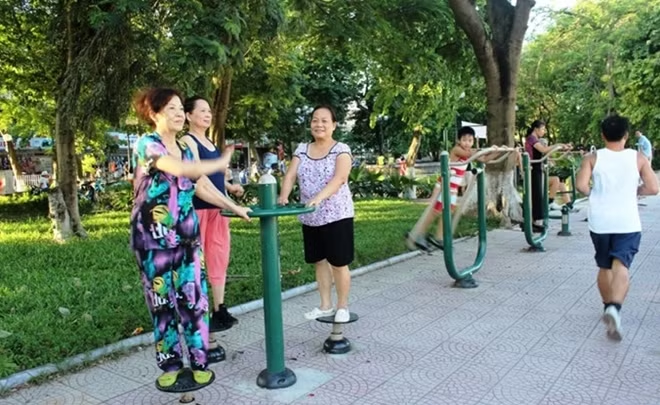
The installation of exercising equipment in parks and other public areas has been an unqualified success in the capital city.

The free outdoor gyms that began springing up three years ago have proved very popular with residents, prompting more people to exercise regularly.

Dinh Van Luyen, Head of Public Sports Division under the city’s Department of Culture and Sports, said that between 2014 and 2016, exercise equipment was installed in the seven districts.

“The free outdoor gyms have been welcomed and applauded. Previously, people usually went to the parks to walk, jog or do a few stretching exercise. Now they can do more with the supporting exercise equipment,” Luyen said.

The outdoor gyms have not only been funded by the city’s budget, but also with financial assistance from district budgets or private donors.

In May, the Tay Ho District People’s Committee inaugurated two free outdoor gyms worth about VNĐ1 billion in its Thuy Khue and Buoi wards.

Tay Ho Vice Chairman Pham Xuan Tai said that district wanted to provide free exercise equipment to all eight wards in the district to promote sports and improve public health.

The district authority has called on private sector to join developing such gyms that beneficiaries would be responsible to manage and maintain, Tai said.

To some extent, the free outdoor gyms have helped meet demand for public sports facilities of people in crowded inner districts.

However, little of this change has made it to suburban areas in Hanoi.

Nguyen Van Hanh, a mechanic from Phu Xuyen district – a suburban district of Hanoi, said that he lived and worked in Buoi Ward, Tay Ho District.

“I tried the exercise equipment. I saw many people interested in doing exercises around West Lake and some parks in Cau Giay District,” he said, adding that he wished such equipment would soon be available in his hometown.

“I’m sure that if the equipment is installed in the ground of the Community House in my hamlet, many people will begin exercising,” Hanh said.

At a meeting of culture and sports officials in Hanoilast year, director of the My Duc District Sports Centre, Nguyen Thi Thuyen, said that suburban districts faced difficulties in providing free outdoor gyms because they had modest budgets.

“It is also more difficult for suburban districts to call for financial support from the private sector,” she said.   

In June, the city’s Culture and Sports Department proposed to the People’s Committee that six new free outdoor gyms are opened this year in some districts.

Between 2018 and 2020, the city plans to expand such gyms to other districts in the city, mostly suburban ones.

This is part of the city’s sport development plant until 2020 with vision towards 2030, which targets all communes and wards (except those in four inner districts) having sports facilities including a stadium, a gymnasium, a swimming pool and a playground.

Every hamlet in communes will have a community house combined with a sports ground, the plan says.

The plan was developed in light of the Law on Sports and a Government decision No112/2007/ND-CP clarifying some provisions of the law.

However, regulations on developing public sport facilities continue to be general and vague, said National Assembly deputy Ngo Duy Hieu.

The law states that People’s Committees at all levels are responsible for building public sports facilities. The Government’s decision stated that the People’s Committees should ensure resources including funding for public sports facilities.

"Both the law and the decision are too general, not specifying what the actual responsibilities are at various levels," Hieu said.

Such ambiguity could lead to overlapping or ignoring of responsibilities by administrations at different levels, he added.

In Nam Tu Liem District, a project to build a Culture and Sports Centre was approved in 2007 and about 5,000sq.m of land allotted for it. But the centre has not been built so far.

The ward has 15 residential groups, but only seven have community houses and public playgrounds for sports or exercises.

Deputy director of the district’s Culture and Sport Centre, Nguyen Thi Nga, said that other wards in the district did not have public playgrounds, despite the fact that land was available.

“Specific regulations, at least on funding, are needed to speed up the projects,” she said.

Ngo Van Quy, Vice Chairman of the Hanoi People’s Committee, said detailed information such as the number and the minimum area of public playgrounds in a hamlet had to be compiled to implement and actualise such projects.


VNS

Other News

Hanoi to provide free textbooks from 2026–2027 school year

Hanoi to provide free textbooks from 2026–2027 school year

The municipal Department of Education and Training will work with the Department of Finance to guide wards, communes and educational institutions in implementing the student support policies adopted by central authorities and the municipal People’s Council.

Vietnamese students shine at AIMO 2026 international finals

Vietnamese students shine at AIMO 2026 international finals

The Vietnamese team won one Champion title, four First Runner-up awards, three Second Runner-up awards, 42 gold medals, 83 silver medals, 70 bronze medals and two consolation prizes at the 2026 International Finals of the Asia International Mathematical Olympiad Open Contest (AIMO) held in Hanoi on August 2-5.

Politburo's Resolution 57-NQ/TW powers new growth momentum

Politburo's Resolution 57-NQ/TW powers new growth momentum

NSO Director Nguyen Thi Huong said alongside foreign investment and the green economy, science – technology, innovation, the digital economy and digital transformation are the new drivers that can can pack a serious second-half punch.

Vietnam’s poverty reduction miracle: A journey for the people

Vietnam’s poverty reduction miracle: A journey for the people

From a country where more than 50% of the population lived below the poverty line in the early 1990s, Vietnam has reduced its poverty rate to just 2.95% today. This achievement reflects not only the effectiveness of socio-economic development policies, but also Vietnam’s ability to translate growth into tangible opportunities for its people, steadily realizing inclusive development and ensuring that no one is left behind.

Can Tho boosts Vietnamese language support for ethnic minority children

Can Tho boosts Vietnamese language support for ethnic minority children

Backed by more than 4.2 billion VND (161,000 USD) from the State budget, the programme aims to strengthen children's Vietnamese communication skills before they begin primary school, helping them integrate more smoothly into the classroom and improve learning outcomes from the outset.

Powering growth: Ensuring reliable energy supply to keep investment flowing

Powering growth: Ensuring reliable energy supply to keep investment flowing

Across Ha Tinh and Nghe An, maintenance teams conduct inspections day and night, using thermal cameras and drones to detect potential faults without interrupting electricity supply. Their work helps ensure stable power supply for businesses as the region accelerates development in line with the Government's economic growth targets.

One Vietnamese worker killed in Japan earthquake

One Vietnamese worker killed in Japan earthquake

The Embassy of Vietnam in Japan and its labour management board are actively implementing citizen protection measures and maintaining close contact with relevant organisations and companies employing Vietnamese workers in the affected areas to monitor the situation.

Hanoi to support low-income residents in replacing high-emission motorbikes

Hanoi to support low-income residents in replacing high-emission motorbikes

A key task is to formulate a support scheme for low-income residents to replace ageing motorcycles and mopeds that fail to meet emission standards and pose a high risk of pollution. It will also propose funding to provide free first-time emission testing for motorcycles and mopeds across the city.

UNESCO endorses vision for restoring Thang Long Imperial Citadel's central axis

UNESCO endorses vision for restoring Thang Long Imperial Citadel's central axis

The committee commended Vietnam for fulfilling the commitments it has made since the citadel was inscribed on the UNESCO World Heritage List in 2010, as well as for implementing recommendations from the committee and its advisory bodies. It also praised the country's efforts to preserve the site's cultural, historical and social values, transforming the imperial citadel into a space for public engagement, cultural exchange and historical education. The committee further welcomed the long-term vision as an important basis for the proposed restoration of Kinh Thien Palace in line with the approved conservation strategy.

Border guards seize 15,200 drug pills, heroin in major trafficking bust

Border guards seize 15,200 drug pills, heroin in major trafficking bust

At about 10:15 pm on July 20, officers from the Operations Division of the Nghe An Border Guard Command and the Nam Can International Border Gate Border Guard Station, in coordination with customs officers at the Nam Can International Border Gate, caught a resident of Tan Tien hamlet, Chieu Luu commune, Nghe An province, allegedly transporting narcotics in Tien Tieu hamlet, Nam Can commune.