Hanoi to end use of deadly stoves

Hanoi plans to stop the use of beehive-shaped coal bricks by 2020 as part of measures to improve air quality and living conditions, according to the municipal Department of Natural Resources and Environment.
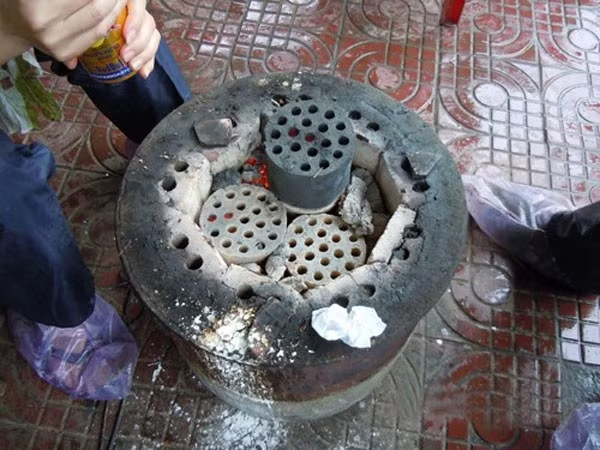
The survey, carried out on 23 out of 30 districts and suburban districts of Hanoi last year, showed that about 63 per cent of coal burners were used in urban districts, mostly by small restaurants and food shops along pavements. Photo petrotimes.vn

The move was made following a recent survey by the department’s environmental office which revealed that Hanoi has about 55,000 beehive coal stoves, which burn a total of more than 528 tonnes of coal each day, filling the air with carbon dioxide.

The survey, carried out on 23 out of 30 districts and suburban districts of Hanoi last year, showed that about 63 per cent of coal burners were used in urban districts, mostly by small restaurants and food shops along pavements.

Le Thanh Thuy, a representative from the department, said the use of the coal stoves was one of the key sources of environmental pollution. Other sources included a huge amount of fumes from vehicles, construction sites and the burning of rubbish.

Many people know the environmental harm of using an earthenware stove with coal, but it remains a habit for many Vietnamese. Many families in both rural and urban areas use them to overcome the rising costs of gas and electricity.

Nguyen Thi Hanh from Bach Khoa Ward, Hai Ba Trung District, said she still used a stove with coal to cook, although she had a gas cooker.

“I prefer using coal stove as it is cheaper, particularly when you have to braise food like meat and fish. Besides, I have been using it for a long time and find it hard to get rid of it,” she said.

However, Le Hoai Thu, a mother of two, in Hoang Mai District, said she felt uncomfortable to see some of her neighbours still using the cookers.

“I can’t stand their smell. Inhaling carbon dioxide released from coal burners is harmful to your health, especially children. I have to close all the windows and doors of my house whenever my neighbours burn the coal,” she said.

According to experts, the use of beehive coal poses serious threats to health. They normally produce carbon dioxide, but in unventilated rooms, they start to produced deadly carbon monoxide, which is a killer. 

Once inhaled, carbon monoxide molecules bind to the oxygen-carrying sites in red blood cells, cutting off the supply of oxygen to the body, especially the brain. Gradually, those exposed to the substance lose consciousness and face permanent brain damage from oxygen deprivation, if not death.

Statistics of the Poisoning Prevention Centre under the Hanoi-based Bach Mai Hospital show that dozens of patients need treatment for coal air poisoning per year, and many people die.

As part of the plan to end the use of the stoves, the environment office has chosen Ba Dinh and Hoan Kiem districts to pilot a campaign to raise public awareness while introducing new kinds of stoves using clean fuel.

On February 6, the department singed an agreement with the SNV, a Netherlands Development Organisation, on a programme to pilot the use of environmentally friendly stoves in the capital city.

Mai Trong Thai, head of the Ha Noi Environmental Protection Department, told the Kinh te va Do thi (Economic and Urban Affairs) newspaper that the city targeted to reduce 70 per cent of beehive stoves this year and totally stop their use by 2020.

Under the pilot programme, citizens in Ba Dinh and Hoan Kiem districts can borrow stoves that use clean fuels to use for one month. From February to April this year, people will enjoy a discount of 30-40 per cent to buy them.

The SNV organisation claims that the stoves have been "strictly tested" for exhaust levels, safety and fuel efficiency. Fuels for the stoves are said to meet international standards. 
VNS

Other News

Vietnam steps up implementation of ethnic affairs strategy through 2030

Vietnam steps up implementation of ethnic affairs strategy through 2030

To accelerate the implementation of the the Ethnic Affairs Strategy by 2030, with a vision toward 2045, the Prime Minister requested ministries, agencies and local authorities to continue thoroughly carrying out the Party and State’s policies on ethnic affairs, enhancing the effectiveness of State management and strengthening oversight of policy implementation.

Security preparations reviewed for APEC 2027 in Phu Quoc

Security preparations reviewed for APEC 2027 in Phu Quoc

The team examined the APEC 2027 Convention Centre, where main conference activities are scheduled; Sun Serenia Hospital, designated to provide healthcare and emergency medical services for delegates; provincial road DT.975, which connects Phu Quoc International Airport to the convention centre; and the area surrounding Phu Quoc International Airport.

Hanoi accelerates seven Red River bridge projects, many exceed 70% completion

Hanoi accelerates seven Red River bridge projects, many exceed 70% completion

According to the municipal Transport Construction Investment Project Management Board, the city is simultaneously implementing seven projects, namely Tu Lien, Ngoc Hoi, Tran Hung Dao, Thuong Cat, Van Phuc, Hong Ha and Me So bridges. Construction is being carried out on multiple fronts, focusing on bored piles, pile caps, piers and superstructure works.

Dien Bien battlefield legacy powers tourism revival

Dien Bien battlefield legacy powers tourism revival

Seventy-two years after the Dien Bien Phu Victory, its legacy still reverberates. The unity, self-reliance, and resilience forged in that historic triumph remain a powerful internal engine, now propelling Dien Bien toward fast and sustainable development.

Hanoi accelerates shift to green buses, targets 100% by 2030

Hanoi accelerates shift to green buses, targets 100% by 2030

In the 2027–2030 period, the city will accelerate the transition towards the complete phase-out of fossil fuel-powered buses. The share of electric and green energy-fueled buses is projected to reach 79–89% by 2029 and 100% by 2030.

36 fishermen safely rescued after boat breaks down near Truong Sa

36 fishermen safely rescued after boat breaks down near Truong Sa

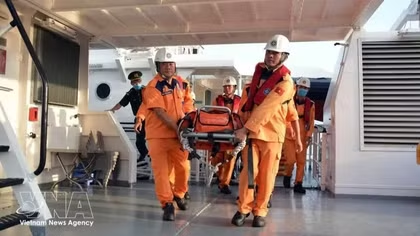
At 8:00 the same day, KN475 began towing the disabled fishing boat toward Da Tay A island. The towing operation was carried out safely, and by 18:30 both the vessel and its crew had arrived at the island without incident, where repairs and additional support procedures were arranged.

Vietnamese language contest in Laos strengthens youth ties, bilateral friendship

Vietnamese language contest in Laos strengthens youth ties, bilateral friendship

Held in response to the launch of the Vietnamese Language Day among overseas Vietnamese communities, the event aimed to enhance the quality of Vietnamese language teaching and learning in Laos while contributing to the great friendship, special solidarity, comprehensive cooperation and strategic cohesion between the two countries.

Vietnamese language contest in Laos strengthens youth ties, bilateral friendship

Vietnamese language contest in Laos strengthens youth ties, bilateral friendship

Held in response to the launch of the Vietnamese Language Day among overseas Vietnamese communities, the event aimed to enhance the quality of Vietnamese language teaching and learning in Laos while contributing to the great friendship, special solidarity, comprehensive cooperation and strategic cohesion between the two countries.

Hanoi launches 10 electric bus routes from April 1

Hanoi launches 10 electric bus routes from April 1

By the end of April, the number of buses using electricity and other green energy sources in the city is expected to reach 822, including 683 electric buses and 139 compressed natural gas (CNG) buses, representing 42.1% of the total number of vehicles.