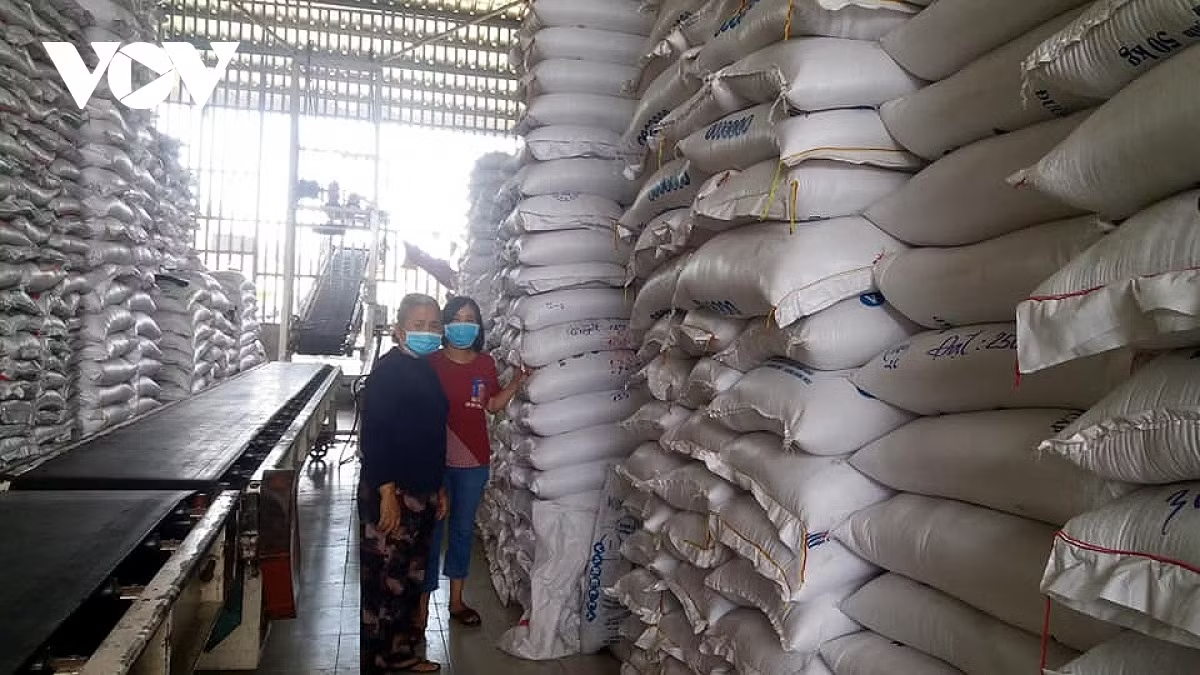
Recent times have seen Vietnamese rice products continuously dominate many markets, including ASEAN and the EU, due to their unique advantages in terms of quality and price, along with incentives from various Free Trade Agreements (FTAs) that have contributed to creating a high level of competition.
However, for the UK market, Vietnamese rice has not yet captured a significant market share, although both nations have made commitments as a means of cutting tariffs under the terms of the UK-Vietnam Free Trade Agreement (UKVFTA).
Market potential yet to be fully exploited
It can be said that the UKVFTA has opened up an array of fresh opportunities for Vietnamese rice, although British rice imports from 2021 highlight that Vietnamese rice products have not yet fully exploited the market potential that exists.
Last year, the rice volume exported from the country to the UK stood at 2,731 tonnes, much lower than the demand of 651,803 tonnes of British importers and the ability of Vietnamese exporters.
The assessment made by the Ministry of Industry and Trade also indicates that the majority of Vietnamese rice sold within the UK is primarily with the distributors’ brand, as opposed to bearing the brands of manufacturers, rice growing regions, or exporters. Therefore, the nation’s brad is not known widely among local consumers.
The main reason behind this is that Vietnamese exporters have not made their own brands, or alternatively local distributors think that their own brands are more effective in marketing than the brands of Vietnamese exporters.
Regarding the UK market's potential for Vietnamese rice products, Nguyen Canh Cuong, counselor of the Vietnamese Trade Office in the UK, said that the country is currently ranked 15th among rice exporters to the UK, with its market share standing at only 0.42%.
There is room to boost Vietnamese rice in the UK through the Overseas Vietnamese community of 100,000 people, as well as favourable tariff quotas given by the UKVFTA.
Like other markets in Europe, the UK imposes many strict barriers on food safety, as well as environmental protection for imported products, especially food products.
Due to these barriers, in order to turn rice export potential into reality, the global standard of good agricultural practice (Global G.A.P) must be fully applied by rice growers and rice exporters, while simultaneously boosting the production of high quality fragrant rice.
Competent agencies and localities that boast large rice-growing areas must implement a programme to support farmers in terms of rice varieties, safe agricultural materials, milling, and preserving rice before exporting, Cuong recommended.
Clearer brand strategy needed
Before the UKVFTA took effect, many Vietnamese goods entering the UK market were subject to extremely high taxes. Therefore, the tax reduction set out under the UKVFTA’s commitment is widely viewed as a great opportunity for many strong Vietnamese products such as agricultural and aquatic products, fruits, coffee, rice, garments and textiles, and furniture to increase their competitiveness in this highly lucrative market.
Specifically, in terms of trade in goods, the UK pledged to eliminate 85.6% of the tariff lines for Vietnamese goods as soon as the agreement came into effect from January 1, 2021, with this rising to up to 99.2% of tariff lines from January 1, 2027. In addition, 0.8% of the remaining tariff lines will enjoy a tariff quota with an import tax within the quota of 0%.
Most notably, under this agreement, fragrant rice imported from the nation will be exempt from tax instead of being subject to 17.4% as it was before. This makes Vietnamese rice more competitive than other countries exporting fragrant rice to the UK.
In order to create a bigger market breakthrough and strengthen the sustainable position of Vietnamese rice within the UK market, as well as other major markets, the Vietnamese rice industry needs to come up with a clear brand strategy tailored to each individual market.
The national brand programme needs to select a number of high-quality rice varieties that have a large output and then name them in a way that is simple, easy to pronounce, and associated with the place where the rice is grown.
According to Hoang Le Hang, first secretary of the Vietnam Trade Office in the UK, although there is no consistent concept of good rice in the UK, there are some common standards, such as the length of a rice grain of 7mm or more. Along with this, when cooked into rice, it must be flexible, soft, non-sticky and fragrant. In addition, the rice must be clean and free of chemical residues or preservatives.