- Police forces strive to prevent African swine fever from spreading to Southern localities
- Efforts augmented to contain African swine fever epidemic
The mission team included experts on ASF, emergency management, Depopulation, Disposal and Decontamination (3D), the swine industry and technical staff from the Viet Nam Department of Animal Health (DAH) and FAO Viet Nam.
The mission objectives were to: advise the Ministry of Agriculture and Rural Development (MARD) on the best practices for culling affected pigs and disposal of carcasses; advise on the best use of available resources to contain the spread of the ASF virus in the local context; propose immediate, short and medium-term actions.
 |
The aim is to combine these actions with the Viet Nam Emergency Response Action Plan for ASF preparedness and control, other regional ASF projects and provide the basis for the formulation of a national ASF response project.
The team visited affected provinces and met with leaders of Departments of Animal Health, Livestock Production and provincial authorities to assess the current outbreak response measures and resources allocated to control the outbreak, as well as to investigate how ASF is spreading.
“The Department of Livestock Production (DLP) estimated over 2.5 million households in Viet Nam are currently actively engaged in pig farming. As such, the loss of pigs due to ASF infection and control measuresleads to a heavy economic burden to many rural families. Together with other international partners, FAO will be doing its best to support the Viet Nam government in coping with the disease and its consequences.” said Mr Albert T. Lieberg, FAO Representative in Viet Nam.
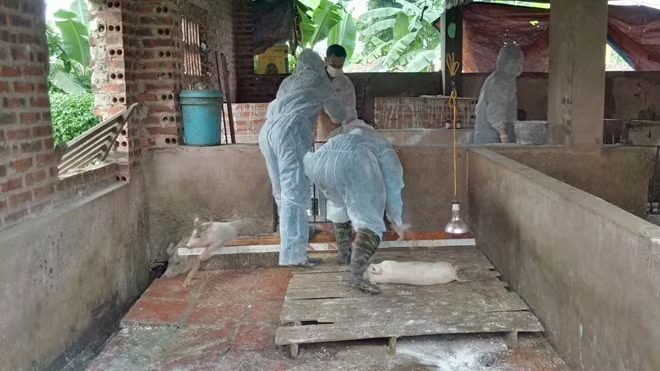
The team visited both ASF infected and non-infected pig farms, burial sites and a pig slaughterhouse in Hai Phong city and Thai Binh province, where they collected information on disease epidemiology and observed current 3D practices.
Although the local government authorities have been implementing strict movement control of pigs and pig products from infected communes, mobilising their resources for pig culling and disposal, small pig farming models with low biosecurity and swill feeding still continue to facilitate ASF spread.
“It is critically important for all media to accurately inform the public of the facts. ASF is a very contagious disease between pigs that has no direct threat to human health. Good biosecurity is the key factor to keeping pigs safe from ASF. Infected and exposed pigs have to be destroyed to prevent further spread” quoted Mr Ian Dacre, mission team leader.
To enhance the ASF response capacities and prevent its further spread, the mission team proposed immediate, short and medium-term actions to the Ministry of Agriculture and Rural Development. Some of the key recommended actions included declaring the ASF outbreak as a national emergency, applying a zoning approach to prevent long-distance ASF spread and developing standard operating producers for swine depopulation and carcass disposal.
| About ASF ASF does NOT transmit to, and cause disease to, humans. It does however kill domestic and wild pigs. It is a deadly pig disease that has been historically limited to Africa with a few historical outbreaks in Europe. However, in 1997 a new incursion in Europe led to its slow but continuous spread from Eastern Europe to Asia over the past 12 years. It was reported for the first time in China in August 2018 but since then has spread very quickly to large parts of the country despite the efforts and measures implemented by the Chinese Veterinary Services. On 19 February 2019, Viet Nam announced the first ASF outbreaks in Thai Binh and Hung Yen provinces. As of 15 March 2019, the Department of Animal Health confirmed a total of 239 ASF outbreaks in 17 provinces. More than 25,000 pigs have been culled in an effort to stop further transmission. Farmers in Asia have limited knowledge of this disease and its specific epidemiology having only recently been introduced to the region. Despite public awareness campaigns, most of the countries and stakeholders in Asia are unprepared for ASF introduction and spread. |