Khuc pie: A gift from Hanoi’s rural area

The fragrance of steaming Khuc pie will live forever as one of most potent childhood memories of Hanoian.

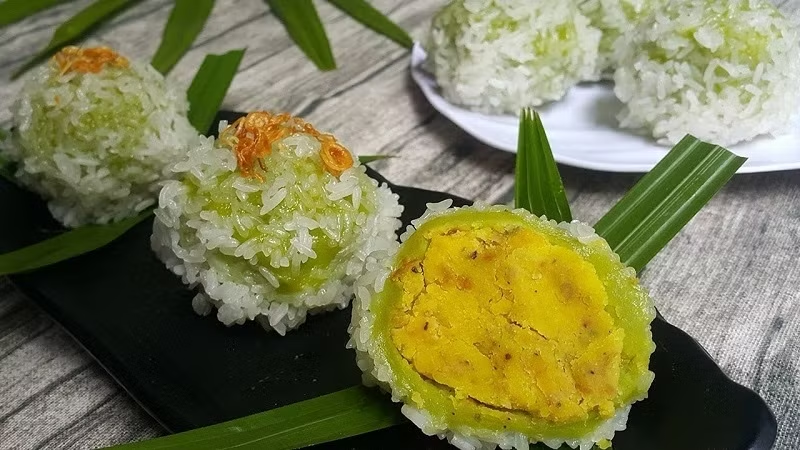
The Khuc pie occupies a special place in the hearts of Hanoians. (Photo: Diep Huong)

The Khuc pie occupies a special place in the hearts of Hanoians. (Photo: Diep Huong)

At the end of the 19th century, Hanoi was already famed for its cuisine, but then, as today, the best-known dishes were not found in large restaurants or at fancy feasts, street stalls and on the dining tables of ordinary Hanoians.

No matter what time of day or night, a light meal has always been easy to find in the capital, but one dish that occupies a special place in the heart of Hanoians, the Khuc pie.

I was born and raised on the outskirts of Hanoi where after every harvest the rice fields would be covered with the fresh cudweed (khuc) leaves, the main ingredient of Khuc pie.

In the spring, when the misty rain coats the north of Vietnam in its haze for days at a time, the cudweed pushes its way through the earth in the fields, covering the rice stubble with its bounty.

After picking the vegetables, my mother would wash them in rainwater before boiling them, then grind the boiled vegetable in a stone mortar, mixing it with sticky rice flour to make a dark green mixture which would be rolled into portions the size of a child's fist.

Each piece would then be rolled in boiled, green peas and meat, which had been soaked in pepper.

Finally, the Khuc pies would be layered into a large steamer, each layer covered with carefully soaked sticky rice. The fragrance of steaming Khuc pie will live forever as one of most potent childhood memories.

When the pie was so cooked that its delicious aroma permeated the house, my mother would take each piece from the steamer and lay it on a plate, which she would first offer to the ancestral altar.

Soon after, each child would be given a hot piece there in the kitchen. Holding a hot Khuc pie in our little hands and examining each grain of sticky rice before finally biting into it was one of the great joys of those cold nights. 

Today, as an adult, I sometimes despair of ever tasting these “real” Khuc pies again. 

Skyscrapers have risen around the city, sprouting in place of the rice fields, and Khuc is now so rare that cooker have to order it from far away, or even using dried leaves from the last crop to make the specialty.

As the fields surrounding the city are replaced by the urban sprawl, fewer and fewer children have the chance to enjoy this spring treat. Perhaps the time is past for this particular traditional favourite, and I often wonder if in the next 10 or 20 years, how many cooks could remember the way a Khuc pie is cooked? 

And as the city spreads, a home-made Khuc pie is becoming a rarity. 
HanoiTimes

Other News

Vietnam secure berth at FIFA U17 World Cup 2026 for first time

Vietnam secure berth at FIFA U17 World Cup 2026 for first time

Vietnam national U17 football team secured a place at the FIFA U17 World Cup 2026 for the first time after defeating United Arab Emirates national U17 football team 3-2 on in the final Group C match of the AFC U17 Asian Cup 2026 in Saudi Arabia on early May 14 (Vietnam time).

Vietnam’s most beautiful railway station twins with French counterpart

Vietnam’s most beautiful railway station twins with French counterpart

A twinning agreement between Da Lat Railway Station in Vietnam and Trouville-Deauville Railway Station in France was signed at the French Embassy in Vietnam on May 7, creating new opportunities for cooperation in station management and operations, as well as cultural and tourism promotion between the two sides.

Hanoi gains two more craft villages in World Crafts Cities network

Hanoi gains two more craft villages in World Crafts Cities network

The recognition of Chuyen My and Son Dong craft villages as members of the World Crafts Cities network represents international acknowledgement of the cultural value, artisanal techniques, creativity and sustainable vitality of Vietnam’s traditional craft villages, he said.

Thang Long - Hanoi Festival 2026 to return in September

Thang Long - Hanoi Festival 2026 to return in September

Co-hosted by the municipal People’s Committee, the Department of Culture and Sports, and domestic and foreign agencies, the whole spectacle is meant to honour the city’s millennia-old heritage while reafffirming its strategy of establishing culture as a development engine.

Spreading Vietnamese cultural identity in digital space

Spreading Vietnamese cultural identity in digital space

In the context of deep international integration, cultural identity serves as both a “shield” against assimilation and a defining marker of a nation’s image. Protecting and promoting uniquely Vietnamese cultural values has therefore become a pressing task, particularly in an increasingly complex digital environment.

ITE HCMC 2026 to promote Vietnam’s tourism on global map

ITE HCMC 2026 to promote Vietnam’s tourism on global map

With its large scale, the ITE HCMC 2026 aims to promote tourism cooperation between Vietnam and priority markets such as Northeast Asia, Western Europe, North America, Southeast Asia, and Oceania while also boosting visitor arrivals from the Indian market

Vietnamese puppetry seeks renewal amid preservation challenges

Vietnamese puppetry seeks renewal amid preservation challenges

Although widely regarded as a cultural “speciality” attracting tourists, Vietnamese puppetry is facing multiple challenges in preservation and development, requiring renewed efforts to both safeguard its identity and adapt to contemporary cultural currents.

Project on digital transformation in cultural sector approved

Project on digital transformation in cultural sector approved

By 2030, the project targets the establishment of shared digital platforms across 100% of cultural sectors. All digitised cultural heritage will be standardised under the national data framework and shared in accordance with regulations, while 80% of public digital heritage assets are expected to receive digital identifiers to clarify ownership and management, encouraging organisations and individuals to do the same and support market development.

Vietnam eyes becoming region’s leading tourism destination

Vietnam eyes becoming region’s leading tourism destination

Vietnam has in recent years undergone a notable transformation in its tourism development strategy, placing a strong emphasis on nature-based and eco-tourism. This shift is not merely aligned with global trends, but represents a necessary step towards safeguarding valuable natural resources, while appealing to a growing segment of environmentally conscious travellers.