MoIT denies proposing price stabilisation fund for steel

The Ministry of Industry and Trade (MoIT) has denied rumours that it proposed the establishment of a State stabilisation fund to cope with the sudden increase in steel prices that has impacted many businesses.

MoIT denies proposing price stabilisation fund for steel ảnh 1

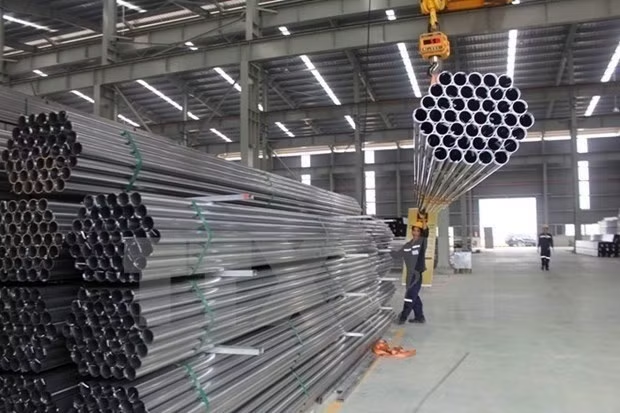
Deputy Minister of Industry and Trade Do Thang Hai told a recent press conference that from the end of 2020 until now, the price of raw materials for steel production has soared, causing a sudden increase in the price of steel products, affecting construction enterprises and their ongoing projects. 

After Deputy Prime Minister Le Minh Khai’s request to report about the situation on May 8, the ministry met with leading steel manufacturing and trading enterprises like the Vietnam Steel Corporation and Hoa Phat Group, then submitted their report to the Government.

Hai said, “The MoIT does not propose a stabilisation fund for steel prices.”

Earlier, experts and steel manufacturing enterprises came out as opposed to such a fund.

Nguyen Van Sua, a steel industry expert, told local media a steel price stabilisation fund was "incompatible with the principle of price management in a market economy" because steel is not a commodity managed by the State. 

Sua said, “The recent spike in domestic steel prices was mainly due to the high price of raw materials for this product known as iron ore, fat coal and scrap steel, which have all skyrocketed in the international market.”

“Raw materials account for 90% of the steel production price, so when raw materials increase, domestic steel prices go up," he added.

As steel prices increased due to the world price level, a stabilisation fund is not suitable, said Sua, adding it was necessary to use the law of supply and demand of the market to cool down the price. 

Economist Ngo Tri Long, who is an expert in prices, said the steel market has been competitive since 2012 and there is no reason to use the tools of the State for this market. Instead, to cool down steel prices, indirect tools such as taxes and trade should be used, he said.

Long said steel was not listed as a good subject to price stabilisation by law, so a proposal to build such a fund was not suitable.

On June 3, Hai said the MoIT and its branches would conduct research, review and implement the construction of technical barriers and quality standards, create a healthy competitive environment and ensure the interests of consumers, as well as implement trade remedies for steel products in accordance with trade regulations and international laws.

At the same time, the ministry would monitor and consider handling possible dumping of some steel products imported into Vietnam as well as deal with anti-dumping lawsuits of other countries against Vietnamese steel exports. 

The deputy minister said market management teams would focus on the steel market to prevent and handle the phenomenon of speculation to increase steel prices, manipulate steel prices in the market, and trade fraud.

The MoIT also suggested steel manufacturing enterprises reduce input costs, production costs to lower the cost of finished steel products, maximise domestic capacity to increase supply and limit exports of domestic products that are in demand. 

From the beginning of this year, steel prices have jumped by 40 percent, significantly pushing up investment capital, in some cases by billions of Vietnamese dong, for construction projects.

According to the General Statistics Office (GSO), the price index of steel and iron products increased by nearly 20% in April from the same period last year and more than 23% in the first four months of 2021.

The GSO pointed out three reasons for the increase, including the rise in prices of raw materials for steel production and transportation costs, the decrease of global steel supplies as China tightened control over production volume and rising domestic demand.

VR Sharma, Managing Director of Jindal Steel and Power Ltd (JSPL), one of India’s leading conglomerates with interests in steel, power, mining and infrastructure, told hellenicshippingnews.com on June 4 that: “Steel consumption has increased worldwide. America is pulling a lot of demand, so is China and this has led to the overall increase in the raw material prices.”
VNS/VNA

Other News

Vietnam – one of most attractive destinations for leading US semiconductor companies: expert

Vietnam – one of most attractive destinations for leading US semiconductor companies: expert

Vietnam has built a solid semiconductor and electronics industry before joining ITSI, attracting major US semiconductor companies. Intel Products Vietnam is one of Intel's largest assembly and testing facilities worldwide, while chip design companies such as Synopsys, Cadence, Marvell and Qualcomm have established engineering and research centres in the Southeast Asian country.

Vietnam targets higher-quality FDI under Resolution 10

Vietnam targets higher-quality FDI under Resolution 10

During the first seven months of 2026, Vietnam attracted more than 38 billion USD in registered FDI, up nearly 58% year-on-year. More importantly, the increase was driven by large-scale, high-tech projects rather than a surge in the number of new investments, signalling a significant improvement in the quality of capital inflows.

Manufacturing, engineering drive hiring growth in H1: report

Manufacturing, engineering drive hiring growth in H1: report

Manufacturing and engineering posted the strongest recruitment growth, with hiring demand surging 70% year-on-year, driven by production expansion, supply chain restructuring and sustained investment inflows in high-tech manufacturing.

Government proposes special mechanisms to unblock APEC 2027 projects in Phu Quoc

Government proposes special mechanisms to unblock APEC 2027 projects in Phu Quoc

The projects in Phu Quoc have been implemented under tight deadlines. Since May 2025, the Prime Minister has directed preparations for APEC 2027, including accelerated infrastructure development on the special zone. An Giang province and investors have subsequently launched a number of major projects involving complex technical requirements and demanding construction schedules.

Financial market reform plan targets high, sustained growth through 2045

Financial market reform plan targets high, sustained growth through 2045

The plan seeks to develop a balanced and modern financial market that is closely integrated with regional and global markets, strengthens the mobilisation and allocation of domestic and foreign capital, and enhances the market’s role as a key provider of medium- and long-term capital for the economy and as a major driver of sustained high economic growth.

An Giang aims to become leading maritime economic hub

An Giang aims to become leading maritime economic hub

Under the province's master plan for 2021–2030 with a vision to 2050, An Giang will prioritise investment in five strategic sectors: strategic infrastructure; processing industries and clean energy; trade, services, logistics and border-gate economy; high-quality tourism; and high-tech agriculture, ecological development and the circular economy.

Lien Khuong International Airport set to reopen on August 19

Lien Khuong International Airport set to reopen on August 19

Once operations stabilise, Lien Khuong International Airport in the Central Highlands province of Lam Dong is projected to serve approximately 6,800 passengers a day, nearly 1,000 more than before its temporary closure. Passenger throughput during the final four months of 2026 is forecast to reach around 816,000.

Global buyers turn to Ho Chi Minh City for sourcing

Global buyers turn to Ho Chi Minh City for sourcing

The growing number of international retailers and importers choosing Ho Chi Minh City as a sourcing destination underscores the city's transformation from a trade promotion venue into a regional procurement hub.

PM's conclusions set to clear bottlenecks, spur corporate growth

PM's conclusions set to clear bottlenecks, spur corporate growth

The PM called on the business community, business associations and the Vietnam Chamber of Commerce and Industry (VCCI) to strengthen self-reliance, innovation and competitiveness by improving governance, adopting advanced technologies, enhancing product quality and using capital more efficiently.

Incentive policies for high-tech agricultural zones

Incentive policies for high-tech agricultural zones

Under Decree No. 263/2026/ND-CP, qualified projects are given priority to participate in State support programmes as well as funds and policies on research and development, technological innovation, technology transfer, human resource training, investment promotion and trade promotion.