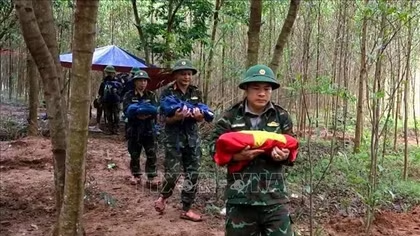
More efforts needed to clear bombs

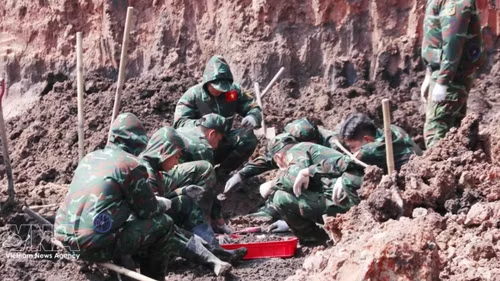
Vietnam has put a lot of efforts into removing explosives remnants of war (ERW), but the issue is still a great challenge for the country, a high-ranking army officer has said.

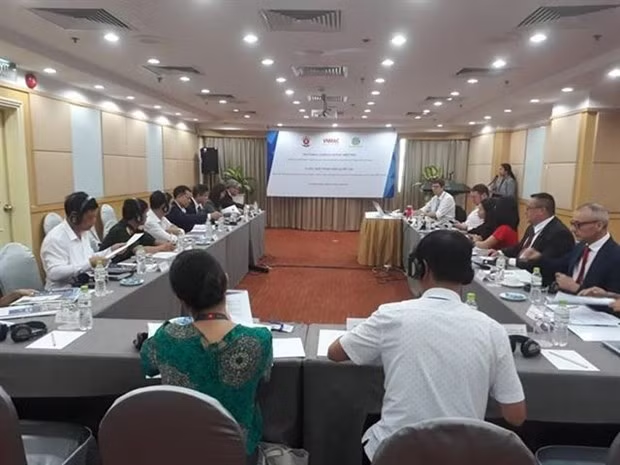
Colonel Nguyen Hanh Phuc, Deputy Director of the Vietnam National Mine Action Centre (VNMAC), made the statement at a meeting in Hanoi on September 16.

The national consultative meeting 'Enhance awareness programmes on the dangers of mine/explosive remnants of war' was organised by the VNMAC, the ASEAN Regional Mine Action Centre (ARMAC) and the Japan-ASEAN Cooperation.

Phuc said that during the past 40 years, the country has seen improving consequences of mine and explosive remnants of war as an urgent, important, regular and long-term duty.
To create a legal corridor for the work, the then Prime Minister Nguyen Tan Dung in 2010 approved the national action programme to tackle the impact of post-war bombs and mines in 2010-2025, often called Programme 504. 

Programme 504 helps guide and manage post-war mines and ERW, creating coordination between State management agencies and localities in the work.

An important policy was strengthening support to help victims of mines and ERW integrate into the community, he said.

Phuc said more education on preventing mine and ERW accidents should be given to citizens.

Hal Judge, ARMAC’s mine risk education expert, said Cambodia, Laos, Myanmar, Vietnam and Thailand were affected by mines and ERW, and ARMAC, through a set of consultative meetings, aimed to bring these countries together to share their knowledge and experiences to build a regional approach to mine risk education.

The goal of the project would be to establish a platform for ASEAN countries to learn from one another so a collaborative community of mine risk education experts could be established.

Incomplete statistics show the number of bombs left after the war in Vietnam is about 800,000 tonnes, with the total area suspected of bomb and mine pollution about 6.13 million hectares, accounting for 18.71 per cent of the country, according to the VNMAC. The largest amount is said to be in central provinces.

From 1975 until now, bombs and mines have killed more than 40,000 people and injured 60,000.

The United Nations Sustainable Development Programme to 2030 considers tackling landmines and war consequences to be a major goal.

In recent years, the Ministry of National Defence has sped up the process of overcoming the consequences of mines and ERW in polluted areas, especially Quang Tri, Quang Nam, Binh Dinh and Ha Giang.

Despite the positive results, the country needs tens of billions of dollars, not including billions of dollars for resettlement in the contaminated areas, and more than 100 years to finish the work, according to the ministry.
VNA

Other News

Hanoi ready to implement Capital Law 2026, unlocking new development momentum

Hanoi ready to implement Capital Law 2026, unlocking new development momentum

The effectiveness of the Capital Law 2026 will be measured not by the number of legal documents issued but by tangible improvements in governance and public administration, better services for people and businesses, faster administrative procedures, stronger investment attraction and higher economic growth.

Vietnamese students earn honours at ROBOG Asia Cup 2026

Vietnamese students earn honours at ROBOG Asia Cup 2026

Three teams from Chu Van An Secondary School in Vietnam’s Thai Nguyen province have earned First Prize honours and advanced to the quarterfinals at the ROBOG Asia Cup 2026, a regional robotics and artificial intelligence (AI) competition for students held in Hong Kong, China.

Hanoi sets out new investment blueprint with century-long development vision

Hanoi sets out new investment blueprint with century-long development vision

As of early June, Hanoi had attracted 74.6 billion USD in foreign direct investment (FDI) through more than 9,250 valid projects. FDI inflows in the first six months were projected at 3.2 billion USD, surpassing the annual target by 116%, while nearly 16,000 new businesses were established in the first five months, up 34.4% year-on-year.

Vietnam promotes legal cooperation and rule of law at global forum

Vietnam promotes legal cooperation and rule of law at global forum

Vietnam’s development and international integration have gone hand in hand with the improvement of its legal system, the incorporation of international commitments into domestic legislation, and legal reforms aimed at fostering development, openness and global integration. The country regards international law as an essential instrument for building fair, mutually beneficial relations among nations.

Hanoi to hold investment promotion event on June 29

Hanoi to hold investment promotion event on June 29

At the event, Hanoi authorities plan to grant investment policy decisions and investment registration certificates to 20 exemplary projects in the fields of transportation infrastructure, industrial parks, urban development, social housing, environment, science and technology, and foreign investment attraction.

Hanoi's Red River urban area development draws widespread attention

Hanoi's Red River urban area development draws widespread attention

Located south of the Red River and extending from the historic inner city to newly developing areas in the south and the west, the central urban area along Red River’s right bank covers approximately 45,317 hectares and is projected to accommodate around 6.365 million residents by 2045 and 6.455 million by 2065.

Hanoi's Red River urban area development draws widespread attention

Hanoi's Red River urban area development draws widespread attention

Located south of the Red River and extending from the historic inner city to newly developing areas in the south and the west, the central urban area along Red River’s right bank covers approximately 45,317 hectares and is projected to accommodate around 6.365 million residents by 2045 and 6.455 million by 2065.

Regional cooperation strengthened to combat cross-border drug crime

Regional cooperation strengthened to combat cross-border drug crime

Vietnam, China, Laos and Myanmar face common challenges as drug syndicates increasingly exploit the Mekong River, cross-border transport networks, e-commerce platforms, international logistics services, cyberspace and cryptocurrencies to organise drug transactions and smuggling operations.