PM highlights 'silver economy' as sustainable growth driver

The PM stressed that population ageing is an inevitable part of development, and the key challenge is not to avoid it but to respond proactively with sound policies and decisive action to turn the "silver economy" into a new driver of growth, innovation and sustainable development.

Prime Minister Pham Minh Chinh has demanded developing a "silver economy" with harmonious cultural, political, economic and social progress that turns the burden of ageing into an economic development opportunity.

He made the request while addressing the national conference on global "silver economy" trends and Vietnam’s policy response on March 11.
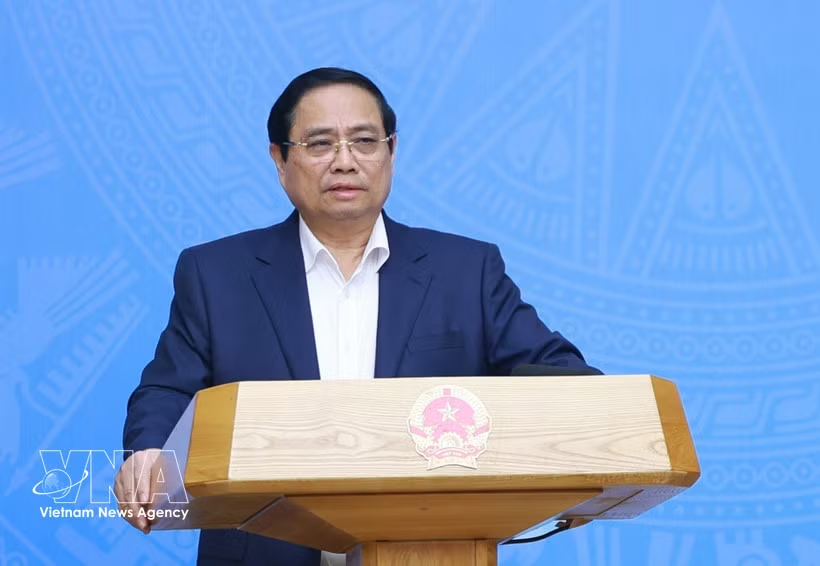
PM highlights 'silver economy' as sustainable growth driver -0
Prime Minister Pham Minh Chinh speaks at the conference. Photo: VNA

Vietnam officially entered the ageing population phase in 2011, with the number of elderly people rising rapidly. In 2024, the country had about 14.2 million people aged 60 and above, a figure projected to approach 18 million by 2030. The demographic shift presents both challenges and opportunities. While it places increasing pressure on the social welfare system, it also serves as a driving force for seeking a new growth model to achieve fast and sustainable development. Therefore, developing the "silver economy" is an inevitable trend, with older persons not regarded as a social burden but as a valuable resource for national development, said officials at the meeting.

The "silver economy", PM Chinh said, reflects a new development mindset in which the elderly is both contributors to and beneficiaries of economic growth.

PM highlights 'silver economy' as sustainable growth driver -0
Prime Minister Pham Minh Chinh chairs the conference on global "silver economy" trends and Vietnam’s policy response in Hanoi on March 11. Photo: VNA

He noted that many countries have already shifted their approach to ageing, recognising the "silver economy" as a new and sustainable growth driver that relies less on external factors. The PM noted that international experience shows three major solutions – improving the quality of life for the elderly, introducing flexible retirement age policies, and encouraging businesses to invest in the "silver economy" market.

According to the Government leader, two foundational elements of the "silver economy" are now available in Vietnam – a changing perception of population ageing as a substantial impetus and social resource rather than a risk, and the recognition of older people as a valuable national asset, a crucial force of the country and a mainstay of families and communities.

He stressed that Vietnam has already begun building a policy framework to adapt to ageing, including adjustments to retirement age and the expansion of community-based care models and small-scale livelihood support for the elderly. The goal of promoting older people's economic role has been clearly set out, particularly in a programme encouraging their participation in digital transformation, green transition, entrepreneurship and job creation.

To further advance the "silver economy", PM Chinh outlined five key priorities, focusing on raising public awareness and reshaping perceptions of ageing; developing a comprehensive healthcare ecosystem for older persons; encouraging businesses to expand services for the elderly; promoting the social participation of older people; and strengthening the role of the Vietnam Association of the Elderly.

He also highlighted three pillars for developing the "silver economy": placing older people at the centre, positioning businesses as the core force for innovation and implementation while promoting their social responsibility and age-friendly workplace, and ensuring the State builds supportive legal frameworks, incentives and social security systems.

He urged ministries and localities to improve institutions, develop strategic infrastructure serving the "silver economy", mobilise and efficiently use resources, train human resources, and promote social awareness to support the "silver economy". Local authorities were asked to introduce suitable policies, remove bottlenecks, expand effective models, encourage businesses to invest in the "silver economy", and further promote the role of older people in the community and policy-making process.

The PM stressed that population ageing is an inevitable part of development. The key challenge is not to avoid it but to respond proactively with sound policies and decisive action to turn the "silver economy" into a new driver of growth, innovation and sustainable development./.
VNA

Other News

SBV raises short-term capital lending cap to 40%

SBV raises short-term capital lending cap to 40%

The new circular will help credit institutions have more room to provide capital to businesses and investment projects to support high economic growth in the next few years, while increasing flexibility in the SBV’s monetary policy management.

Business confidence in Vietnam rebounds strongly: UOB

Business confidence in Vietnam rebounds strongly: UOB

The study found that 85% of Vietnamese enterprises reported positive business sentiment, a sharp increase from 48% in 2025, when business confidence was weighed down by uncertainties surrounding US tariff policies and related trade developments.

Bac Ninh seeks high-quality foreign investment for sustainable growth

Bac Ninh seeks high-quality foreign investment for sustainable growth

According to Vice Chairman of the provincial People’s Committee Pham Van Thinh, the province aims to maintain stable and sustainable growth, improve the competitiveness of both the economy and local businesses, and make better use of free trade agreements (FTAs) to expand and diversify export markets.

Green building trend flourishes in Ho Chi Minh City's real estate landscape

Green building trend flourishes in Ho Chi Minh City's real estate landscape

The International Finance Corporation (IFC) highlighted the city's dominance in green-certified building floor space in Vietnam, reflecting the rapid expansion of the green building market with 780 completed green buildings encompassing over 18.69 million sq.m by 2025, predominantly certified by EDGE and LEED.

UK supports Vietnam in wind power and green finance development

UK supports Vietnam in wind power and green finance development

The United Kingdom officially announced two new climate cooperation initiatives to support Vietnam in its energy transition and green growth journey. These programs focus on offshore wind power development and the creation of a sustainable green financial ecosystem.

Ample room remains for Vietnam–India logistics cooperation

Ample room remains for Vietnam–India logistics cooperation

The GTTCI expert noted that alongside logistics and integrated warehousing, e-commerce is expected to be a particularly high-growth sector in the coming years. He described it as a multi-billion-dollar market with significant untapped opportunities for cooperation between Vietnam and India.

Exports gain momentum from high-tech growth drivers

Exports gain momentum from high-tech growth drivers

According to the Ministry of Industry and Trade, Vietnam’s exports reached 215.66 billion USD in the first five months of 2026, up 19.5% year-on-year. Twenty-six export items generated more than 1 billion USD in revenue each, including seven with turnover exceeding 10 billion USD.

Vietnam–China crossings see spike in ASEAN fresh produce

Vietnam–China crossings see spike in ASEAN fresh produce

Since the start of the summer harvest season, China's two major border gates with Vietnam, Youyi Guan in Pingxiang and Beilun 2 Bridge in Dongxing, have entered their peak period for handling imports of fresh agricultural and seafood products from member states of the Association of Southeast Asian Nations (ASEAN).

Cargo handling operations at Berths 3 and 4 of the Hai Phong International Gateway Port. (Photo: VNA)

AI reshapes logistics, raising bar for workforce skills

According to the Vietnam Logistics Business Association (VLA), the logistics sector will require around 2.2 million workers by 2030, including 1.6 million employees for logistics service providers and nearly 600,000 personnel supporting logistics operations in manufacturing and trading enterprises.

Robust dispute resolution framework key to Vietnam's IFC ambitions

Robust dispute resolution framework key to Vietnam's IFC ambitions

The development strategy for VIFC-HCMC envisions a comprehensive financial ecosystem encompassing green finance, carbon credits, financial technology (fintech), blockchain technology, digital assets, digital banking and other innovative business models. These highly internationalised sectors involve complex cross-border transactions and sophisticated legal structures.