PM meets Indian business leaders for further Vietnam-India economic cooperation

Continuing his ongoing state visit to India, Prime Minister Pham Minh Chinh engaged with leaders of several leading Indian economic conglomerates in New Delhi on July 31, with the discussions focusing on deepening and concretising the Vietnam-India comprehensive strategic partnership.

PM meets Indian business leaders for further Vietnam-India economic cooperation -0
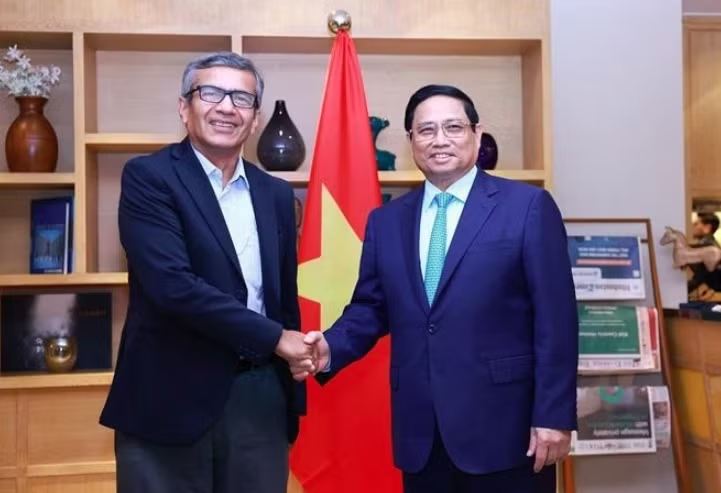
Prime Minister Pham Minh Chinh (R) and Rajesh Kumar Singh, Chairman of the National Industrial Corridor Development Corporation (NICDC) Limited at their meeting New Delhi on July 31.

The PM met with Rajesh Kumar Singh, chairman of the National Industrial Corridor Development Corporation (NICDC) Limited – a unit of the Indian Ministry of Commerce and Industry’s Department for Promotion of Industry and Internal Trade.

Chinh commended NICDC's operational model, scale, vision, and significant role in India's socio-economic development, modernisation, and industrialisation, particularly in developing strategic infrastructure and creating new growth spaces.

Considering it a good model for Vietnam to follow, the government leader requested Vietnamese ministries, agencies, and localities closely collaborate with the Indian ministry and NICDC, while suggesting the establishment of a working group to facilitate bilateral cooperation, research, and experience exchange in the near future.

The same day, the PM received Arun Kumar Singh, chairman and CEO of the Oil and Natural Gas Corporation Limited (ONGC), the largest of its kind in India.

Singh told the Vietnamese leader his wish to expand investment cooperation in Vietnam, where the corporation’s subsidiary ONGC Videsh Ltd is currently involved in a joint venture for two oil and gas blocks.

Considering oil and gas cooperation a pillar of bilateral relations, Chinh encouraged ONGC to further invest in the field and the renewable energy sector in Vietnam. He requested ONGC's assistance in evaluating oil and gas reserves within areas under Vietnam's sovereignty, and urged the company to explore more investments, partnerships, and joint ventures with capable Vietnamese partners serving energy development as well as related technology transfer and human resources training.

The PM affirmed that the Vietnamese Government is willing to provide a favourable legal environment for investment and business activities of both domestic and international enterprises, including Indian companies like ONGC Videsh. He assured continued facilitation for the group's sustainable and successful operations in the country.

Also on July 31, PM Chinh hosted Director Shikhar Malhotra and senior members of HCLTech, which boasts offices in over 60 countries and offers a wide range of IT infrastructure management, digital transformation, cloud services, cybersecurity, engineering, and R&D solutions.

Malhotra reported that HCLTech has established representative offices in Hanoi and Ho Chi Minh City, achieving revenues of US$16.5 million in Vietnam for the fiscal year 2024 and creating over 1,000 jobs through partnerships with 19 Vietnamese universities. The company is interested in engaging in sectors such as smart cities, digital transformation, and aviation in the Southeast Asian nation.

Praising HCLTech's operational model, scale, vision and role; and welcoming its plans for cooperation and technology transfer with Vietnam, the PM encouraged the company to continue collaborating with the nation regarding digital infrastructure investment, smart management experience sharing, and high-quality human resources training. He emphasised the importance of such cooperation in the areas of digital transformation, knowledge economy, digital economy, innovation, semiconductors, artificial intelligence, cloud computing, and cybersecurity.

The leader also suggested that HCLTech consider outsourcing technology products to capable Vietnamese companies, thus helping them integrate into the global supply chain under a win-win principle.

VNA

Other News

SBV raises short-term capital lending cap to 40%

SBV raises short-term capital lending cap to 40%

The new circular will help credit institutions have more room to provide capital to businesses and investment projects to support high economic growth in the next few years, while increasing flexibility in the SBV’s monetary policy management.

Business confidence in Vietnam rebounds strongly: UOB

Business confidence in Vietnam rebounds strongly: UOB

The study found that 85% of Vietnamese enterprises reported positive business sentiment, a sharp increase from 48% in 2025, when business confidence was weighed down by uncertainties surrounding US tariff policies and related trade developments.

Bac Ninh seeks high-quality foreign investment for sustainable growth

Bac Ninh seeks high-quality foreign investment for sustainable growth

According to Vice Chairman of the provincial People’s Committee Pham Van Thinh, the province aims to maintain stable and sustainable growth, improve the competitiveness of both the economy and local businesses, and make better use of free trade agreements (FTAs) to expand and diversify export markets.

Green building trend flourishes in Ho Chi Minh City's real estate landscape

Green building trend flourishes in Ho Chi Minh City's real estate landscape

The International Finance Corporation (IFC) highlighted the city's dominance in green-certified building floor space in Vietnam, reflecting the rapid expansion of the green building market with 780 completed green buildings encompassing over 18.69 million sq.m by 2025, predominantly certified by EDGE and LEED.

UK supports Vietnam in wind power and green finance development

UK supports Vietnam in wind power and green finance development

The United Kingdom officially announced two new climate cooperation initiatives to support Vietnam in its energy transition and green growth journey. These programs focus on offshore wind power development and the creation of a sustainable green financial ecosystem.

Ample room remains for Vietnam–India logistics cooperation

Ample room remains for Vietnam–India logistics cooperation

The GTTCI expert noted that alongside logistics and integrated warehousing, e-commerce is expected to be a particularly high-growth sector in the coming years. He described it as a multi-billion-dollar market with significant untapped opportunities for cooperation between Vietnam and India.

Exports gain momentum from high-tech growth drivers

Exports gain momentum from high-tech growth drivers

According to the Ministry of Industry and Trade, Vietnam’s exports reached 215.66 billion USD in the first five months of 2026, up 19.5% year-on-year. Twenty-six export items generated more than 1 billion USD in revenue each, including seven with turnover exceeding 10 billion USD.

Vietnam–China crossings see spike in ASEAN fresh produce

Vietnam–China crossings see spike in ASEAN fresh produce

Since the start of the summer harvest season, China's two major border gates with Vietnam, Youyi Guan in Pingxiang and Beilun 2 Bridge in Dongxing, have entered their peak period for handling imports of fresh agricultural and seafood products from member states of the Association of Southeast Asian Nations (ASEAN).

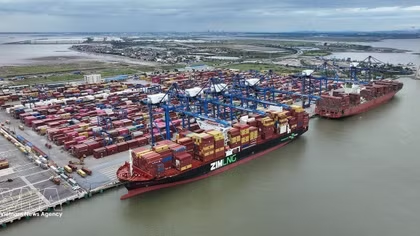
Cargo handling operations at Berths 3 and 4 of the Hai Phong International Gateway Port. (Photo: VNA)

AI reshapes logistics, raising bar for workforce skills

According to the Vietnam Logistics Business Association (VLA), the logistics sector will require around 2.2 million workers by 2030, including 1.6 million employees for logistics service providers and nearly 600,000 personnel supporting logistics operations in manufacturing and trading enterprises.

Robust dispute resolution framework key to Vietnam's IFC ambitions

Robust dispute resolution framework key to Vietnam's IFC ambitions

The development strategy for VIFC-HCMC envisions a comprehensive financial ecosystem encompassing green finance, carbon credits, financial technology (fintech), blockchain technology, digital assets, digital banking and other innovative business models. These highly internationalised sectors involve complex cross-border transactions and sophisticated legal structures.