Film for art or film for commercial
At least five art films have been released in the second quarter of this year, including ‘Cha Cong Con’(Father and Son), ‘Lo To’ (The Lottery), ‘Co Can Nha Nam Nghe Nang Mua’ (Motherhood), ‘Da Co Hoai Lang’ (Two Fellow Countrymen), and ‘Dao Cua Dan Ngu Cu’ (The Way Station). Based on novels, drama, or inspired from documentaries, the films tell stories of people’s tragedies. However, they have not reached the expected revenue, even the film ‘Father and Son’ lost VND 5 billion (US$220,000) as its total budget was VND 18 billion (US$792,000) while its gross has been estimated at around VND 13 billion (US$ 572,000).
An art film is typically a serious artistic film which explores the psychological developments of characters and opens up meditations and requires viewers to contemplate meaning rather than only containing entertainment factors such as cinematic skills, all-star film casts, and love or action scenes.
While commercial films target to attract viewers to the cinema, art films provide a way for producers to make their individual mark on the film industry. Therefore, art films are often aimed at a niche market rather than a mass market audience.
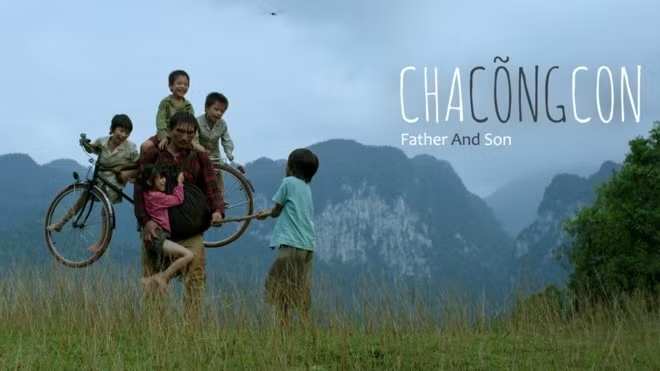 |
| Poster of the ‘Cha Cong Con’ (Father and Son) film by director Luong Dinh Dung |
There is no obvious boundary dividing these two genres. It has been shown that many commercial films have been highly applauded for their aesthetic values, and many art films are commercially successful, such as ‘Toi Thay Hoa Vang Tren Co Xanh' (Yellow flowers on the green grass), which set a record of VND 80 billion (US$3.5 million) in revenue by the end of 2015.
However, many Vietnamese films have not been well-received by a majority of Vietnamese audiences even though they have won many prestigious prizes at international film festivals. One of which is ‘Father and Son’ by director Luong Dinh Dung, which was hugely popular at many international film fests but failed to make an impact in domestic cinemas.
Most recently, “The Way Station”, which was directed by Hong Anh and based on a novel by writer Do Phuoc Tien, was announced as ‘Best Film’ at the ASEAN International Film Festival & Awards (AIFFA Award) 2017 in Malaysia in May. The film also won ‘Best Actor’ for Pham Hong Phuoc and ‘Best Director of Photography’ for Ly Thai Dung. It had record nominations in eight out of nine key categories of the festival, including best director, best actress, best supporting actor, and best screenplay. The film has received a record number of nominations at international film festivals so far.
Before it was released in the domestic market, the film had been introduced at Cannes Film Festival 2017 in France and screened at a Vietnamese Film Week in Madrid, Spain. The film has also received offers from international film distributors who want to buy the film copyright license to show it in France, Chinese Taipei, the Republic of Korea, German, Spain and the US.
However, on the first day of its premier at the National Cinema Centre (NCC) in Hanoi, two consecutive shows were cancelled as no tickets were bought. On the following days, despite the number of cinemagoers increasing, there was still only a modest attendance. The common feedback shared by the viewers about the film was that it was slow and difficult to understand.
According to Nguyen Manh Cuong, an officer from the NCC, the film received less of a response because it was set in a stale atmosphere with an unhappy ending, which was unpopular with viewers. Meanwhile, most of audience are youngsters who go to the cinema for entertainment only. In addition, the film crew did not invest much on PR and marketing.
Another example is ‘Cha Va Con Va…’ (Big Father, Small Father and Other Stories), a 2015 film by director Phan Dang Di. It was considered for the Golden Bear Awards at the 65th Berlin International Film Festival (Berlinale), one of the most prestigious film fests around the world. The film was then shown in France under the name ‘Mekong Stories’ and won positive reviews.
However, it wasn’t until March 2017 the film was introduced to Vietnamese audiences at the L’Espace French Cultural Centre in Hanoi. Up until now, the film producers haven’t reached an agreement with any film distributor to screen it at domestic cinemas.
Paving the way for art films
Despite many difficulties, art films are predicted to attract more and more independent film makers, particularly those of younger generations.
According to Doctor Ngo Phuong Lan, Head of the Cinema Department, art film makers should first question themselves on why their films are not well received by the viewers rather than solely blaming the audience. It is acceptable to be experimental in film making, but the ultimate target should also involve making high-quality works which can draw interest from the audience.
Nguyen Hoang Diep, director of ‘Dap Canh Giua Khong Trung’ (Flapping in the Middle of Nowhere), which has secured many domestic and international prizes while succeeding in wining over Vietnamese audiences, also shared the difficulty in releasing an art film. It happens not only in Vietnam but also in countries with a developed film industry. However, art film makers always receive a certain respect as their films are unique and stray away from the mainstream.
A film industry cannot establish its position if it merely focuses on commercial works rather than high-quality art films. Therefore, it is necessary to form policies supporting the release of art films. Developed film industries such as France and the Republic of Korea have established funds and cinemas to support art films.
In Vietnam, although a proposal for the establishment of a Film Support Fund was submitted to the Government, it has not yet been approved due to obstacles and the overlapping of relevant agencies. It has forced art filmmakers to look for sponsorship from culture and art funds from embassies of foreign countries in Vietnam.
Another suggestion is to screen art films on TV. Danet, a channel managed by the BHD Company, is the first to update viewers on the latest and most appreciated Vietnamese art films.
It is undeniable that art films have contributed to advertising Vietnamese arts and culture to the world. ‘The Way Station’ has been selected to compete at the Eurasia International Film Festival, which will take place in Kazakhstan from July 22-28. To encourage more serious artistic works, it requires more support from the State, society and audiences. Moreover, film makers themselves must also renovate their mind-set in order to attract viewers while also following their passion.