Regulations needed for new beer clubs

Beer clubs, which offer entertainment services similar to bars and discos, have been booming in many big cities. However, there are currently no regulations on managing this type of business, causing difficulties for authorized agencies in deterring violations.

Beer clubs appeared in Ho Chi Minh City three years ago, providing foods and drinks alongside music, professional DJs, and performances by promotional girls.

Soon enough, the model expanded to other big cities like Hanoi and Vung Tau. In Hanoi alone, there is already a wide array of beer clubs, serving thousands of customers per day.

Nguyen Hoai Lan, in Hanoi’s Hoaan Kiem district said that she and her group of friends frequent some beer clubs near Hoan Kiem Lake.
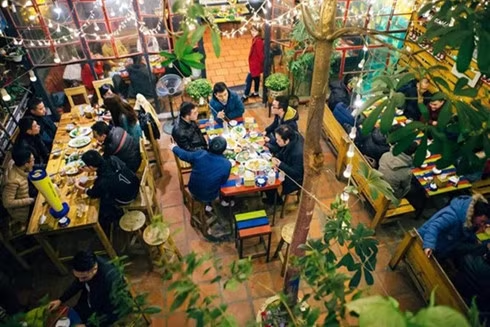
“It has everything – foods, drinks, music, performances… and it’s much cheaper than bars or discos,” she said. On average, a beer costs between VND25,000-VND50,000.

Lan said she and her friends could go and have fun in the daytime, rather than waiting until night to go to bars or discos.

An owner of a beer club, who wished to remain anonymous, said that investing in a bar or club was not a simple feat.

The owners must meet strict regulations before being able to open a venue. The bars must be located in licensed areas, and be granted operation licences to start their business.

In case they sold wine and strong alcohol, they must be licensed to trade in this kind of goods and pay appropriate taxes. All bars must close at midnight.

Even after following strict regulations, most bars and clubs only get customers from 10pm until midnight. The two hours of operation was not enough to turn a profit, he said, adding that many bars have switched to being beer clubs, seeking profit and looser regulations.

Nguyen Thi Bach Ngan, vice chairwoman of Ba Ria-Vung Tau province’s Vung Tau city said that the city was encouraging such services to attract visitors.

Currently, there are about 18 beer clubs, bars and discos in the province, 12 of which are located in Vung Tau city.

However, Ngan said the city found it hard to manage this type of business as there is a shortage of legal documents and specific regulations for it.

Beer clubs were not listed as special businesses such as bars or nightclubs, but could not be listed as food service businesses either. Basically, they provide loud music, lighting, professional DJs and promotional girls, which is exactly the same as bars and discos have done, she added.

Dang Minh Thong, vice chairman of the provincial People’s Committee affirmed that this model of entertainment service should be encouraged in cities to attract tourists.
However, the operation of such services must be licensed and managed by authorized agencies to avoid negative impacts on local residents living nearby and ensure security and order.
They must not be located in residential areas or near schools, he added.
VNA

Other News

SBV raises short-term capital lending cap to 40%

SBV raises short-term capital lending cap to 40%

The new circular will help credit institutions have more room to provide capital to businesses and investment projects to support high economic growth in the next few years, while increasing flexibility in the SBV’s monetary policy management.

Business confidence in Vietnam rebounds strongly: UOB

Business confidence in Vietnam rebounds strongly: UOB

The study found that 85% of Vietnamese enterprises reported positive business sentiment, a sharp increase from 48% in 2025, when business confidence was weighed down by uncertainties surrounding US tariff policies and related trade developments.

Bac Ninh seeks high-quality foreign investment for sustainable growth

Bac Ninh seeks high-quality foreign investment for sustainable growth

According to Vice Chairman of the provincial People’s Committee Pham Van Thinh, the province aims to maintain stable and sustainable growth, improve the competitiveness of both the economy and local businesses, and make better use of free trade agreements (FTAs) to expand and diversify export markets.

Green building trend flourishes in Ho Chi Minh City's real estate landscape

Green building trend flourishes in Ho Chi Minh City's real estate landscape

The International Finance Corporation (IFC) highlighted the city's dominance in green-certified building floor space in Vietnam, reflecting the rapid expansion of the green building market with 780 completed green buildings encompassing over 18.69 million sq.m by 2025, predominantly certified by EDGE and LEED.

UK supports Vietnam in wind power and green finance development

UK supports Vietnam in wind power and green finance development

The United Kingdom officially announced two new climate cooperation initiatives to support Vietnam in its energy transition and green growth journey. These programs focus on offshore wind power development and the creation of a sustainable green financial ecosystem.

Ample room remains for Vietnam–India logistics cooperation

Ample room remains for Vietnam–India logistics cooperation

The GTTCI expert noted that alongside logistics and integrated warehousing, e-commerce is expected to be a particularly high-growth sector in the coming years. He described it as a multi-billion-dollar market with significant untapped opportunities for cooperation between Vietnam and India.

Exports gain momentum from high-tech growth drivers

Exports gain momentum from high-tech growth drivers

According to the Ministry of Industry and Trade, Vietnam’s exports reached 215.66 billion USD in the first five months of 2026, up 19.5% year-on-year. Twenty-six export items generated more than 1 billion USD in revenue each, including seven with turnover exceeding 10 billion USD.

Vietnam–China crossings see spike in ASEAN fresh produce

Vietnam–China crossings see spike in ASEAN fresh produce

Since the start of the summer harvest season, China's two major border gates with Vietnam, Youyi Guan in Pingxiang and Beilun 2 Bridge in Dongxing, have entered their peak period for handling imports of fresh agricultural and seafood products from member states of the Association of Southeast Asian Nations (ASEAN).

Cargo handling operations at Berths 3 and 4 of the Hai Phong International Gateway Port. (Photo: VNA)

AI reshapes logistics, raising bar for workforce skills

According to the Vietnam Logistics Business Association (VLA), the logistics sector will require around 2.2 million workers by 2030, including 1.6 million employees for logistics service providers and nearly 600,000 personnel supporting logistics operations in manufacturing and trading enterprises.

Robust dispute resolution framework key to Vietnam's IFC ambitions

Robust dispute resolution framework key to Vietnam's IFC ambitions

The development strategy for VIFC-HCMC envisions a comprehensive financial ecosystem encompassing green finance, carbon credits, financial technology (fintech), blockchain technology, digital assets, digital banking and other innovative business models. These highly internationalised sectors involve complex cross-border transactions and sophisticated legal structures.