Rice quality matters: Prime Minister Phuc

Since taking office in 2016, Prime Minister Nguyen Xuan Phuc has helped drive an industry-wide discussion and led the effort to improve the quality of rice grown in Vietnam.

With more than 50% of Vietnam rice being sold on the export market, improving its quality is imperative for maintaining exports, as well as competing domestically with an increasing population of discriminating consumers.

The Vietnam government continues to be committed to improving rice quality, working with public breeding partners as well as buyers to develop better varieties and implement innovative technologies that bring value not only to the end buyers and end users, but to the farmer as well.
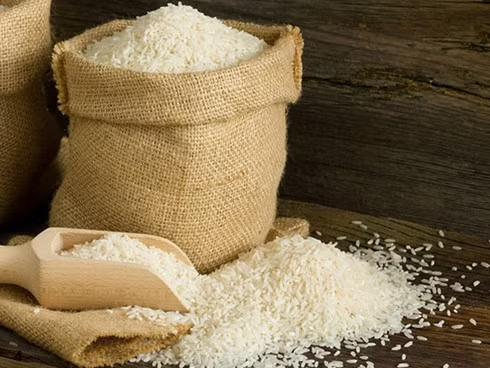
New high-yielding varieties capable of producing the appearance and cooking properties desired by important foreign and domestic buyers are needed, said Dang Quang Vinh, a researcher at the Central Institute for Economic Management.

Mr Vinh noted the rice currently produced in Vietnam is not competitive in some markets such as those in Central America that prefer parboiled rice, which possesses superior cooking and processing properties.

Quality improvements could also be achieved by developing semi-dwarf varieties that possess better milling traits and better long-grains offering excellent blast resistance and good grain quality with yield potential that rivals the highest-yielding cultivars currently produced anywhere.

In addition, Mr Vinh suggested that rice farmers consider the use of bubble dryers to improve the quality of local rice.

The post-harvest loss rate currently stands at 13.7%, which is too high and much greater than that of Thailand at 6.1% and India at 6%, said Mr Vinh, noting that a sizable portion of the loss results from poor drying techniques.

He said bubble dryer technology, powered by solar energy prevents contamination, aflatoxin in maize, reduces cost and enhances profit.

He made the comments at a training workshop in Hanoi, adding that the bubble dryer, is ‘green dryer’ technology that uses solar radiation to power a system to blow hot air to dry rice.

It is said to reduce moisture levels in rice from 22% to between 12 and 13% in as little as 24 hours.

Mr Vinh lamented that though new farming technologies were in existence, Vietnamese farmers underutilize them and said it was time they welcomed innovation for growth in the segment.

He said the bubble dryer is proven technology that is currently in use by smallholder farmers and farmer groups around the globe and urged local farmers to take advantage of the technology.

Dang Kim Son, former director general of Institute of Policy and Strategy for Agriculture and Rural Development in turn said the focus should be to help increase earnings for smallholder farmers.

He also hinted at plans to offer technical training for actors in the rice value chain saying that without trained farmers, the country could not achieve food security.  He underscored the need for regular capacity building for farmers.

Vietnamese farmers need to learn and use new farming techniques. They must know about seed quality, types of soil and chemical application not only dropping the seed in the soil.
VOV

Other News

Private economic sector poised for breakthrough growth

Private economic sector poised for breakthrough growth

More than a year after the Politburo's Resolution No. 68-NQ/TW on private sector development came into effect, expectations now extend beyond increasing the number of enterprises. The goal is to build a stronger business community with greater resilience, larger ambitions and the capacity to compete in global supply chains.

Vietnam remains ASEAN growth leader in 2026 despite global headwinds: WB

Vietnam remains ASEAN growth leader in 2026 despite global headwinds: WB

Vietnam is expected to remain one of ASEAN’s fastest-growing economies in 2026, supported by resilient exports, strong investment inflows and an ambitious reform agenda, despite mounting global uncertainties, according to the World Bank’s latest Vietnam Economic Update released on May 15.

Ministry establishes monitoring framework for carbon market

Ministry establishes monitoring framework for carbon market

Under a new circular, the exchange of greenhouse gas emission quotas and carbon credits is conducted on the domestic carbon credit exchange through the carbon trading system, which is interconnected with the national registration system.

Biofuel ready for nationwide rollout

Biofuel ready for nationwide rollout

For biofuels, particularly E10, to develop successfully, stronger and more coordinated policies are needed, especially pricing mechanisms capable of creating a sufficiently attractive gap between E10 and mineral-based petrol, an expert has said.

Vietnamese farm produce promoted at African investment, trade forum

Vietnamese farm produce promoted at African investment, trade forum

The 12th Africa Forum for Investment & Commerce (AFIC 12) opened in Algiers, the capital of Algeria, on May 9, drawing around 2,000 participants, including officials, economists, businesses, financial and development organizagtions from 43 African countries and international partners, including Vietnam.

Int'l medical, pharmaceutical expo opens in Hanoi

Int'l medical, pharmaceutical expo opens in Hanoi

The exhibition, which runs until May 9 at the Hanoi International Centre for Exhibition, showcases advanced products and technologies across a range of fields, including pharmaceuticals, drug manufacturing machinery and equipment, medical devices, hospital and clinic services and dental equipment.

Mega projects to transform Ho Chi Minh City urban landscape

Mega projects to transform Ho Chi Minh City urban landscape

Leading the charge in this massive building spree is the new central city square in the core of the Thu Thiem new urban area. Spanning more than 20 ha, it’s the crown jewel of the Central Square and new administrative center complex.

Vietnam establishes itself as one of region’s most dynamic manufacturing and supply bases

Vietnam establishes itself as one of region’s most dynamic manufacturing and supply bases

The country’s stable political and economic environment provides a critical foundation for long-term sourcing strategies. At the same time, Vietnam has demonstrated a strong ability to scale up manufacturing, supported by a continuously expanding industrial base capable of meeting both high-volume demand and increasingly complex technical and quality requirements.

Vietnamese pomelos gain broader access to Australian market

Vietnamese pomelos gain broader access to Australian market

The update by Australia’s Department of Agriculture, Fisheries and Forestry to its Biosecurity Import Conditions system (BICON) on April 10, officially setting out import conditions for Vietnamese pomelos, is regarded as a major milestone in market access efforts.

Vietnam's industry spearheads transition to circular economy

Vietnam's industry spearheads transition to circular economy

The circular economy is no longer just a policy choice. It has become an inevitable trend for delivering sustainable and green growth, sharpening competitiveness at home and abroad, and meeting Vietnam’s net-zero emissions target by 2050. It is now a prerequisite to sustain long-term economic expansion, particularly in industrial production and supporting industries.

Nearly 100 tonnes of Vietnamese fruits, vegetables airlifted to UAE

Nearly 100 tonnes of Vietnamese fruits, vegetables airlifted to UAE

Vietnamese fresh produce and processed foods are increasingly recognised for their quality, with items such as cashew nuts, coffee and spices gaining popularity among Middle East consumers. In 2025, Vietnam’s farm produce exports to the UAE exceeded 445 million USD, up nearly 24% year-on-year.