- US National Centre for APEC helps lure businesses to Vietnam
- UN convention supports Vietnamese businesses
- Vietnam promotes business links with Algeria
The National Financial Supervisory Commission of Vietnam (NFSC) says this year, Vietnam’s economy will improve due to the reform of institutions and of the investment environment, as well as the price recovery of energy and farming products on the world market, creating new impetus for the private sector.
Meanwhile, the World Bank (WB) and Asia Development Bank (ADB) have forecast that Vietnam’s GDP growth will reach 6.3% for this year, and the International Monetary Fund (IMF) set that figure at 6.2%.
 |
The National Centre for Socio-economic Information and Forecast (NCIF) under the Ministry of Planning and Investment has two scenarios for domestic economic development this year based on the impact of the Government’s directions and an IMF forecast of global GDP growth of 3.4%.
According to the more likely first scenario, the domestic economy will remain stable and development and local investment will keep improving. Vietnam will benefit from its global integration to improve exports and investment. That would translate into 6.44% GDP growth and inflation of 5% in 2017.
The second scenario foresees 6.72% GDP growth and inflation of 6% if it further impproves the structure and efficiency of the economy.
Policy management as well as legal and investment environment reforms in 2016 have begun to have an effect, the NCIF says. The consumption index increased slowly and steadily. The State implemented flexible management of monetary and exchange rate policies, presaging an average basic interest rate of 6% in 2017. The nation is forecast to achieve its money supply and credit growth goals.
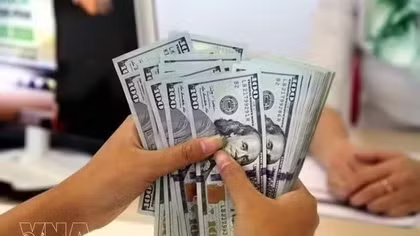
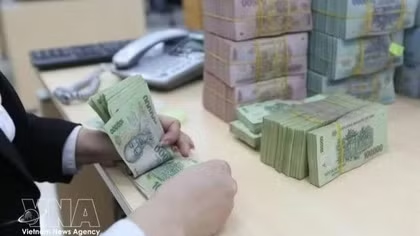
Economic expert Vu Dinh Anh says the exchange rate between the Vietnamese đong and US dollar will flutuate in 2017, in accordance with economic and financial changes in the world, reports the Tien Phong newspaper.
This year, Vietnam needs more active and flexible exchange rates, Anh says. The value of the Vietnamese dong can suffer from growth of inflation, while import volume and the price of petrol and other goods will increase. Le Xuan Nghia, a member of the National Financial and Monetary Policy Advisory Council, says the council predicts interest rates hikes of 1%-2%, depending on directions from the State Bank of Vietnam, reports the Giao thong newspaper.
Rate hike pressure will come from inflation and an increase of basic salaries, from three expected interest rate hikes by the Fed, from interbank interest rates moving up and from an upward trend of Government bond interest rates, Nghia says.
In addition, the increase in interest rates could be due to the trade deficit reaching US$4-US$5 billion this year, increases in the price of the US dollar, and China’s adjustment of exchange rates, he says.
Economic expert Vo Tri Thanh says Vietnam’s economic growth next year will be boosted by the processing industry, foreign direct investments, and the construction and services sectors.
In 2017, the agriculture sector will improve, while the construction sector will still face many difficulties. The property market will not experience a bubble but Vietnam will not be able to attract as much foreign investment as in 2016, he says.
The Government has set economic development targets of 6.7% GDP growth, 4% inflation and export value growth of 6%-7% for 2017.
To reach the goals, experts say, the Government will have to stabilise the macro economy, improve investment and business environments, and implement efficient economic restructuring to achieve greater productivity, higher quality and competitive ability.
The Central Institute of Economic Management (CIEM) says the Government should continue renovation of the micro economy. It should complete regulations guiding implementation of the amended Law on Investment and the Law on Enterprise, abolish unsuitable business conditions and simplify remaining business conditions.
The Government should encourage the private sector to join in formulating investment and business policies, complete tariff calculations appropriate for international standards of transparency, according to the CIEM. Vietnam needs to take advantage of free trade agreements to promote exports and deal with the challenges of climate changes and environmental pollution which will impact mid- and long-term economic growth.
The nation will also face many challenges in reaching economic development this year and beyond. These include slow growth in the agriculture sector, economic growth dependent on the FDI sector, slow restructuring in some sectors, financial system dependent on the banking sector and difficulties in reducing lending interest rates.