Rosy signs show bright prospect for rice export

Vietnam is enjoying strong growth in both rice export volume and value, and more export chances are still ahead as some free trade agreements (FTAs) have come into force and consumers around the globe are boosting purchase to ensure food security amid the COVID-19 outbreak.
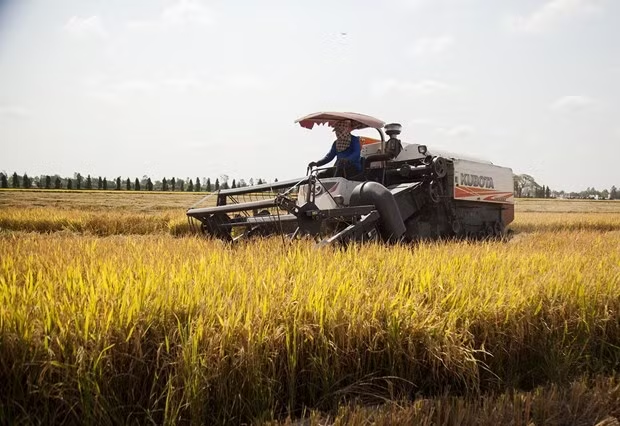
Winter-spring rice is harvested in Tan An commune of Tan Hiep district, the Mekong Delta province of Kien Giang (Photo: VNA)

Winter-spring rice is harvested in Tan An commune of Tan Hiep district, the Mekong Delta province of Kien Giang (Photo: VNA)

Vietnam is enjoying strong growth in both rice export volume and value, and more export chances are still ahead as some 

free trade agreements (FTAs) have come into force and consumers around the globe are boosting purchase to ensure food security amid the COVID-19 outbreak.

In the first two months of 2020, about 900,000 tonnes of rice worth 410 million USD were shipped abroad, up 27 percent in volume and 32 percent in value year on year, according to the Ministry of Agriculture and Rural Development (MARD).

Export prices averaged 478 USD per tonne in January, rising 7 percent from the same period last year. The Philippines was the biggest importer, accounting for 31 percent of total rice shipments. Meanwhile, Mozambique and Angola were among the markets with biggest growth rates.

Phan Xuan Que, General Director of the Vietnam Northern Food Corporation (VINAFOOD 1), said after the Lunar New Year holiday in late January, the rice market has been very vibrant. Prices set for both export and domestic sale surged by 30 – 50 USD per tonne, depending on varieties and quality.

He noted rice prices are usually adjusted on the quarterly or yearly basis, but they have been changed week by week in the first months of this year, which is a very rare situation, especially when the Mekong Delta – the country’s largest agricultural production hub – is currently in the harvest period of the winter-spring crop.

These positive signs show Vietnam is likely to achieve the rice export target of 6.7 million tonnes worth over 3 billion USD this year, according to him.

Explaining the reason for good prices in all segments, Que said as countries opened their markets for rice imports early, businesses have inked big contracts and stepped up purchase of inputs. Besides, China, which previously dominated the African market with about 3 million tonnes of rice annually, has been affected by the COVID-19 outbreak, creating a chance for Vietnamese rice in this market.

Strong demand from the Philippines and Malaysia has also helped raise prices of Vietnamese rice, thus helping the grain to narrow the price gap with the Thai counterpart and surpass the Myanmar and Indian rivals.

The MARD’s Agro Processing and Market Development Authority said demand for Thai rice stays flat as drought in this country has driven concerns about supply sources.

Export prices of Vietnamese rice are likely to rise further since they are still much lower than those of other producers’ rice, the authority noted, adding that global consumers are boosting purchase while China doesn’t increase its shipments in order to ensure food security to cope with the COVID-19 epidemic.

Que attributed the rosy export signs partly to the agricultural restructuring, which in turn has helped restructure export markets to reduce dependence on certain markets. Moreover, the competitiveness of Vietnamese rice, including that of components in the rice value chain from production, supply, processing and transportation, has been improved.

However, he said the agricultural sectors as well as businesses should continue to keep a close watch on changes in the market to concurrently attain food security and export targets.

According to the MARD, the COVID-19 outbreak has little impact on Vietnam’s rice sector, and there are likely more opportunities for export to East Africa. Besides, companies should also gear up to capitalise on advantages generated the FTA between the EU and Vietnam when this deal takes effect.
VNA

Other News

SBV raises short-term capital lending cap to 40%

SBV raises short-term capital lending cap to 40%

The new circular will help credit institutions have more room to provide capital to businesses and investment projects to support high economic growth in the next few years, while increasing flexibility in the SBV’s monetary policy management.

Business confidence in Vietnam rebounds strongly: UOB

Business confidence in Vietnam rebounds strongly: UOB

The study found that 85% of Vietnamese enterprises reported positive business sentiment, a sharp increase from 48% in 2025, when business confidence was weighed down by uncertainties surrounding US tariff policies and related trade developments.

Bac Ninh seeks high-quality foreign investment for sustainable growth

Bac Ninh seeks high-quality foreign investment for sustainable growth

According to Vice Chairman of the provincial People’s Committee Pham Van Thinh, the province aims to maintain stable and sustainable growth, improve the competitiveness of both the economy and local businesses, and make better use of free trade agreements (FTAs) to expand and diversify export markets.

Green building trend flourishes in Ho Chi Minh City's real estate landscape

Green building trend flourishes in Ho Chi Minh City's real estate landscape

The International Finance Corporation (IFC) highlighted the city's dominance in green-certified building floor space in Vietnam, reflecting the rapid expansion of the green building market with 780 completed green buildings encompassing over 18.69 million sq.m by 2025, predominantly certified by EDGE and LEED.

UK supports Vietnam in wind power and green finance development

UK supports Vietnam in wind power and green finance development

The United Kingdom officially announced two new climate cooperation initiatives to support Vietnam in its energy transition and green growth journey. These programs focus on offshore wind power development and the creation of a sustainable green financial ecosystem.

Ample room remains for Vietnam–India logistics cooperation

Ample room remains for Vietnam–India logistics cooperation

The GTTCI expert noted that alongside logistics and integrated warehousing, e-commerce is expected to be a particularly high-growth sector in the coming years. He described it as a multi-billion-dollar market with significant untapped opportunities for cooperation between Vietnam and India.

Exports gain momentum from high-tech growth drivers

Exports gain momentum from high-tech growth drivers

According to the Ministry of Industry and Trade, Vietnam’s exports reached 215.66 billion USD in the first five months of 2026, up 19.5% year-on-year. Twenty-six export items generated more than 1 billion USD in revenue each, including seven with turnover exceeding 10 billion USD.

Vietnam–China crossings see spike in ASEAN fresh produce

Vietnam–China crossings see spike in ASEAN fresh produce

Since the start of the summer harvest season, China's two major border gates with Vietnam, Youyi Guan in Pingxiang and Beilun 2 Bridge in Dongxing, have entered their peak period for handling imports of fresh agricultural and seafood products from member states of the Association of Southeast Asian Nations (ASEAN).

Cargo handling operations at Berths 3 and 4 of the Hai Phong International Gateway Port. (Photo: VNA)

AI reshapes logistics, raising bar for workforce skills

According to the Vietnam Logistics Business Association (VLA), the logistics sector will require around 2.2 million workers by 2030, including 1.6 million employees for logistics service providers and nearly 600,000 personnel supporting logistics operations in manufacturing and trading enterprises.

Robust dispute resolution framework key to Vietnam's IFC ambitions

Robust dispute resolution framework key to Vietnam's IFC ambitions

The development strategy for VIFC-HCMC envisions a comprehensive financial ecosystem encompassing green finance, carbon credits, financial technology (fintech), blockchain technology, digital assets, digital banking and other innovative business models. These highly internationalised sectors involve complex cross-border transactions and sophisticated legal structures.