Russian autos gain free access to ASEAN via Vietnam

Vietnam-Russia commercial trade remains relatively insignificant, said Hoang Quang Phong, vice chair of the Vietnam Chamber of Commerce and Industry at a recent business forum in Hanoi.

Official statistics for 2015, said Mr Phong, showed that the combined exports and imports of Vietnam to and from Russia was roughly US$4 billion, which is only a small fraction of the trade figure of other trade partners.

For comparison purposes, the country’s commercial trade with its five largest trading partners for 2015 was – China (US$66 billion), ASEAN (US$42.1 billion), the US ($41.5 billion), the EU ($41.2 billion) and the Republic of Korea ($36.7 billion).
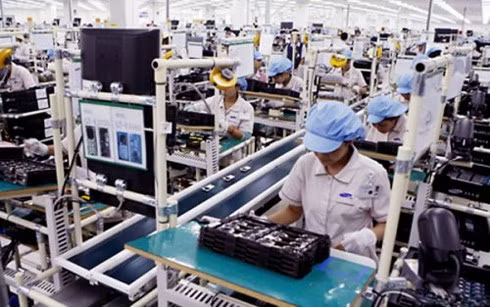
With total foreign direct investment estimated at just US$2 billion, Russia ranks No. 17 among other economies currently doing business in Vietnam, noted Mr Phong.

While on the reverses side, he added, that Vietnamese companies have foreign investment of approximately US$3 billion in Russia, substantially all of which is in the oil and gas segment.

However, despite the relatively weak economic ties, the two countries have strong cultural and political links dating back to the Soviet Union era, Mr Phong observed.

Notably, a study by the Pew Research Centre, a think tank based in Washington DC, the US, conducted in 2015 showed that 75% of Vietnamese people viewed Russia positively. Of all the people surveyed in some 40 countries, only 30% saw Russia favourably.

Russia became Vietnam’s first strategic partner in 2001 even before its major Asian neighbours like Japan (2006), India (2007) and China (2008). Alongside China, Russia is currently one of the two countries with which Vietnam has established a comprehensive strategic partnership.

In May 2015, following six years and eight rounds of negotiations, Vietnam signed a free trade agreement with the Russia-led Eurasian Union (EAEU), comprised of Armenia, Belarus, Kazakhstan, Kyrgyzstan and Russia.

That Agreement and the new free trade region it created came into force this past October 2016, noted Mr Phong, adding that it holds great promise for eliminating both tariff (previously at 5.63%) and non-tariff barriers to trade of Vietnam with the EAEU.

Pursuant to the Agreement, the EAEU eliminates import duties on 88% of goods imported from Vietnam either immediately when the Agreement came into force or with a phase-out transit period of five to 10 years.

Thus, Vietnamese producers have already gotten significant preferential access to many consumer goods markets of the EAEU including clothes, shoes, fish, rice, fruits, vegetables and consumer electronics.

In return, the average level of Vietnam duties imposed on EAEU goods will drop from 10 to 1%.

Vietnam has agreed to eliminate its import duties on 91% of its goods' nomenclature, which means that zero duties will apply to EAEU beef, dairy products, tinned fish, flour, cereals as well as to rolled steel, pipes, asbestos, ships, petroleum products and many other categories of goods.

The duty on petrol will be reduced from 19 to 0% with a transition period; on cables, from 20 to 0% over a period of 10 years; for large goods vehicles, from 17 to 0%.

Vietnam has also agreed to partially liberalize access to its market for EAEU tobacco products, while the EAEU automobile industry companies will be given exclusive access to the Vietnamese market.

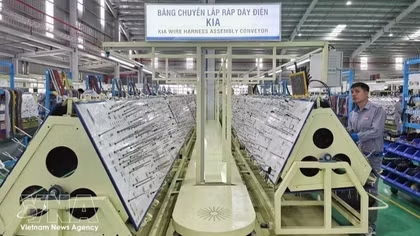
Vietnam has signed an investment agreement for the industrial assembly of cars and trucks with companies from Russia and Belarus. Assembled vehicles will be considered as manufactured in Vietnam and will thus have free access to the markets of ASEAN member states.

We hope that the growth in trade resulting from the newly created free trade EAEU region will increase to US$10 billion by 2020 as agreed upon by the two governments, noted Mr Phong.

However, the challenges such as high shipping costs due to the geographical distances, along with differences in business culture and languages may prove to be too formidable obstacles for Vietnamese companies.
VOV

Other News

SBV raises short-term capital lending cap to 40%

SBV raises short-term capital lending cap to 40%

The new circular will help credit institutions have more room to provide capital to businesses and investment projects to support high economic growth in the next few years, while increasing flexibility in the SBV’s monetary policy management.

Business confidence in Vietnam rebounds strongly: UOB

Business confidence in Vietnam rebounds strongly: UOB

The study found that 85% of Vietnamese enterprises reported positive business sentiment, a sharp increase from 48% in 2025, when business confidence was weighed down by uncertainties surrounding US tariff policies and related trade developments.

Bac Ninh seeks high-quality foreign investment for sustainable growth

Bac Ninh seeks high-quality foreign investment for sustainable growth

According to Vice Chairman of the provincial People’s Committee Pham Van Thinh, the province aims to maintain stable and sustainable growth, improve the competitiveness of both the economy and local businesses, and make better use of free trade agreements (FTAs) to expand and diversify export markets.

Green building trend flourishes in Ho Chi Minh City's real estate landscape

Green building trend flourishes in Ho Chi Minh City's real estate landscape

The International Finance Corporation (IFC) highlighted the city's dominance in green-certified building floor space in Vietnam, reflecting the rapid expansion of the green building market with 780 completed green buildings encompassing over 18.69 million sq.m by 2025, predominantly certified by EDGE and LEED.

UK supports Vietnam in wind power and green finance development

UK supports Vietnam in wind power and green finance development

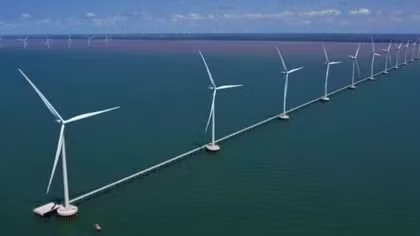
The United Kingdom officially announced two new climate cooperation initiatives to support Vietnam in its energy transition and green growth journey. These programs focus on offshore wind power development and the creation of a sustainable green financial ecosystem.

Ample room remains for Vietnam–India logistics cooperation

Ample room remains for Vietnam–India logistics cooperation

The GTTCI expert noted that alongside logistics and integrated warehousing, e-commerce is expected to be a particularly high-growth sector in the coming years. He described it as a multi-billion-dollar market with significant untapped opportunities for cooperation between Vietnam and India.

Exports gain momentum from high-tech growth drivers

Exports gain momentum from high-tech growth drivers

According to the Ministry of Industry and Trade, Vietnam’s exports reached 215.66 billion USD in the first five months of 2026, up 19.5% year-on-year. Twenty-six export items generated more than 1 billion USD in revenue each, including seven with turnover exceeding 10 billion USD.

Vietnam–China crossings see spike in ASEAN fresh produce

Vietnam–China crossings see spike in ASEAN fresh produce

Since the start of the summer harvest season, China's two major border gates with Vietnam, Youyi Guan in Pingxiang and Beilun 2 Bridge in Dongxing, have entered their peak period for handling imports of fresh agricultural and seafood products from member states of the Association of Southeast Asian Nations (ASEAN).

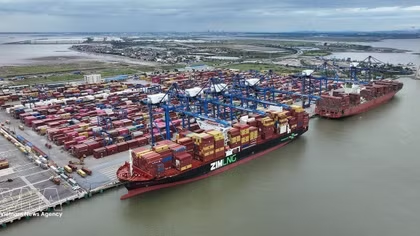
Cargo handling operations at Berths 3 and 4 of the Hai Phong International Gateway Port. (Photo: VNA)

AI reshapes logistics, raising bar for workforce skills

According to the Vietnam Logistics Business Association (VLA), the logistics sector will require around 2.2 million workers by 2030, including 1.6 million employees for logistics service providers and nearly 600,000 personnel supporting logistics operations in manufacturing and trading enterprises.

Robust dispute resolution framework key to Vietnam's IFC ambitions

Robust dispute resolution framework key to Vietnam's IFC ambitions

The development strategy for VIFC-HCMC envisions a comprehensive financial ecosystem encompassing green finance, carbon credits, financial technology (fintech), blockchain technology, digital assets, digital banking and other innovative business models. These highly internationalised sectors involve complex cross-border transactions and sophisticated legal structures.