Socio-economic situation remains stable despite COVID-19 outbreak: PM

Despite difficulties resulting from the acute respiratory disease caused by the novel coronavirus SARS-CoV-2 (COVID-19), Vietnam’s socio-economic situation in February basically remained stable, said Prime Minister Nguyen Xuan Phuc.
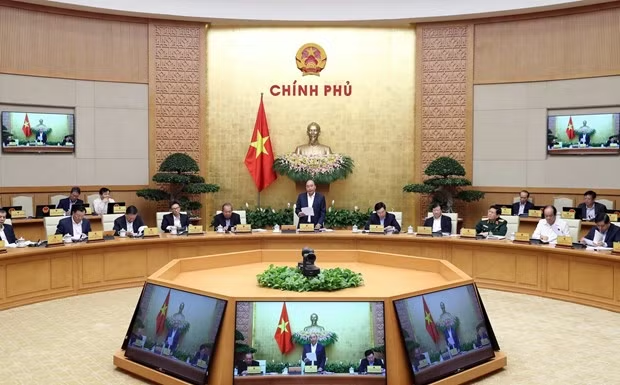
The Government's meeting in Hanoi on March 3 (Photo: VNA)

The Government's meeting in Hanoi on March 3 (Photo: VNA)

Despite difficulties resulting from the acute respiratory disease caused by the novel coronavirus SARS-CoV-2 (COVID-19), Vietnam’s socio-economic situation in February basically remained stable, said Prime Minister Nguyen Xuan Phuc.

At the Government’s regular meeting on March 3, the Cabinet leader said thanks to the political system’s activeness, drastic and effective actions, and the spirit of “fighting the disease is like fighting enemies”, COVID-19 prevention and control efforts have reaped encouraging outcomes.

He repeated the Government’s consistent viewpoint of being ready to sacrifice economic benefits to protect the health of people and visitors to Vietnam.

According to the PM, Vietnam has stayed calm and sober in assessing the issue, and it has been ready to respond to every circumstance. The localisation of hotbeds has been carried out in a drastic and timely manner, while the quarantine of Vietnamese citizens and foreigners who travelled through coronavirus-hit areas has proved effective.

Thanks to these efforts, the COVID-19 outbreak in Vietnam has been minimised although the country shares a long border with China, where the epidemic started. So far, there have been only 16 infection cases in Vietnam, and all of them have fully recovered, PM Phuc noted.

He lauded the efforts being made by various sectors, especially the military, police and health forces, and localities nationwide, adding that nearly 10,000 people have undergone quarantine and received care from local authorities and military units.

Vietnam has recorded no new SARS-CoV-2 infection cases over the last 18 days, he noted.

However, as the disease has spread to 67 countries and territories, and the World Health Organisation (WHO) has raised the global risk assessment of the infection to “very high”, it is necessary to take drastic actions to continue disease prevention and control tasks to prevent COVID-19 from spreading in the community, PM Phuc said.

The PM pointed out that the outbreak has greatly influenced all major economies around the world. In Vietnam, it has heavily impacted air transport, tourism, services, and especially value chains, leading to an interruption in the supply of input materials.

Despite that fact, the socio-economic situation in February basically remained stable, PM Phuc said, noting that the consumer price index (CPI) declined, budget revenue increased, funding for anti-disease work was provided in a timely manner, and agriculture developed stably.

He asked Government members to discuss financial – banking solutions and other measures to facilitate production and business activities to realise their development targets.

At the meeting, the Ministry of Planning and Investment reported that many areas fell in the first two months from the same period last year, such as the disbursed and registered FDI capital. Retail sales of goods and consumer service revenue, as well as foreign arrivals in Vietnam, also witnessed slower growth

However, there remained many positive points to the socio-economic situation, the ministry said.

Macro-economic stability has been maintained, and the February CPI fell 0.17 percent month on month. Meanwhile, exports in the first two months grew 2.4 percent year on year to 36.9 billion USD, and agricultural development has remained stable.

More than 17,400 businesses with registered capital of almost 364 trillion VND (15.7 billion USD) were established in the two months, up 9.1 percent and 47.1 percent, respectively. Nearly 12,000 firms also resumed operations, up 17.1 percent.
VNA

Other News

Data-driven land valuation to curb speculation: Experts

Data-driven land valuation to curb speculation: Experts

From a property-market perspective, Do Thi Thu Giang, National Director of Valuation and Advisory at Savills Vietnam, said the orientations under Resolution No. 21-NQ/TW could make the market more transparent and efficient, with property values increasingly tied to actual development and use potential.

Resolution No. 19-NQ/TW sets new growth drivers for Vietnam

Resolution No. 19-NQ/TW sets new growth drivers for Vietnam

Science and technology, innovation, digital transformation and AI must be translated into higher productivity rather than pursued as ends in themselves. At the same time, people should be placed at the centre of development, not merely viewed as a resource but as the ultimate objective of development policies.

Expo to open door for Vietnamese suppliers to enter US market

Expo to open door for Vietnamese suppliers to enter US market

US retail giant Target is seeking Vietnamese suppliers of household goods, home textiles, children’s products, personal care and beauty products, with a focus on companies capable of manufacturing and developing products that meet requirements on quality, design and supply chain management.

2026 Banking Sector Digital Transformation to open in Hanoi

2026 Banking Sector Digital Transformation to open in Hanoi

The annual event, which will be held on August 18-19, 2026, at the ICE International Exhibition Centre, 91 Tran Hung Dao Street, Hanoi, is expected to attract around 324 delegates and feature 21 booths representing credit institutions, payment intermediary service providers, and technology companies.

Vietnam – one of most attractive destinations for leading US semiconductor companies: expert

Vietnam – one of most attractive destinations for leading US semiconductor companies: expert

Vietnam has built a solid semiconductor and electronics industry before joining ITSI, attracting major US semiconductor companies. Intel Products Vietnam is one of Intel's largest assembly and testing facilities worldwide, while chip design companies such as Synopsys, Cadence, Marvell and Qualcomm have established engineering and research centres in the Southeast Asian country.

Vietnam targets higher-quality FDI under Resolution 10

Vietnam targets higher-quality FDI under Resolution 10

During the first seven months of 2026, Vietnam attracted more than 38 billion USD in registered FDI, up nearly 58% year-on-year. More importantly, the increase was driven by large-scale, high-tech projects rather than a surge in the number of new investments, signalling a significant improvement in the quality of capital inflows.

Manufacturing, engineering drive hiring growth in H1: report

Manufacturing, engineering drive hiring growth in H1: report

Manufacturing and engineering posted the strongest recruitment growth, with hiring demand surging 70% year-on-year, driven by production expansion, supply chain restructuring and sustained investment inflows in high-tech manufacturing.

Government proposes special mechanisms to unblock APEC 2027 projects in Phu Quoc

Government proposes special mechanisms to unblock APEC 2027 projects in Phu Quoc

The projects in Phu Quoc have been implemented under tight deadlines. Since May 2025, the Prime Minister has directed preparations for APEC 2027, including accelerated infrastructure development on the special zone. An Giang province and investors have subsequently launched a number of major projects involving complex technical requirements and demanding construction schedules.

Financial market reform plan targets high, sustained growth through 2045

Financial market reform plan targets high, sustained growth through 2045

The plan seeks to develop a balanced and modern financial market that is closely integrated with regional and global markets, strengthens the mobilisation and allocation of domestic and foreign capital, and enhances the market’s role as a key provider of medium- and long-term capital for the economy and as a major driver of sustained high economic growth.

An Giang aims to become leading maritime economic hub

An Giang aims to become leading maritime economic hub

Under the province's master plan for 2021–2030 with a vision to 2050, An Giang will prioritise investment in five strategic sectors: strategic infrastructure; processing industries and clean energy; trade, services, logistics and border-gate economy; high-quality tourism; and high-tech agriculture, ecological development and the circular economy.