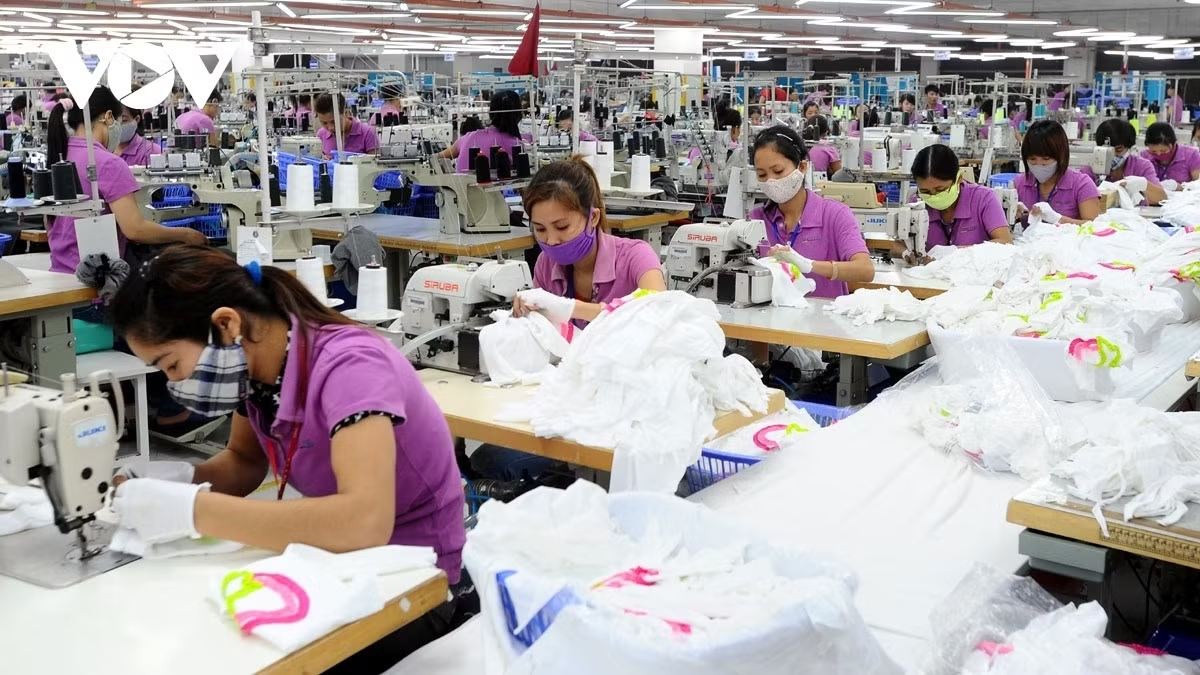
South America viewed as potential market for Vietnamese apparel

Despite trade activities between the nation and South American nations seeing growth in recent times, it remains far from fulfilling its full potential, especially for the textile and garment sector, according to industry insiders.

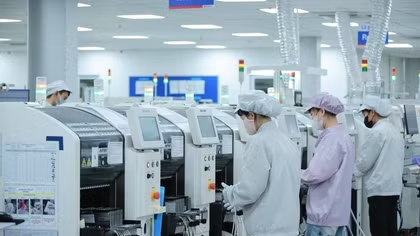
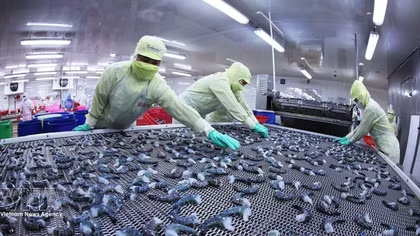
South America viewed as potential market for Vietnamese apparel ảnh 1

South America is viewed as a highly lucrative fashion market that boasts a population of more than 437 million people and a relatively high per capita income. However, there are still few businesses and consumers in South America who are fully aware of Vietnamese fashion products.

Furthermore, the Vietnamese textile and garment industry is in the process of developing rapidly and is able to meet many large orders with high requirements from different markets. Currently, the nation’s textile and garment exports to Brazil stands at between US$150 million and US$200 million per year, whilst those to Chile are between US$70 million and US$90 million per year and to Peru the figure is around US$30 million to US$40 million per year.

Meanwhile, local textile and garment imports, mainly cotton from Brazil, are approximately US$300 million to US$500 million.

According to Le Hoang Tai, deputy director of the Trade Promotion Department under the Ministry of Industry and Trade, said the volume and value of Vietnamese textile and garment exports to the South American market remain limited.

“There are many reasons for the limitation such as geographical location, cultural differences, lack of information on capacity and needs between both sides’ enterprises and effective trade promotion activities. Additionally, some South American economies have low openness," said Tai.

Sharing this point of view, Truong Van Cam, vice chairman and general secretary of the Vietnam Textile and Apparel Association (VITAS), assessed that the understanding of Vietnamese firms about national culture, consumers, customs, and habits of South American countries is limited and vice versa. In addition, many South American countries are large textile and garment producing countries, meaning that they are both co-operative and competitive with Vietnamese textile and garment companies.

Following the COVID-19 pandemic, there is a need to diversify the supply of raw materials and import-export markets, whilst the need to reshape the supply chains of enterprises in both Vietnam and South American countries remains very high.

Currently, the two sides are in the process of working to form a supply chain between local textile enterprises and those South American countries. This will prioritise co-operation in areas such as raw materials, weaving, and fabric dyeing, with the application of criteria for sustainable development being to ensure consistent working conditions and labour standards.

It can be seen as necessary to quickly start the negotiation of a free trade agreement between the South American Common Market known as MERCOSUR and Vietnam to allow local textile enterprises and South American nations to co-operate to boost development for mutual benefits.

Moreover, information on market trends is needed to connect Vietnamese textile and garment enterprises directly with their South American partners. Indeed, this should be done while simultaneously launching trade promotion delegations in this region to attract more investors, Cam added.

Vietnam Trade Offices in South America said that after the COVID-19 pandemic, countries in the region have been attempting to reshape the supply chain and diversify the supply of imported goods, which is seen as an opportunity. for strong Vietnamese businesses and industries. This includes textiles and garments as part of efforts to intensify trade promotion and increase their presence in the South American region, thereby gradually increasing their market share and export value.
VOV

Other News

SBV raises short-term capital lending cap to 40%

SBV raises short-term capital lending cap to 40%

The new circular will help credit institutions have more room to provide capital to businesses and investment projects to support high economic growth in the next few years, while increasing flexibility in the SBV’s monetary policy management.

Business confidence in Vietnam rebounds strongly: UOB

Business confidence in Vietnam rebounds strongly: UOB

The study found that 85% of Vietnamese enterprises reported positive business sentiment, a sharp increase from 48% in 2025, when business confidence was weighed down by uncertainties surrounding US tariff policies and related trade developments.

Bac Ninh seeks high-quality foreign investment for sustainable growth

Bac Ninh seeks high-quality foreign investment for sustainable growth

According to Vice Chairman of the provincial People’s Committee Pham Van Thinh, the province aims to maintain stable and sustainable growth, improve the competitiveness of both the economy and local businesses, and make better use of free trade agreements (FTAs) to expand and diversify export markets.

Green building trend flourishes in Ho Chi Minh City's real estate landscape

Green building trend flourishes in Ho Chi Minh City's real estate landscape

The International Finance Corporation (IFC) highlighted the city's dominance in green-certified building floor space in Vietnam, reflecting the rapid expansion of the green building market with 780 completed green buildings encompassing over 18.69 million sq.m by 2025, predominantly certified by EDGE and LEED.

UK supports Vietnam in wind power and green finance development

UK supports Vietnam in wind power and green finance development

The United Kingdom officially announced two new climate cooperation initiatives to support Vietnam in its energy transition and green growth journey. These programs focus on offshore wind power development and the creation of a sustainable green financial ecosystem.

Ample room remains for Vietnam–India logistics cooperation

Ample room remains for Vietnam–India logistics cooperation

The GTTCI expert noted that alongside logistics and integrated warehousing, e-commerce is expected to be a particularly high-growth sector in the coming years. He described it as a multi-billion-dollar market with significant untapped opportunities for cooperation between Vietnam and India.

Exports gain momentum from high-tech growth drivers

Exports gain momentum from high-tech growth drivers

According to the Ministry of Industry and Trade, Vietnam’s exports reached 215.66 billion USD in the first five months of 2026, up 19.5% year-on-year. Twenty-six export items generated more than 1 billion USD in revenue each, including seven with turnover exceeding 10 billion USD.

Vietnam–China crossings see spike in ASEAN fresh produce

Vietnam–China crossings see spike in ASEAN fresh produce

Since the start of the summer harvest season, China's two major border gates with Vietnam, Youyi Guan in Pingxiang and Beilun 2 Bridge in Dongxing, have entered their peak period for handling imports of fresh agricultural and seafood products from member states of the Association of Southeast Asian Nations (ASEAN).

Cargo handling operations at Berths 3 and 4 of the Hai Phong International Gateway Port. (Photo: VNA)

AI reshapes logistics, raising bar for workforce skills

According to the Vietnam Logistics Business Association (VLA), the logistics sector will require around 2.2 million workers by 2030, including 1.6 million employees for logistics service providers and nearly 600,000 personnel supporting logistics operations in manufacturing and trading enterprises.

Robust dispute resolution framework key to Vietnam's IFC ambitions

Robust dispute resolution framework key to Vietnam's IFC ambitions

The development strategy for VIFC-HCMC envisions a comprehensive financial ecosystem encompassing green finance, carbon credits, financial technology (fintech), blockchain technology, digital assets, digital banking and other innovative business models. These highly internationalised sectors involve complex cross-border transactions and sophisticated legal structures.