UNESCO launches handbook on Journalism, Fake News and Disinformation at VIF 2019

As a part of the “Global Initiative for Excellence in Journalism Education”, which is a focus of UNESCO’s International Programme for the Development of Communication (IPDC), the handbook seeks to engage with teaching, practising and researching of journalism from a global perspective.

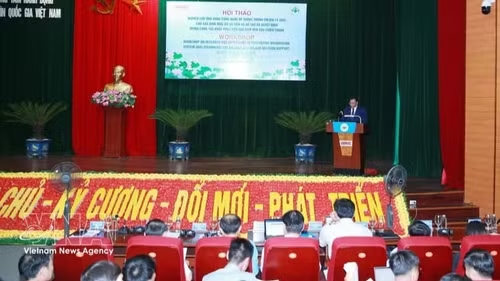
Within the framework of the Vietnam Internet Forum 2019 (VIF 2019) which took place in Hanoi on March 20-21, UNESCO officially introduced the Vietnamese version of its handbook called "Journalism, 'Fake News' and Disinformation: A Handbook for Journalism Education and Training".

Information is the engine of development in the 20th and 21st century. This is fueled by independent news media that can act as a trusted guardian of public interest, and as an essential part of society’s checks and balances on power. But recent developments have put journalism under fire.

Political, technological, economic and social transformations are inexorably reshaping the communications landscape and raising many questions about the quality, impact and credibility of journalism.

The Vietnamese version of the handbook "Journalism, 'Fake News' and Disinformation: A Handbook for Journalism Education and Training".

In addition, the information ecology is being contaminated by orchestrated campaigns to spread untruths via disinformation. This disruption is accompanied by manipulation of half-truths via mal-information, and by the unwitting sharing of misinformation.

This is the context in which UNESCO is publishing a model curriculum on a highly topical and significant subject. The new resource is aimed mainly at journalism educators and trainers, but is also of direct interest to practicing journalists and others who are interested in the quality of information in circulation.

Written by experts in the fight against disinformation, the handbook explores the very nature of journalism with modules on why trust matters; thinking critically about how digital technology and social platforms are conduits of the information disorder; fighting back against disinformation and misinformation through media and information literacy; fact-checking 101; social media verification and combatting online abuse.

To serve as a model curriculum, this handbook is designed to give journalism educators and trainers, along with students of journalism, a framework and lessons to help navigate the issues associated with ‘fake news’. This model curriculum is an essential addition to teaching syllabi for all journalism educators, as well as practicing journalists and editors who are interested in information, how we share it and how we use it.  

Political parties, health professionals, businesspeople, scientists, election monitors, NGOs and others will also find useful insight in this publication. The idea is not to prescribe a curriculum, but to present knowledge resources for insight and adaptation as each reader sees fit.
By An Nhien

Other News

Hanoi ready to implement Capital Law 2026, unlocking new development momentum

Hanoi ready to implement Capital Law 2026, unlocking new development momentum

The effectiveness of the Capital Law 2026 will be measured not by the number of legal documents issued but by tangible improvements in governance and public administration, better services for people and businesses, faster administrative procedures, stronger investment attraction and higher economic growth.

Vietnamese students earn honours at ROBOG Asia Cup 2026

Vietnamese students earn honours at ROBOG Asia Cup 2026

Three teams from Chu Van An Secondary School in Vietnam’s Thai Nguyen province have earned First Prize honours and advanced to the quarterfinals at the ROBOG Asia Cup 2026, a regional robotics and artificial intelligence (AI) competition for students held in Hong Kong, China.

Hanoi sets out new investment blueprint with century-long development vision

Hanoi sets out new investment blueprint with century-long development vision

As of early June, Hanoi had attracted 74.6 billion USD in foreign direct investment (FDI) through more than 9,250 valid projects. FDI inflows in the first six months were projected at 3.2 billion USD, surpassing the annual target by 116%, while nearly 16,000 new businesses were established in the first five months, up 34.4% year-on-year.

Vietnam promotes legal cooperation and rule of law at global forum

Vietnam promotes legal cooperation and rule of law at global forum

Vietnam’s development and international integration have gone hand in hand with the improvement of its legal system, the incorporation of international commitments into domestic legislation, and legal reforms aimed at fostering development, openness and global integration. The country regards international law as an essential instrument for building fair, mutually beneficial relations among nations.

Hanoi to hold investment promotion event on June 29

Hanoi to hold investment promotion event on June 29

At the event, Hanoi authorities plan to grant investment policy decisions and investment registration certificates to 20 exemplary projects in the fields of transportation infrastructure, industrial parks, urban development, social housing, environment, science and technology, and foreign investment attraction.

Hanoi's Red River urban area development draws widespread attention

Hanoi's Red River urban area development draws widespread attention

Located south of the Red River and extending from the historic inner city to newly developing areas in the south and the west, the central urban area along Red River’s right bank covers approximately 45,317 hectares and is projected to accommodate around 6.365 million residents by 2045 and 6.455 million by 2065.

Hanoi's Red River urban area development draws widespread attention

Hanoi's Red River urban area development draws widespread attention

Located south of the Red River and extending from the historic inner city to newly developing areas in the south and the west, the central urban area along Red River’s right bank covers approximately 45,317 hectares and is projected to accommodate around 6.365 million residents by 2045 and 6.455 million by 2065.

Regional cooperation strengthened to combat cross-border drug crime

Regional cooperation strengthened to combat cross-border drug crime

Vietnam, China, Laos and Myanmar face common challenges as drug syndicates increasingly exploit the Mekong River, cross-border transport networks, e-commerce platforms, international logistics services, cyberspace and cryptocurrencies to organise drug transactions and smuggling operations.