Vietnam assisted to meet needs of aging population

The Japan International Cooperation Agency (JICA) and the World Bank (WB) on August 7 jointly launched a knowledge-sharing programme to assist policymakers in Vietnam with developing new models of care services for the elderly as Vietnam’s population is aging at a pace faster than any of its regional peers.

The first activity under this new program was a learning seminar in Hanoi where 40 government officials from various line ministries, including Ministry of Labor, Invalids and Social Affairs, Ministry of Health, Ministry of Finance and Vietnam National Committee on Aging participated to gain a better understanding of the nature of the issues and challenges of eldercare the country is facing.

“Rapid population aging in Vietnam will have significant economic, social and fiscal implications,” said Ousmane Dione, WB Country Director for Vietnam, adding the country needs to start preparing for an ageing society now by developing a comprehensive and financially sustainable health and social care service system that can provide the elderly with the care they need.
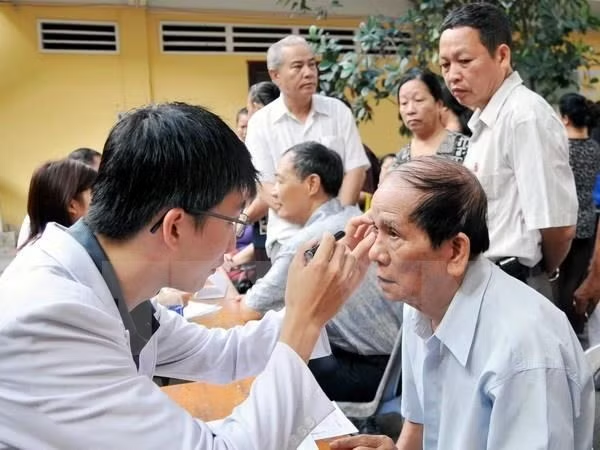
The Japan International Cooperation Agency (JICA) and the World Bank (WB) will jointly assist policymakers in Vietnam with developing new models of care services for the elderly. (Photo: VNA)

“Over the past decade, JICA has been supporting Thailand to develop Community-based Integrated Care Model while adopting to the local context,” said Tetsuo Konaka, JICA Vietnam Office’s Chief Representative. 

“We believe that by utilising experiences and lessons learned from Thailand and Japan, Vietnam can learn how to develop and implement an effective care model for elderly people,” he said. 

At the seminar, experts from Japan and Thailand shared their experiences and lessons learnt in designing policies and institutional arrangements with proper attention to the associated fiscal impacts.

Based on current demographic trends, Vietnam’s elderly population will double from 7 percent to 14 percent of the total population – the threshold for a country’s population to be considered aged – in about 17 years. In comparison, it took Singapore and Thailand 22 and 20 years, respectively, to reach this threshold. Vietnam is projected to become an aged society around 2035.

Like many other countries, family members, particularly women, have been the de facto care-givers for older adults in Vietnam. However, as the family structure evolves and the needs of elders become increasingly complex, there is an imperative for interventions to go beyond the household level to be effective.

To facilitate a transition to a new eldercare model, Vietnam needs to address major structural bottlenecks including limited access to essential medical and social care services as well as weak collaboration across relevant sectors (health, social, and finance, among others). 

The joint programme will be implemented in three phases from August 2019 to 2020. 

Following the seminar, there will be a study tour to Thailand to enhance the learning for participants and promote South-South learning. The last phase will focus on internalizing key learnings from the study tour, synthesise these learnings into policy recommendations and develop a service model. 

VNA

Other News

Hanoi ready to implement Capital Law 2026, unlocking new development momentum

Hanoi ready to implement Capital Law 2026, unlocking new development momentum

The effectiveness of the Capital Law 2026 will be measured not by the number of legal documents issued but by tangible improvements in governance and public administration, better services for people and businesses, faster administrative procedures, stronger investment attraction and higher economic growth.

Vietnamese students earn honours at ROBOG Asia Cup 2026

Vietnamese students earn honours at ROBOG Asia Cup 2026

Three teams from Chu Van An Secondary School in Vietnam’s Thai Nguyen province have earned First Prize honours and advanced to the quarterfinals at the ROBOG Asia Cup 2026, a regional robotics and artificial intelligence (AI) competition for students held in Hong Kong, China.

Hanoi sets out new investment blueprint with century-long development vision

Hanoi sets out new investment blueprint with century-long development vision

As of early June, Hanoi had attracted 74.6 billion USD in foreign direct investment (FDI) through more than 9,250 valid projects. FDI inflows in the first six months were projected at 3.2 billion USD, surpassing the annual target by 116%, while nearly 16,000 new businesses were established in the first five months, up 34.4% year-on-year.

Vietnam promotes legal cooperation and rule of law at global forum

Vietnam promotes legal cooperation and rule of law at global forum

Vietnam’s development and international integration have gone hand in hand with the improvement of its legal system, the incorporation of international commitments into domestic legislation, and legal reforms aimed at fostering development, openness and global integration. The country regards international law as an essential instrument for building fair, mutually beneficial relations among nations.

Hanoi to hold investment promotion event on June 29

Hanoi to hold investment promotion event on June 29

At the event, Hanoi authorities plan to grant investment policy decisions and investment registration certificates to 20 exemplary projects in the fields of transportation infrastructure, industrial parks, urban development, social housing, environment, science and technology, and foreign investment attraction.

Hanoi's Red River urban area development draws widespread attention

Hanoi's Red River urban area development draws widespread attention

Located south of the Red River and extending from the historic inner city to newly developing areas in the south and the west, the central urban area along Red River’s right bank covers approximately 45,317 hectares and is projected to accommodate around 6.365 million residents by 2045 and 6.455 million by 2065.

Hanoi's Red River urban area development draws widespread attention

Hanoi's Red River urban area development draws widespread attention

Located south of the Red River and extending from the historic inner city to newly developing areas in the south and the west, the central urban area along Red River’s right bank covers approximately 45,317 hectares and is projected to accommodate around 6.365 million residents by 2045 and 6.455 million by 2065.

Regional cooperation strengthened to combat cross-border drug crime

Regional cooperation strengthened to combat cross-border drug crime

Vietnam, China, Laos and Myanmar face common challenges as drug syndicates increasingly exploit the Mekong River, cross-border transport networks, e-commerce platforms, international logistics services, cyberspace and cryptocurrencies to organise drug transactions and smuggling operations.