- 30-year FDI attraction: ripple effect on domestic businesses
- 30-year FDI attraction: shifting focus onto quality
- Conference on 30 years of FDI attraction to open new era and vision
Addressing a conference to review the 30 years of foreign investment attraction in Vietnam held in Hanoi, the leader affirmed that the Government will continue with guidelines and policies on foreign investment.
The Government always supports investors, for mutual benefits and sustainable development, he said. “Your success in Vietnam is also our success and pride,” he told the participating foreign investors.
The PM stressed that foreign investment always accompanies Vietnam’s Doi Moi (Reform) process, vividly manifests the country’s open-door policy and forms part of economic as well as international integration Vietnam is pursuing, contributing to raising its position in the international arena.
Over the past 30 years, foreign investment attraction has proven itself as a sound and successful policy of the Vietnamese Party and State, he said, noting that foreign-invested enterprises have become active members of the business community in Vietnam.
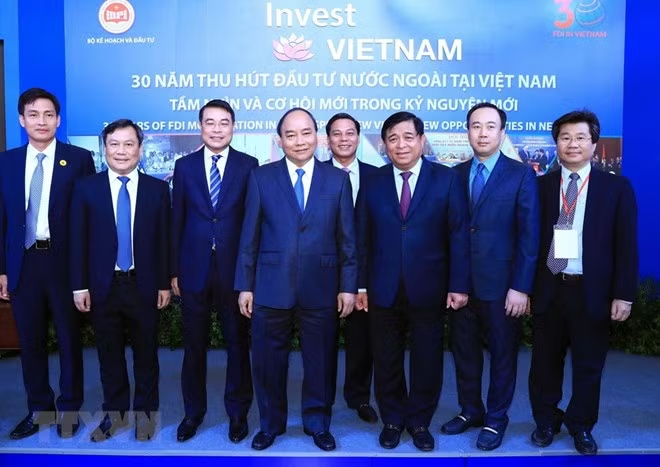 |
| PM Nguyen Xuan Phuc (front line, fourth from left) and delegates at the event. |
The leader, however, pointed out weak points in foreign investment such as the limited number of multi-national groups using high and source technologies, below-expectation coordination between domestic and foreign investment sectors, and environmental pollution caused by some projects.
PM Phuc said foreign investment cooperation has been expanded to management, connectivity, and merger and acquisition (M&A), with an emphasis on environmental protection, labourer protection and social interest guarantee.
Vietnam wants to promote the linkage between foreign-invested and domestic firms in order to develop the supporting industry and other industrial sectors with large scales and high-quality technologies and connected with regional and global value chains.
The country encourages foreign investment in high and environmentally friendly technologies, and attracts foreign projects that aim to approach the Fourth Industrial Revolution to create high added values, he said.
The FDI sector has become an important part of Vietnam’s economy, the PM stressed, urging ministries and agencies to ensure socio-political stability and to stabilise the macro economy, while stepping up infrastructure development and high-quality personnel training.
On this occasion, PM Phuc and Deputy PM Vuong Dinh Hue presented awards to groups, individuals and FDI firms in recognition of their contributions to national socio-economic development over the past time.
At the conference, the PM witnessed the signing of some investment cooperation documents and the hand-over of investment licences.
It was reported that as of August 20, the country counted 26,500 valid FDI projects with the total registered capital reaching 334 billion USD. Of the sum, about 184 billion USD has been disbursed.
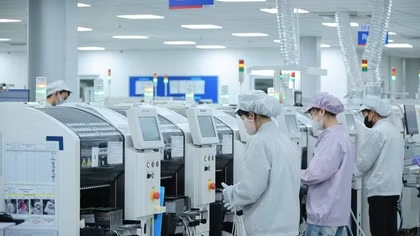
The FDI sector makes up nearly 20 percent to the national GDP, and 58 percent of foreign investment capital has been poured into the processing and manufacturing activities.
In 2017, the FDI sector’s export turnover made up 72.6 percent of the country’s total. The sector has generated about 4 million jobs.
Domestic and foreign investors at the conference showed positive viewpoints on Vietnam’s attractive and open business environment, especially the country’s engagement in 12 bilateral and multilateral trade agreements with 56 partners in the world.
Nicolas Audier, Co-Chairman of the European Chamber of Commerce in Vietnam, said the new-generation FTAs, including the EU-Vietnam FTA, will create opportunities for Vietnam to develop further.
With a preferential investment environment, production cost competitiveness, rosy economic prospects, the development of the middle class, the increasing number of trained labourers and favourable geographical in Southeast Asia, Vietnam is an attractive destination for foreign investors, he said.
Tomaso Andreatta, Co-Chairman of the Vietnam Business Forum (VBF) Consortium, suggested relevant Vietnamese agencies set forth measures to keep investors in Vietnam and attract others with higher quality.
Vietnam should improve skills and knowledge of labourers so as to help them master automatic technologies of the Fourth Industrial Revolution, multiply independent vocational training companies and reform the educational system, he said.
The conference brought together more than 3,500 representatives of ministries, agencies, localities, embassies, diplomatic corps, international organisations, associations and economic groups, experts, scientists and domestic and foreign investors.