Vietnam, EU sign free trade, investment protection agreements

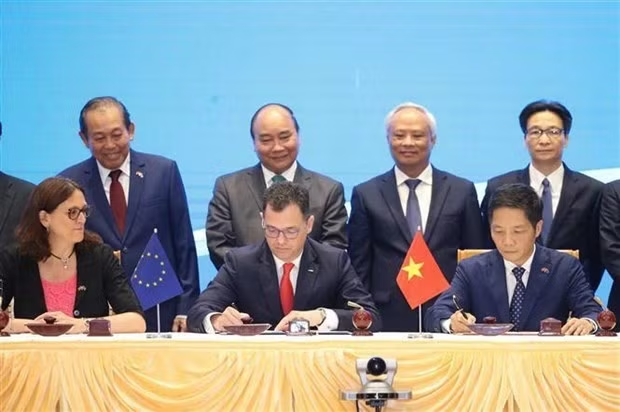
The EU – Vietnam Free Trade Agreement (EVFTA) and the EU – Vietnam Investment Protection Agreement (EVIPA) were officially signed in Hanoi on June 30 afternoon, in the witness of Prime Minister Nguyen Xuan Phuc, Vietnamese National Assembly and Government leaders, and leaders of the European Union (EU).
At the signing ceremony for EVFTA (Photo: VNA)

At the signing ceremony for EVFTA (Photo: VNA)

The EVFTA was inked by Minister of Industry and Trade Tran Tuan Anh and European Commissioner for Trade Cecilia Malmstrom, and the EVIPA, between Minister of Planning and Investment Nguyen Chi Dung and an EU leading official.

Speaking at the signing ceremony, PM Phuc said that at the G20 summit in Japan on June 29, he had an important meeting with President of the European Commission Jean-Claude Juncker who stressed that June 30, 2019, is a special day of historical significance in the Vietnam – EU relations.

The signing of the two important agreements has opened up a new horizon for a larger and more comprehensive cooperation and stronger development of Vietnam and the EU, the Government leader said, thanking EU leading officials for their support.

The EU, with its Look East vision, has taken Vietnam as a partner, PM Phuc stressed, adding that as a country with rich potential for dynamic development of the top level in Southeast Asia which is implementing its foreign policy of multilateralisation and diversification of relations and having a strong vision for intensive and extensive international integration, Vietnam is very happy to cooperate with the EU.

The PM said the EVFTA and the EVIPA will lift bilateral ties to a greater strategic height, especially amid rising protectionism and non-traditional security challenges. 

He thanked the EU member states for supporting Vietnam’s run for a non-permanent seat in the United Nations Security Council for the 2020 – 2021 tenure, adding that Vietnam commits to working closely with the EU on global issues and at the UN. 

The leader expressed his belief that the European Parliament, parliaments of EU member nations, and the Vietnamese National Assembly will soon ratify the EVFTA and EVIPA. 

Vietnam will soon issue a national action programme to realise the deals with special measures, he said. 

According to him, with the new pacts, EU enterprises will be able to access not only the 100-million Vietnamese market, but also markets in the ASEAN, the Comprehensive and Progressive Agreement for Trans-Pacific Partnership (CPTPP) and East Asia, thus creating a driving force for East – West cooperation. 

At the signing ceremony, Minister of Industry and Trade Tran Tuan Anh said the signing of the two agreements will further enhance bilateral ties and bring benefits to both sides, marking a new beginning for a new journey ahead. 

He added that more needs to be done to effectively realise the deals and benefit business communities and peoples. 

The EVFTA is considered a comprehensive, high-quality agreement that ensures balanced benefits for both Vietnam and the EU. At the same time, the agreement complies with the provisions of the World Trade Organisation (WTO).

The pact has 17 chapters, two protocols and several Memoranda of Understanding, covering trade in goods, principles on goods’ origin, facilitation of trade and customs procedures, sanitary and phytosanitary (SPS) measures, technical barriers to trade (TBT), trade in services, investment, trade defence, competitiveness, state-owned enterprises, Government purchase, intellectual property, trade and sustainable development, and legal and institutional issues.

Right after the deal takes effect, more than 85.6 percent of tariff lines imposed on Vietnamese products, equivalent to 70.3 percent of Vietnam’s export turnover to the EU, will be removed. After seven years from the entry into force of the agreement, the EU will abolish 99.2 percent of tariff lines, or 99.7 percent of Vietnam’s export turnover. For the remaining 0.3 percent of shipments, the EU pledged to provide Vietnam with tariff quota of 0 percent.

The level of commitment in the EVFTA is the highest that a partner has made under any FTA Vietnam has signed. It has significant meaning especially as the EU has been one of the two largest export markets of Vietnam for many years.

Regarding the EU’s exports, Vietnam commits to remove 48.5 percent of import tariff on goods from the EU, or 64.5 percent of the bloc’s export turnover, immediately after the deal takes effect. The figure will be increased to 91.8 percent seven years later. For the remaining EU exports, Vietnam will apply a tariff elimination roadmap for longer than 10 years or apply the WTO’s duty quota.

Under the EVIPA, both sides pledged national treatment and most favoured nation treatment to investors of the other side, as well as fair and satisfactory treatment, safe and full protection. Both sides will allow the free movement of capital and profit abroad, pledging not to expropriate or nationalise investors’ assets without appropriate compensation. Furthermore, they pledge to compensate the losses of the other side’s investors in the same way as domestic investors or the third-party investors as a result of war and riots.

On the occasion of the signing of the two important agreements, the Vietnam News Agency organised a photo exhibition on the negotiation process of the two pacts.

VNA

Other News

Vietnam accelerates innovation to boost growth, competitiveness

Vietnam accelerates innovation to boost growth, competitiveness

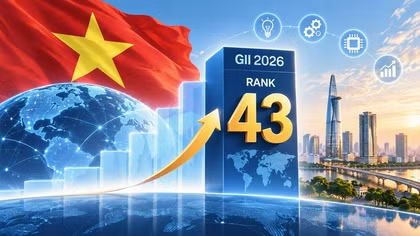
By 2030, Vietnam aims to rank among the world’s top 40 in the GII; raise total social investment in R&D to at least 2% of GDP, with non-State funding accounting for over 60%; increase international scientific publications by an average of 10% annually; and raise the number of patent applications and granted patents by an average of 16-18% annually.

Vietnam sees high growth prospects

Vietnam sees high growth prospects

Experts from the Institute of Vietnam and World Economy under the Vietnam Academy of Social Sciences noted the quality of recent growth as the high growth rate has been recorded against an increasingly higher comparative base.

Vietnam seeks bigger share of global Halal market

Vietnam seeks bigger share of global Halal market

Vietnam's Halal exports remain modest at around 900 million USD a year, accounting for less than 1% of the global market. Most exports are still raw agricultural and seafood products. Only around 1,000–1,300 Vietnamese businesses obtained or maintained Halal certification during 2024–2026.

Hanoi sets up inter-agency mechanism to operate carbon market

Hanoi sets up inter-agency mechanism to operate carbon market

Under a decision of the municipal People’s Committee on establishing an inter-agency working group, departments and agencies are responsible for identifying facilities subject to greenhouse gas inventories, developing emissions-reduction plans and studying projects capable of generating carbon credits.

Shrimp exports reach 3.3 billion USD in eight months

Shrimp exports reach 3.3 billion USD in eight months

According to data from the Vietnam Customs cited by the Vietnam Association of Seafood Exporters and Producers (VASEP), shrimp exports reached 478.5 million USD in August, up 4.2% from the same month last year. The eight-month total stood at 3.3 billion USD, representing a year-on-year increase of 12%.

Russian investors explore opportunities in Vietnam's real estate market

Russian investors explore opportunities in Vietnam's real estate market

Vietnam is seen as a potential market, with considerable room for growth in real estate, particularly commercial property, compared with some regional markets. Strong Vietnam-Russia ties and opportunities to establish foreign-invested enterprises are also considered favourable for Russian investors.

Phu Quoc airport planning adjusted to serve APEC 2027

Phu Quoc airport planning adjusted to serve APEC 2027

For 2021-2030, the Civil Aviation Authority of Vietnam proposed bringing forward the investment in a parallel taxiway system and a connecting taxiway north of Runway No. 2 at Phu Quoc International Airport, in order to connect with the aircraft maintenance and repair facility (hangar) planned for the northern area of ​​the airport.

Policy, infrastructure emerge as new advantages in FDI attraction

Policy, infrastructure emerge as new advantages in FDI attraction

From policy and infrastructure to industrial real estate, Vietnam’s FDI advantages are broadening towards a more integrated production ecosystem, offering investors a stronger combination of conditions for high-value, technology-intensive and long-term projects.

Logistics upgrade vital to 1-trillion-USD trade target: experts

Logistics upgrade vital to 1-trillion-USD trade target: experts

As trade expands, systemic bottlenecks across transport networks, warehousing, ports, border gates, and industrial zones are becoming more apparent. Experts emphasise the need to shift from a fragmented, project-by-project approach toward strategic management structured around trade corridors and integrated supply chains.

Ample room for Vietnam, US to deepen cooperation

Ample room for Vietnam, US to deepen cooperation

Do Ngoc Hung, Trade Counsellor and head of the Vietnam Trade Office in the US, said what stands out is not only the growth in trade volume but also the increasingly deep economic ties between the two countries.

Flexible fiscal policy helps drive economic growth

Flexible fiscal policy helps drive economic growth

According to the Ministry of Finance, State budget revenue in the first eight months of 2026 was estimated at 2.02 quadrillion VND (77.7 billion USD), equivalent to 80% of the annual estimate and up 16% year-on-year. Domestic revenue reached 1.75 quadrillion VND, accounting for 86.6% of total revenue and rising 16.6%.

Electronic components are produced at a factory in Hanoi. (Photo: VNA)

Hanoi's imports surge 41% in first eight months of 2026

Hanoi aims to achieve average annual export growth of at least 12% during 2026-30, with the city seeking to diversify export markets, boost high-tech and value-added products and reduce reliance on traditional markets.