Vietnam going big on shrimp farming

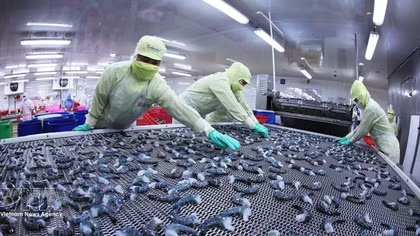
The Vietnam government has announced plans to invest heavily in perfecting the country’s intensive shrimp farming operations and expand production significantly over the next few years.

Earlier this month, the Government announced plans to expand farm raised shrimp exports more than three-fold from the current harvest estimated at US$3 billion in 2016 to US$10 billion over the next few years. 

To accomplish the goal, the country will dig new ponds and expand the hectarage devoted to shrimp production that it already operates by reducing its rice harvest, principally in the Mekong Delta, said Minister of Agriculture and Rural Development Nguyen Xuan Cuong.

The Government made the decision to place all future bets on shrimp farming following a rice harvest in 2016 that was devastated by the rising salinity of the Mekong River in 2016.
In the lower reaches of the Mekong Delta, saltwater has penetrated inland as far as 60 kilometres, according to meteorologists, killing crops and shuttering family farms, eliminating thousands of rural jobs.

Longer-term, the Government is convinced that the shrimp farming business can compete on more equitable terms with the country’s other more profitable agriculture production.

The increasing salinity may be bad for rice farmers but it is great for those in the shrimp business.

Minister Cuong noted the gross revenue of the country’s shrimp farmers from exports last year surpassed that of rice, making it the second-largest agricultural export for 2016, after coffee.

Government officials in the Mekong Delta and other coastal areas have been working to assist rice farmers make the transition to cultivating shrimp that will affect tens of millions in the Mekong Delta alone.

Minister Cuong noted the global market for shrimp has been steadily increasing over the past few years and that the market demand is such that country would be able to safely expand shrimp farming to encompass some one million hectares from the 700,000 hectares now under cultivation.

In addition, he said Government officials will work on introducing better-quality strains of shrimp and improving farming techniques. His target is to expand shrimp production to an average of eight metric tons per hectare.

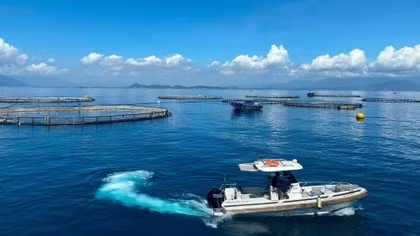
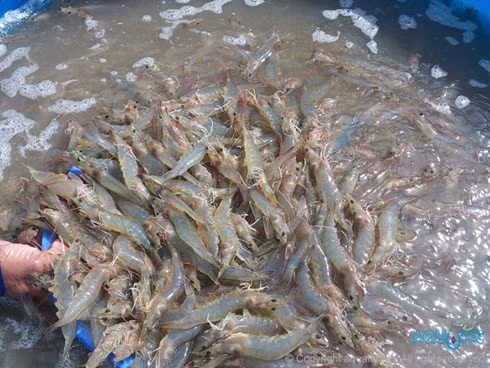
Intensive shrimp farms can hold a density of up to 220 shrimp per square metre, compared with only 180 for semi-intensive farms, resulting in an annual yield of 10 tons, versus 5 tons per hectare using the semi-intensive method.

If one were to run the math, annual gross revenues of US$10 billion from shrimp exports is very doable, said Minister Cuong.

The weather in the Mekong Delta is most suitable for shrimp and is the motivating factor in making the decision to transition away from rice. The current weather oscillations are just too much for rice.
VOV

Other News

SBV raises short-term capital lending cap to 40%

SBV raises short-term capital lending cap to 40%

The new circular will help credit institutions have more room to provide capital to businesses and investment projects to support high economic growth in the next few years, while increasing flexibility in the SBV’s monetary policy management.

Business confidence in Vietnam rebounds strongly: UOB

Business confidence in Vietnam rebounds strongly: UOB

The study found that 85% of Vietnamese enterprises reported positive business sentiment, a sharp increase from 48% in 2025, when business confidence was weighed down by uncertainties surrounding US tariff policies and related trade developments.

Bac Ninh seeks high-quality foreign investment for sustainable growth

Bac Ninh seeks high-quality foreign investment for sustainable growth

According to Vice Chairman of the provincial People’s Committee Pham Van Thinh, the province aims to maintain stable and sustainable growth, improve the competitiveness of both the economy and local businesses, and make better use of free trade agreements (FTAs) to expand and diversify export markets.

Green building trend flourishes in Ho Chi Minh City's real estate landscape

Green building trend flourishes in Ho Chi Minh City's real estate landscape

The International Finance Corporation (IFC) highlighted the city's dominance in green-certified building floor space in Vietnam, reflecting the rapid expansion of the green building market with 780 completed green buildings encompassing over 18.69 million sq.m by 2025, predominantly certified by EDGE and LEED.

UK supports Vietnam in wind power and green finance development

UK supports Vietnam in wind power and green finance development

The United Kingdom officially announced two new climate cooperation initiatives to support Vietnam in its energy transition and green growth journey. These programs focus on offshore wind power development and the creation of a sustainable green financial ecosystem.

Ample room remains for Vietnam–India logistics cooperation

Ample room remains for Vietnam–India logistics cooperation

The GTTCI expert noted that alongside logistics and integrated warehousing, e-commerce is expected to be a particularly high-growth sector in the coming years. He described it as a multi-billion-dollar market with significant untapped opportunities for cooperation between Vietnam and India.

Exports gain momentum from high-tech growth drivers

Exports gain momentum from high-tech growth drivers

According to the Ministry of Industry and Trade, Vietnam’s exports reached 215.66 billion USD in the first five months of 2026, up 19.5% year-on-year. Twenty-six export items generated more than 1 billion USD in revenue each, including seven with turnover exceeding 10 billion USD.

Vietnam–China crossings see spike in ASEAN fresh produce

Vietnam–China crossings see spike in ASEAN fresh produce

Since the start of the summer harvest season, China's two major border gates with Vietnam, Youyi Guan in Pingxiang and Beilun 2 Bridge in Dongxing, have entered their peak period for handling imports of fresh agricultural and seafood products from member states of the Association of Southeast Asian Nations (ASEAN).

Cargo handling operations at Berths 3 and 4 of the Hai Phong International Gateway Port. (Photo: VNA)

AI reshapes logistics, raising bar for workforce skills

According to the Vietnam Logistics Business Association (VLA), the logistics sector will require around 2.2 million workers by 2030, including 1.6 million employees for logistics service providers and nearly 600,000 personnel supporting logistics operations in manufacturing and trading enterprises.

Robust dispute resolution framework key to Vietnam's IFC ambitions

Robust dispute resolution framework key to Vietnam's IFC ambitions

The development strategy for VIFC-HCMC envisions a comprehensive financial ecosystem encompassing green finance, carbon credits, financial technology (fintech), blockchain technology, digital assets, digital banking and other innovative business models. These highly internationalised sectors involve complex cross-border transactions and sophisticated legal structures.