Vietnam has much to do to realise aspiration for prosperity: experts

There would be no success if no effort is made to renovate the mindset, actively build economic development methods, and reform mechanisms and policies, said Minister of Planning and Investment Nguyen Chi Dung.
At the event.
At the event. 

There would be no success if no effort is made to renovate the mindset, actively build economic development methods, and reform mechanisms and policies, said Minister of Planning and Investment Nguyen Chi Dung.

Addressing the opening ceremony of the Vietnam Reform and Development Forum (VRDF) 2019 under the theme “Vietnam: Aspiration for prosperity – Priorities and Actions” in Hanoi on September 19, Dung said that while realizing the aspiration for prosperity, overcoming the “middle income trap” alone is a considerable challenge for many developing countries, including Vietnam.

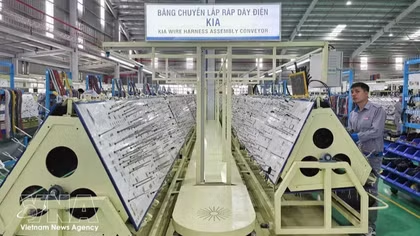
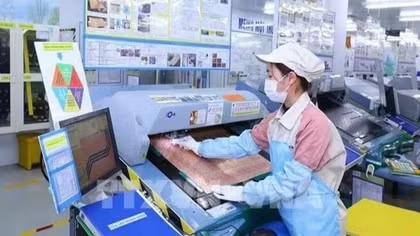
He noted that in line with the economic development trend of the global economy, Vietnam has renovated the economy and applied achievements of the Forth Industrial Revolution in various areas.

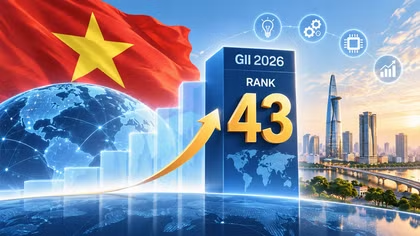
In 2019, the country leaped three positions in the Global Innovation Index (GII) from 2018 to rank 42 out of 129 countries, first among 26 countries with low middle income and third among ASEAN countries after Singapore and Malaysia, Dung said.

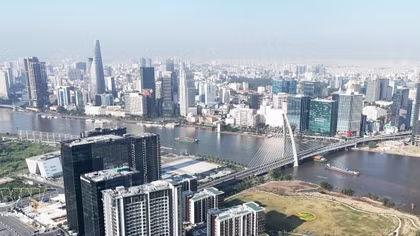
According to the minister, in the 2011-2018 period, Vietnam recorded an annual average gross domestic product (GDP) growth rate of over 6.2 percent. By the end of 2018, Vietnam’s GDP scale valued at over 250 billion USD, with per capita GDP reaching 2,600 USD.

Vietnam has become an attractive destination for foreign investors, with investment in the 2011-2018 period hitting more than 200 billion USD, he said.

However, Dung pointed out that the Vietnamese economy’s labor productivity and competitiveness remain low.

The minister said that in order to realize the aspiration for prosperity, Vietnam has built a draft strategy on socio-economic development for the 2021-2030 period which emphasizes the need to complete the process of turning the economy into a market economy with modern orientations and integration in line with international practice, while perfecting the legal framework for new business forms and digital economy.

Meanwhile, World Bank Country Director in Vietnam Ousmane Dione said that escalating trade tensions and technological changes are affecting Vietnam, adding that the country’s economic model of the country is also facing domestic challenges, including the aging population degradation in natural resources, modest human resources and risk of reduced productivity.

He stressed that breakthrough innovation is necessary for the country to grasp opportunities and mange risks in the future, adding that a well-designed socio-economic development strategy is also significant for Vietnam.

Sharing Malaysia’s experience to escape the middle income trap, K. Yogeesvara, former Deputy Minister of Plantation Industries and Commodities of Malaysia, said that during the period to rise into a high-income country, Malaysia faced challenges in the gap among regions in terms of income and quality of human resources.

He held that adequate investment in human resources development and the people will help get rid of the trap, along with balancing development among production and service sectors, and coping with rich-poor inequality.

Cao Viet Sinh, a senior economist, held that market economy mechanism has been incomprehensive and failed to meet requirements to promote the modern and integrated market economy.

David Dollar, a senior expert from the US-based Brookings Institute, held that the private sector of Vietnam has become backward due to weak access to credit and land. Vietnam should clarify areas for the State-owned sector and those for the private sector, thus creating a fair playground for both sides, he added.

Participants at the event recommended that Vietnam should make the domestic private sector the backbone of the economy, while optimizing renewable energy resources and targeting green production.

The country should focus on improving productivity, developing technology and artificial intelligence application, reforming the economic structure and completing the State system organization, they suggested.
VNA

Other News

SBV raises short-term capital lending cap to 40%

SBV raises short-term capital lending cap to 40%

The new circular will help credit institutions have more room to provide capital to businesses and investment projects to support high economic growth in the next few years, while increasing flexibility in the SBV’s monetary policy management.

Business confidence in Vietnam rebounds strongly: UOB

Business confidence in Vietnam rebounds strongly: UOB

The study found that 85% of Vietnamese enterprises reported positive business sentiment, a sharp increase from 48% in 2025, when business confidence was weighed down by uncertainties surrounding US tariff policies and related trade developments.

Bac Ninh seeks high-quality foreign investment for sustainable growth

Bac Ninh seeks high-quality foreign investment for sustainable growth

According to Vice Chairman of the provincial People’s Committee Pham Van Thinh, the province aims to maintain stable and sustainable growth, improve the competitiveness of both the economy and local businesses, and make better use of free trade agreements (FTAs) to expand and diversify export markets.

Green building trend flourishes in Ho Chi Minh City's real estate landscape

Green building trend flourishes in Ho Chi Minh City's real estate landscape

The International Finance Corporation (IFC) highlighted the city's dominance in green-certified building floor space in Vietnam, reflecting the rapid expansion of the green building market with 780 completed green buildings encompassing over 18.69 million sq.m by 2025, predominantly certified by EDGE and LEED.

UK supports Vietnam in wind power and green finance development

UK supports Vietnam in wind power and green finance development

The United Kingdom officially announced two new climate cooperation initiatives to support Vietnam in its energy transition and green growth journey. These programs focus on offshore wind power development and the creation of a sustainable green financial ecosystem.

Ample room remains for Vietnam–India logistics cooperation

Ample room remains for Vietnam–India logistics cooperation

The GTTCI expert noted that alongside logistics and integrated warehousing, e-commerce is expected to be a particularly high-growth sector in the coming years. He described it as a multi-billion-dollar market with significant untapped opportunities for cooperation between Vietnam and India.

Exports gain momentum from high-tech growth drivers

Exports gain momentum from high-tech growth drivers

According to the Ministry of Industry and Trade, Vietnam’s exports reached 215.66 billion USD in the first five months of 2026, up 19.5% year-on-year. Twenty-six export items generated more than 1 billion USD in revenue each, including seven with turnover exceeding 10 billion USD.

Vietnam–China crossings see spike in ASEAN fresh produce

Vietnam–China crossings see spike in ASEAN fresh produce

Since the start of the summer harvest season, China's two major border gates with Vietnam, Youyi Guan in Pingxiang and Beilun 2 Bridge in Dongxing, have entered their peak period for handling imports of fresh agricultural and seafood products from member states of the Association of Southeast Asian Nations (ASEAN).

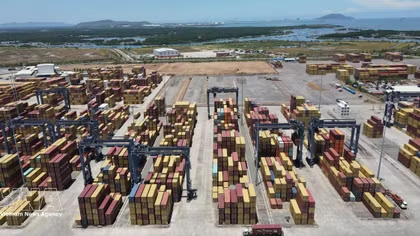
Cargo handling operations at Berths 3 and 4 of the Hai Phong International Gateway Port. (Photo: VNA)

AI reshapes logistics, raising bar for workforce skills

According to the Vietnam Logistics Business Association (VLA), the logistics sector will require around 2.2 million workers by 2030, including 1.6 million employees for logistics service providers and nearly 600,000 personnel supporting logistics operations in manufacturing and trading enterprises.

Robust dispute resolution framework key to Vietnam's IFC ambitions

Robust dispute resolution framework key to Vietnam's IFC ambitions

The development strategy for VIFC-HCMC envisions a comprehensive financial ecosystem encompassing green finance, carbon credits, financial technology (fintech), blockchain technology, digital assets, digital banking and other innovative business models. These highly internationalised sectors involve complex cross-border transactions and sophisticated legal structures.