Vietnam leaps up in Global Connectedness Index

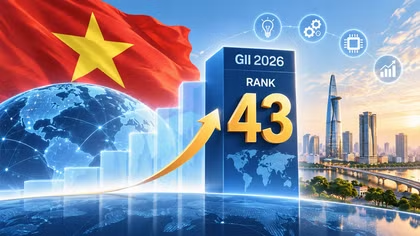
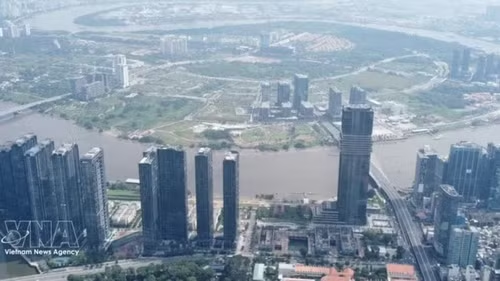
Vietnam ranked 38th out of 169 countries in DHL’s Global Connectedness Index 2020, a single place higher than in 2017.

Vietnam is a fast-rising star in global manufacturing

Vietnam is a fast-rising star in global manufacturing

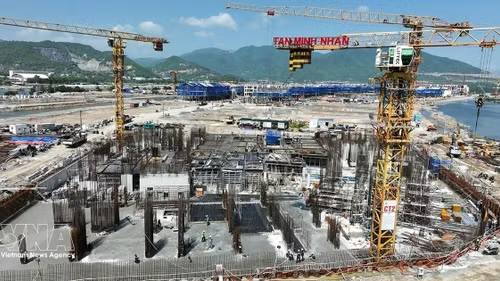
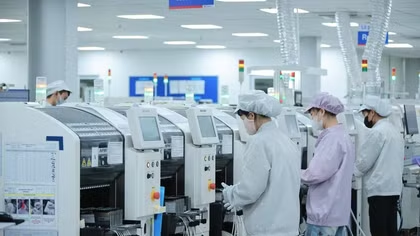
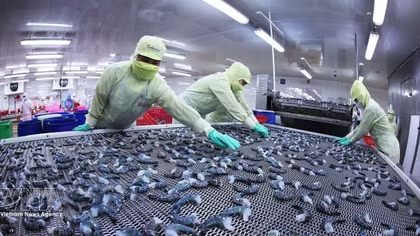
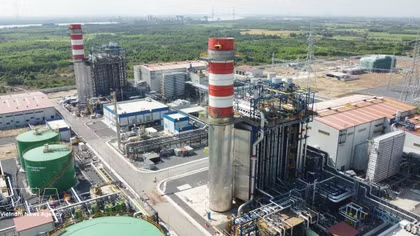
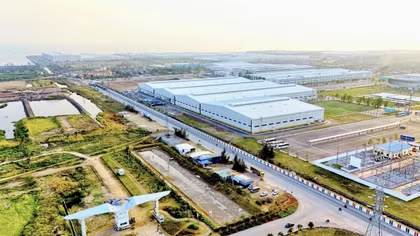
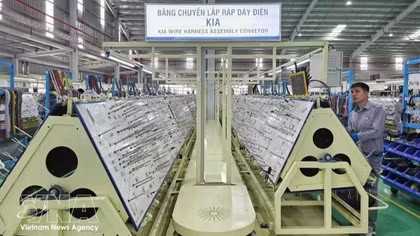
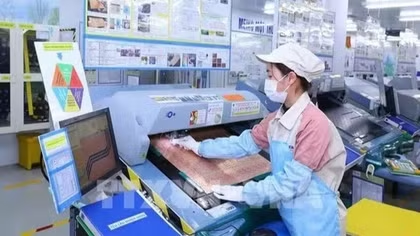
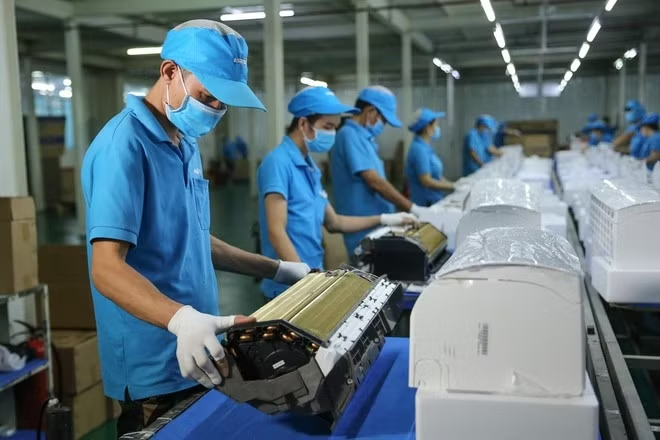
The latest index shows that the country is a fast-rising star in terms of global manufacturing, particularly as China is experiencing a fallout from its trade war with the United States, thereby allowing the Vietnamese market to welcome manufacturers keen to shift production away from the northern neighbour.

It scored its largest annual flow of foreign direct investment (FDI) in 2019 and gained greater attention as an alternative hub when COVID-19 served to disrupt several Chinese manufacturing systems and hit supply chains.

Vietnamese resilience to the negative impacts of the pandemic last year meant it was able to bounce back quickly. Indeed, the local economy expanded 2.9% last year and export value rose by 28.4% in the first half of this year in comparison to the same period from 2020, thereby making it a rare economic success story during the pandemic.

Even amid suffering its worst COVID-19 outbreak yet, the country is continuing to show signs of regaining its economic and manufacturing momentum.

IHS Markit’s Vietnam Manufacturing Purchasing Managers’ Index (PMI) for October rebounded to 52.1 in October after falling to 40.2 the previous month. Even as factories temporarily close due to lockdowns during the middle part of the year, total merchandise exports went up 21.8% for the first eight months of the year compared to 2020.

“Despite near-term risks, over the medium-term economic outlook, a large number of positive growth drivers are creating favorable tailwinds and will continue to underpin the rapid growth of Vietnam’s economy,” says Rajiv Biswas, executive director and chief economist for the Asia-Pacific region of IHS Markit’s, “This is expected to drive strong growth in Vietnam’s total GDP as well as per capita GDP.”

Cyn-Young Park, director for Regional Cooperation and Integration at the Asian Development Bank, pointed out that, “Even as investors may delay their decisions due to the current COVID-19 situation, Vietnam will continue to be a strong regional destination for investment, given the likely changes in the region’s value chain structures and the implementation of the Regional Comprehensive Economic Partnership (RCEP).”

Most notably, changes in Asia’s value chain include China’s shift away from low-cost production to products of higher value, such as robots and advanced semiconductors. This transition has contributed to drive up manufacturing wages, thereby making production hubs with lower labour costs and young workforces like Vietnam more attractive.

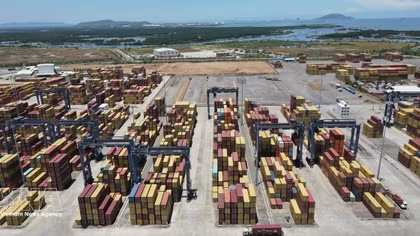
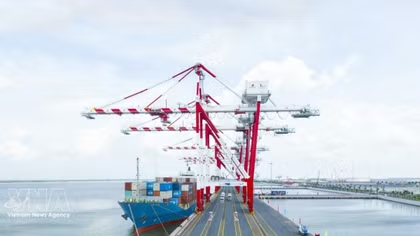
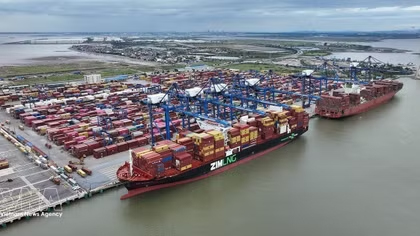
Moreover, the country’s close proximity to China and location along regional shipping routes also play to its advantage, meaning it is strongly connected internationally. 

The nation has also shown a marked improvement, similar to that of neighbouring countries such as Cambodia, Malaysia, and Singapore. With reforms being made to open up the economy over the past few decades pushing up Vietnamese GDP per capita from roughly US$500 in 1985 to its current status as a middle-income country with a GDP per capita of US$2,715.

These policies have served to boost international trade flows, meaning the nation has earned a high place on the Trade pillar of the Global Connectedness Index. By 2019, the country had entered into numerous trade agreements with countries that account for 67% of the global economy.

“A country must have large international trade flows relative to the size of its domestic economy, and international flows must be distributed across the world for it to be considered globally connected,” said Bernardo Bautista, managing director and country manager of DHL Express Vietnam.

VOV

Other News

Data-driven land valuation to curb speculation: Experts

Data-driven land valuation to curb speculation: Experts

From a property-market perspective, Do Thi Thu Giang, National Director of Valuation and Advisory at Savills Vietnam, said the orientations under Resolution No. 21-NQ/TW could make the market more transparent and efficient, with property values increasingly tied to actual development and use potential.

Resolution No. 19-NQ/TW sets new growth drivers for Vietnam

Resolution No. 19-NQ/TW sets new growth drivers for Vietnam

Science and technology, innovation, digital transformation and AI must be translated into higher productivity rather than pursued as ends in themselves. At the same time, people should be placed at the centre of development, not merely viewed as a resource but as the ultimate objective of development policies.

Expo to open door for Vietnamese suppliers to enter US market

Expo to open door for Vietnamese suppliers to enter US market

US retail giant Target is seeking Vietnamese suppliers of household goods, home textiles, children’s products, personal care and beauty products, with a focus on companies capable of manufacturing and developing products that meet requirements on quality, design and supply chain management.

2026 Banking Sector Digital Transformation to open in Hanoi

2026 Banking Sector Digital Transformation to open in Hanoi

The annual event, which will be held on August 18-19, 2026, at the ICE International Exhibition Centre, 91 Tran Hung Dao Street, Hanoi, is expected to attract around 324 delegates and feature 21 booths representing credit institutions, payment intermediary service providers, and technology companies.

Vietnam – one of most attractive destinations for leading US semiconductor companies: expert

Vietnam – one of most attractive destinations for leading US semiconductor companies: expert

Vietnam has built a solid semiconductor and electronics industry before joining ITSI, attracting major US semiconductor companies. Intel Products Vietnam is one of Intel's largest assembly and testing facilities worldwide, while chip design companies such as Synopsys, Cadence, Marvell and Qualcomm have established engineering and research centres in the Southeast Asian country.

Vietnam targets higher-quality FDI under Resolution 10

Vietnam targets higher-quality FDI under Resolution 10

During the first seven months of 2026, Vietnam attracted more than 38 billion USD in registered FDI, up nearly 58% year-on-year. More importantly, the increase was driven by large-scale, high-tech projects rather than a surge in the number of new investments, signalling a significant improvement in the quality of capital inflows.

Manufacturing, engineering drive hiring growth in H1: report

Manufacturing, engineering drive hiring growth in H1: report

Manufacturing and engineering posted the strongest recruitment growth, with hiring demand surging 70% year-on-year, driven by production expansion, supply chain restructuring and sustained investment inflows in high-tech manufacturing.

Government proposes special mechanisms to unblock APEC 2027 projects in Phu Quoc

Government proposes special mechanisms to unblock APEC 2027 projects in Phu Quoc

The projects in Phu Quoc have been implemented under tight deadlines. Since May 2025, the Prime Minister has directed preparations for APEC 2027, including accelerated infrastructure development on the special zone. An Giang province and investors have subsequently launched a number of major projects involving complex technical requirements and demanding construction schedules.

Financial market reform plan targets high, sustained growth through 2045

Financial market reform plan targets high, sustained growth through 2045

The plan seeks to develop a balanced and modern financial market that is closely integrated with regional and global markets, strengthens the mobilisation and allocation of domestic and foreign capital, and enhances the market’s role as a key provider of medium- and long-term capital for the economy and as a major driver of sustained high economic growth.

An Giang aims to become leading maritime economic hub

An Giang aims to become leading maritime economic hub

Under the province's master plan for 2021–2030 with a vision to 2050, An Giang will prioritise investment in five strategic sectors: strategic infrastructure; processing industries and clean energy; trade, services, logistics and border-gate economy; high-quality tourism; and high-tech agriculture, ecological development and the circular economy.