Vietnam posts trade deficit of US$1.47 billion over six-month period

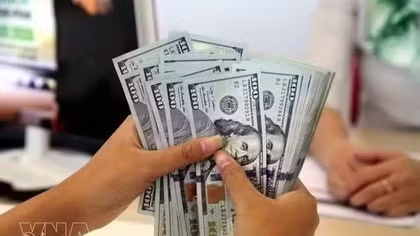
The nation recorded an estimated trade deficit of US$1.47 billion during the first half of the year, according to figures released by the Ministry of Industry and Trade (MoIT).

Vietnam posts trade deficit of US$1.47 billion over six-month period ảnh 1

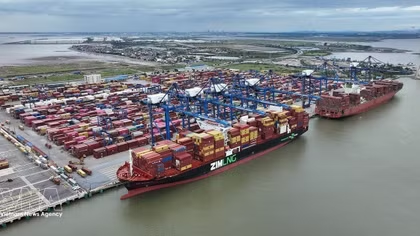
Statistics compiled by the MoIT indicate that the country raked in US$157.63 billion from exports, a rise of 28.4% compared to the same period from last year, with 25 items grossing an export turnover of over US$1 billion, accounting for 88.9% of total export turnover.

Furthermore, import turnover recorded a surge of 36.1% to US$159.1 billion during the reviewed period, marking a rise of 36.1%.

Tran Thanh Hai, deputy director of the MoIT’s Import-Export Department, revealed that the Vietnamese trade deficit in the first half of the year does not represent a worrying sign due to the figure being quite small, making up only 1% in comparison to export turnover.

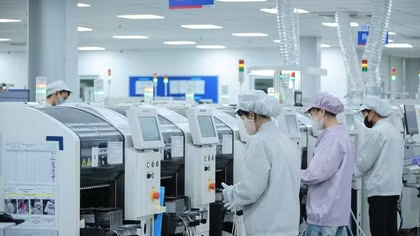
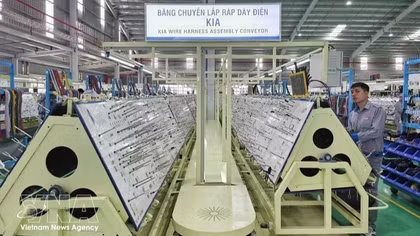
According to insiders, the impact of recent outbreaks of the COVID-19 pandemic in localities such as Bac Giang, Bac Ninh, Hanoi, and Ho Chi Minh City, have impacted the group of electronic goods, which represents the country’s key export items, thereby leading to a decline in production output.

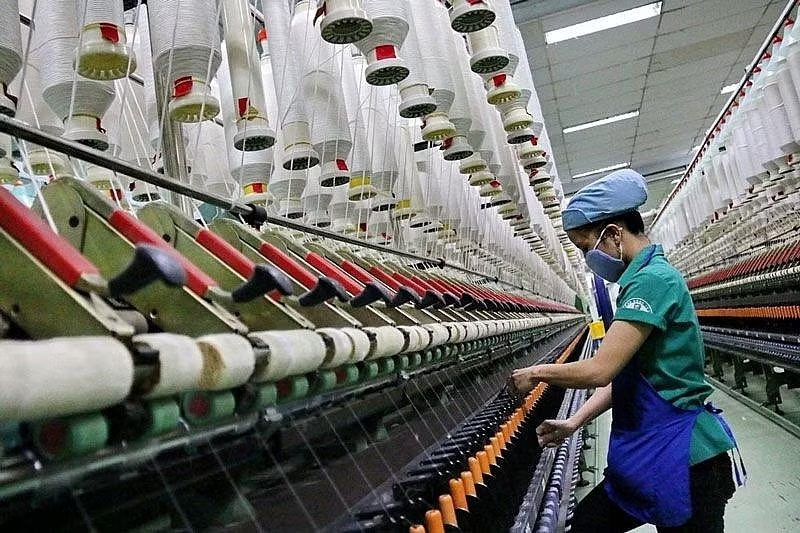
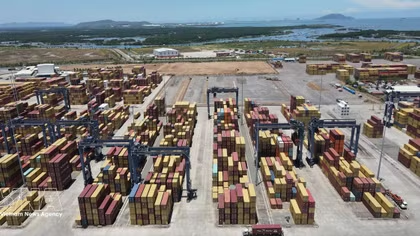
Moreover, the country has also been active in importing raw materials for textile, footwear, and wooden furniture sectors until the end of the year, a factor which has led to a rise in import turnover.

Upon sharing the same viewpoint, Dr. Le Quoc Phuong, former deputy director of the Industry and Trade Information Center, assessed that the Vietnamese trade deficit of 1% throughout the reviewed period is not a matter of great concern.

He went on to reveal that Vietnam represents a developing country and is on the pathway of industrialisation and modernisation which has led to a high demand for imports. Dr. Phuong noted that the Vietnamese economy has mainly relied on assembling and outsourcing which has resulted in an increase in the import of spare parts and raw materials.

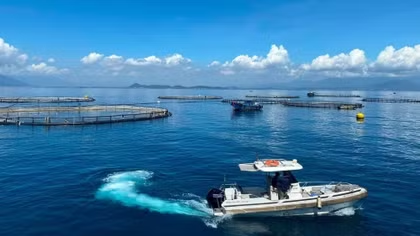
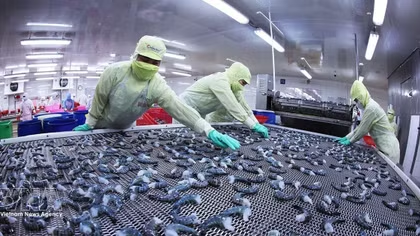
According to the MoIT, export activities have continued to record a high and sustainable growth rate due to exports of key items, such as electronics, textiles, footwear, machinery and equipment, and seafood, to major markets such as the United States, China, and the EU enjoying robust growth.

Recently, domestic enterprises have taken full advantage of opportunities presented by several bilateral and multilateral trade agreements.

Hai therefore expressed his hope that, providing the COVID-19 pandemic is swiftly brought under control over the next few months in the hardest hit localities, production activities can be restored and thrive over the remaining months of the year.

Economists have emphasised that import and export activities are anticipated to continue to prosper in the near future following the effective enforcement of free trade agreements (FTAs), especially new-generation FTAs such as the Comprehensive and Progressive Agreement for Trans-Pacific Partnership (CPTPP), the EU-Vietnam Free Trade Agreement (EVFTA) and the UK-Vietnam FTA (UKVFTA).

These FTAs are anticipated to create favourable conditions for Vietnamese goods to penetrate partner markets whilst enjoying preferential tariffs, thereby promoting greater export growth.

Local firms are advised to enhance their competitiveness and adaptability as a better way of overcoming difficulties, while devising new strategies to effectively seize upon opportunities in the new context.

VOV

Other News

Vietnam accelerates innovation to boost growth, competitiveness

Vietnam accelerates innovation to boost growth, competitiveness

By 2030, Vietnam aims to rank among the world’s top 40 in the GII; raise total social investment in R&D to at least 2% of GDP, with non-State funding accounting for over 60%; increase international scientific publications by an average of 10% annually; and raise the number of patent applications and granted patents by an average of 16-18% annually.

Vietnam sees high growth prospects

Vietnam sees high growth prospects

Experts from the Institute of Vietnam and World Economy under the Vietnam Academy of Social Sciences noted the quality of recent growth as the high growth rate has been recorded against an increasingly higher comparative base.

Vietnam seeks bigger share of global Halal market

Vietnam seeks bigger share of global Halal market

Vietnam's Halal exports remain modest at around 900 million USD a year, accounting for less than 1% of the global market. Most exports are still raw agricultural and seafood products. Only around 1,000–1,300 Vietnamese businesses obtained or maintained Halal certification during 2024–2026.

Hanoi sets up inter-agency mechanism to operate carbon market

Hanoi sets up inter-agency mechanism to operate carbon market

Under a decision of the municipal People’s Committee on establishing an inter-agency working group, departments and agencies are responsible for identifying facilities subject to greenhouse gas inventories, developing emissions-reduction plans and studying projects capable of generating carbon credits.

Shrimp exports reach 3.3 billion USD in eight months

Shrimp exports reach 3.3 billion USD in eight months

According to data from the Vietnam Customs cited by the Vietnam Association of Seafood Exporters and Producers (VASEP), shrimp exports reached 478.5 million USD in August, up 4.2% from the same month last year. The eight-month total stood at 3.3 billion USD, representing a year-on-year increase of 12%.

Russian investors explore opportunities in Vietnam's real estate market

Russian investors explore opportunities in Vietnam's real estate market

Vietnam is seen as a potential market, with considerable room for growth in real estate, particularly commercial property, compared with some regional markets. Strong Vietnam-Russia ties and opportunities to establish foreign-invested enterprises are also considered favourable for Russian investors.

Phu Quoc airport planning adjusted to serve APEC 2027

Phu Quoc airport planning adjusted to serve APEC 2027

For 2021-2030, the Civil Aviation Authority of Vietnam proposed bringing forward the investment in a parallel taxiway system and a connecting taxiway north of Runway No. 2 at Phu Quoc International Airport, in order to connect with the aircraft maintenance and repair facility (hangar) planned for the northern area of ​​the airport.

Policy, infrastructure emerge as new advantages in FDI attraction

Policy, infrastructure emerge as new advantages in FDI attraction

From policy and infrastructure to industrial real estate, Vietnam’s FDI advantages are broadening towards a more integrated production ecosystem, offering investors a stronger combination of conditions for high-value, technology-intensive and long-term projects.

Logistics upgrade vital to 1-trillion-USD trade target: experts

Logistics upgrade vital to 1-trillion-USD trade target: experts

As trade expands, systemic bottlenecks across transport networks, warehousing, ports, border gates, and industrial zones are becoming more apparent. Experts emphasise the need to shift from a fragmented, project-by-project approach toward strategic management structured around trade corridors and integrated supply chains.

Ample room for Vietnam, US to deepen cooperation

Ample room for Vietnam, US to deepen cooperation

Do Ngoc Hung, Trade Counsellor and head of the Vietnam Trade Office in the US, said what stands out is not only the growth in trade volume but also the increasingly deep economic ties between the two countries.

Flexible fiscal policy helps drive economic growth

Flexible fiscal policy helps drive economic growth

According to the Ministry of Finance, State budget revenue in the first eight months of 2026 was estimated at 2.02 quadrillion VND (77.7 billion USD), equivalent to 80% of the annual estimate and up 16% year-on-year. Domestic revenue reached 1.75 quadrillion VND, accounting for 86.6% of total revenue and rising 16.6%.

Electronic components are produced at a factory in Hanoi. (Photo: VNA)

Hanoi's imports surge 41% in first eight months of 2026

Hanoi aims to achieve average annual export growth of at least 12% during 2026-30, with the city seeking to diversify export markets, boost high-tech and value-added products and reduce reliance on traditional markets.