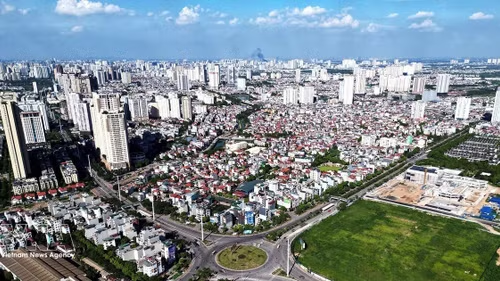
Vietnam and Singapore will expand cooperation in innovation and technology – a new area in the bilateral economic partnership that was recommended at the 14th ministerial meeting on economic connectivity between the two countries.

Vietnamese Minister of Planning and Investment Nguyen Chi Dung and Singaporean Minister for Trade and Industry Chan Chun Sing co-chaired the event in Singapore on March 13.
The two ministers agreed that aside from the six prior areas of cooperation, Vietnam and Singapore will add innovation and technology as the seventh field of collaboration as a priority in the context of the Fourth Industrial Revolution (Industry 4.0).
The two countries will develop action plans with the implementation of specific joint projects.
The Singaporean side suggested reforming cooperation in education and training associated with technology. Specifically, Singapore will provide 50-100 scholarships for outstanding Vietnamese students to study at its leading technology universities.
The two sides also reviewed the outcomes of bilateral cooperation in six fields raised at the 13th meeting in Hanoi in October 2017, namely finance, education and training, transportation, information technology and communications, investment, trade, and services.
They affirmed that economic partnership is one of the key pillars to promote and further deepen the strategic partnership between Vietnam and Singapore.
Vietnam asked Singapore to join efforts to implement new initiatives in the agreement on economic connectivity and encourage Singaporean businesses to put forth new cooperation proposals and increase investment in Vietnam.
Earlier, on March 12, at a conference in Singapore, Minister Dung introduced the National Innovation Centre (NIC) and called for investment in Industry 4.0 projects.
He said the centre is expected to push the transformation of Vietnam’s economic growth, prioritising the spheres of smart factory, digital economy, cyber security, urban area, and environmental technology.
At the conference, the ministry’s Department of Science, Education, Natural Resources, and Environment signed a memorandum of understanding with the Singapore Manufacturing Federation (SMF) to enhance business and project opportunities in high-tech parks with SMF member companies and businesses to promote innovation and entrepreneurship ecosystems in Vietnam.
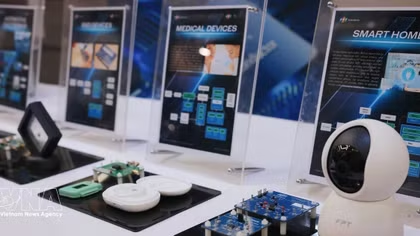
Vietnam should give priority to areas where it has potential to build strengths, particularly manufacturing and packaging.
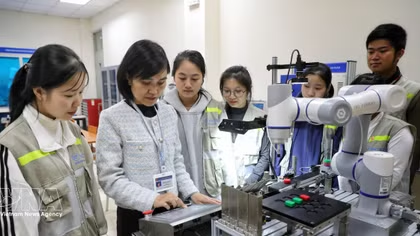
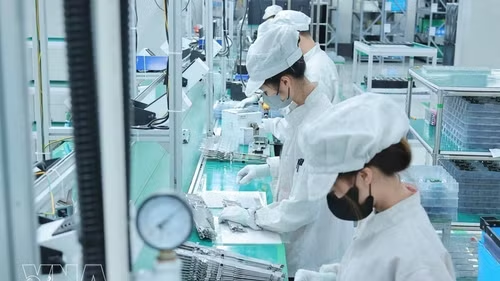
Vietnam has built a solid semiconductor and electronics industry before joining ITSI, attracting major US semiconductor companies. Intel Products Vietnam is one of Intel's largest assembly and testing facilities worldwide, while chip design companies such as Synopsys, Cadence, Marvell and Qualcomm have established engineering and research centres in the Southeast Asian country.
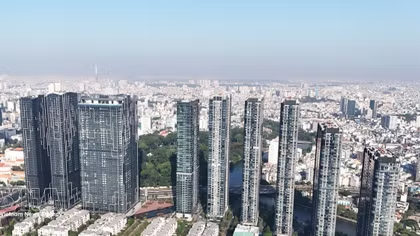
According to the Ministry of Construction, Vietnam has around 2,500 old apartment blocks and collective housing complexes built before 1994, covering about 3 million square metres of floor space, mainly in Hanoi and Ho Chi Minh City. Of these, around 196 have been classified as severely deteriorated and unsafe.
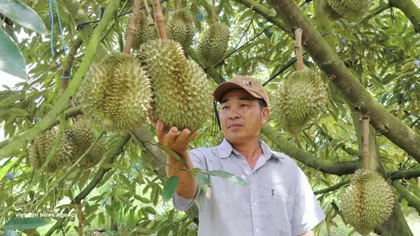
Durian exports reached nearly 1.1 billion USD in the first six months of 2026, up 32% year-on-year. The industry's strongest export season, however, is still ahead.
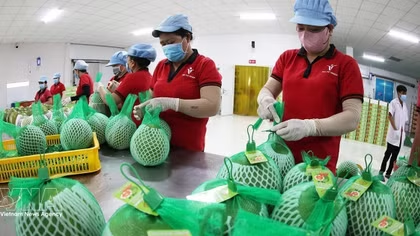
The country's agro-forestry-aquatic product exports reached nearly 42.8 billion USD in the January–July period, up 7.5% year-on-year and equivalent to almost 60% of the annual target of 74 billion USD.
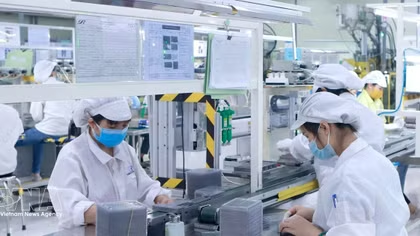
During the first seven months of 2026, Vietnam attracted more than 38 billion USD in registered FDI, up nearly 58% year-on-year. More importantly, the increase was driven by large-scale, high-tech projects rather than a surge in the number of new investments, signalling a significant improvement in the quality of capital inflows.
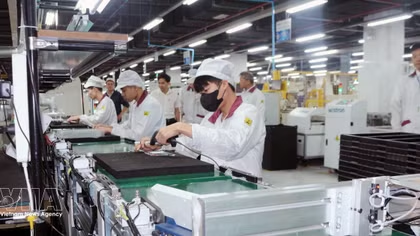
Manufacturing and engineering posted the strongest recruitment growth, with hiring demand surging 70% year-on-year, driven by production expansion, supply chain restructuring and sustained investment inflows in high-tech manufacturing.
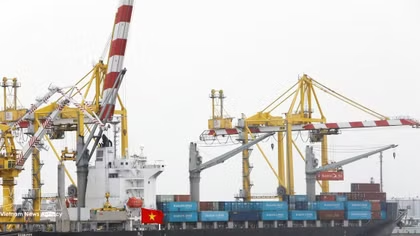
Vietnam's total import-export turnover reached 659.58 billion USD in the first seven months of 2026, up 28.1% year-on-year.
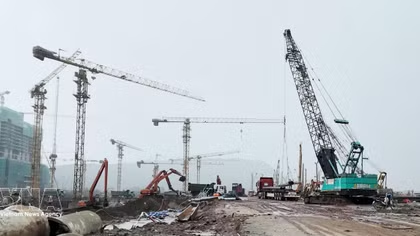
The projects in Phu Quoc have been implemented under tight deadlines. Since May 2025, the Prime Minister has directed preparations for APEC 2027, including accelerated infrastructure development on the special zone. An Giang province and investors have subsequently launched a number of major projects involving complex technical requirements and demanding construction schedules.
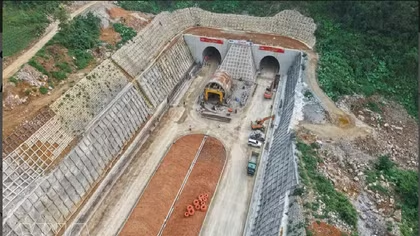
The NSO also reported that realised FDI reached an estimated 15.2 billion USD during the January-July period, an increase of 11.8% from a year earlier and the highest seven-month disbursement recorded over the past five years.
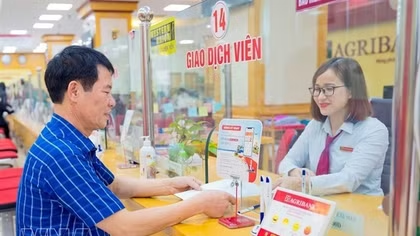
Household deposits at banks reached a new high of 10.8 quadrillion VND (414 billion USD) at the end of May, up more than 108 trillion VND from April and increasing by 4.76% from the beginning of the year, equivalent to nearly 492 trillion VND.
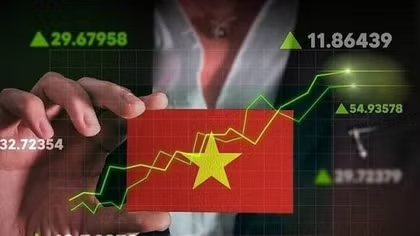
The plan seeks to develop a balanced and modern financial market that is closely integrated with regional and global markets, strengthens the mobilisation and allocation of domestic and foreign capital, and enhances the market’s role as a key provider of medium- and long-term capital for the economy and as a major driver of sustained high economic growth.

Under the province's master plan for 2021–2030 with a vision to 2050, An Giang will prioritise investment in five strategic sectors: strategic infrastructure; processing industries and clean energy; trade, services, logistics and border-gate economy; high-quality tourism; and high-tech agriculture, ecological development and the circular economy.
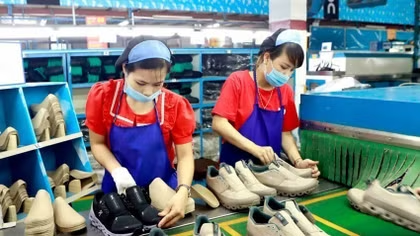
According to the VCCI, these measures are not only necessary for managing potential risks arising from US trade actions but also crucial to enhancing competitiveness and meeting growing international expectations on compliance, product origin, quality and transparency.
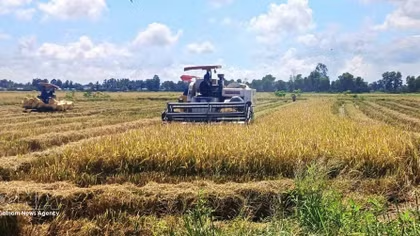
Businesses say the biggest obstacle to reducing emissions and transforming production models remains the lack of financial resources needed to upgrade technologies, modernise production lines and build governance systems that comply with global sustainability standards.
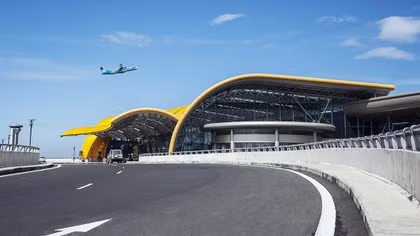
Once operations stabilise, Lien Khuong International Airport in the Central Highlands province of Lam Dong is projected to serve approximately 6,800 passengers a day, nearly 1,000 more than before its temporary closure. Passenger throughput during the final four months of 2026 is forecast to reach around 816,000.

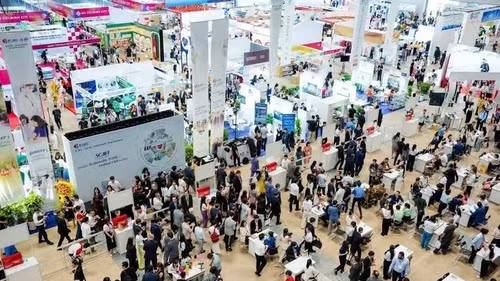
The growing number of international retailers and importers choosing Ho Chi Minh City as a sourcing destination underscores the city's transformation from a trade promotion venue into a regional procurement hub.
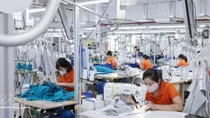
The PM called on the business community, business associations and the Vietnam Chamber of Commerce and Industry (VCCI) to strengthen self-reliance, innovation and competitiveness by improving governance, adopting advanced technologies, enhancing product quality and using capital more efficiently.
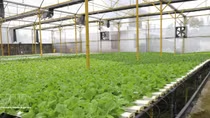
Under Decree No. 263/2026/ND-CP, qualified projects are given priority to participate in State support programmes as well as funds and policies on research and development, technological innovation, technology transfer, human resource training, investment promotion and trade promotion.
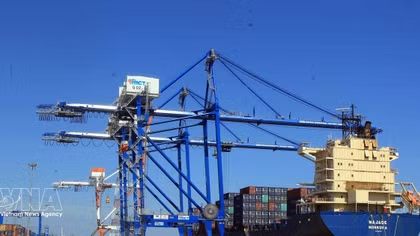
In its latest economic outlook report, Standard Chartered said the adjustment follows Vietnam’s positive economic performance in the first half of the year, with growth drivers continuing to gain momentum.