 |
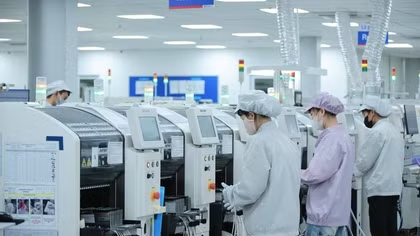
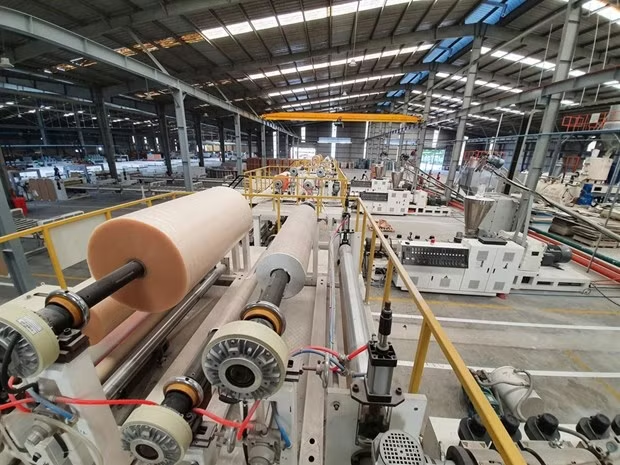
| Inside a floor tile manufacturing of Hoang Gia Investment and Trading Joint Stock Company. — Photo courtesy of the company |
Vietnam is entering a level playing field in which efficient solutions to maintain economic development always causes headaches for experts and business leaders.
Data released by the General Statistics Office recently showed that Vietnam’s 10-year consecutive export growth declined in the first half of this year, with only 238.4 billion USD in value, down 2.1 percent year-on-year.
However, there are several bright spots, including the export turnover of goods to the US reaching 30.3 billion USD, up more than 10 percent.
The US was still Vietnam’s largest export market in the first half of this year, outstripping China at 19.5 billion USD.
Talking about exports to the US, a market of more than 300 million people and the highest purchasing power and expenditure in the world, Dinh Viet Anh, Chairman of Hoang Gia Investment and Trading Joint Stock Company – the second largest manufacturer of floor tiles in Vietnam – said people in the US people change the interior of their houses whenever they change tenants. They are also likely to renovate their own houses after a few years.
“Therefore, the consumption of materials in the US market usually ranks first in the world,” Anh said.
Anh said this is one of the reasons that Royal Crystal Joint Stock Company, a joint venture between Hoang Gia and Crystal Plastic Manufacturing and Technology Joint Stock Company (PLP) – a listed company on HOSE – decided to pour capital into the production of SPC plastic bricks, with export-oriented focus on the US.
PLP currently owns a quarry in the central province of Nghe An with reserves of more than five million tonnes of PVC, a plastic material.
Plastic bricks have just appeared on the world market in the last two years with a core layer of calcium carbonate (CaCO3) stone powder.
In the US market, this material has accounted for 50 percent of the flooring market share, reaching an unexpected growth rate for the material distributors.
According to Chairman of FPT Corporation Truong Gia Binh, the domestic market with nearly 100 million people is important, but Vietnamese businesses can only grow if they reach out.
In the first five months of this year, while FPT’s domestic revenue sharply decreased compared with the same period last year, its foreign market still maintained growth, with 20 percent in the EU, 18 percent in the US and 15 percent in Japan.
Economic expert Phan Van Truong, a trade advisor to the French Government, said to help Vietnamese businesses reach out to the global market, it needed a strategy supported by the Government at the national level.
In the field of international trade, Truong said most advanced countries have their economic and trade counsellor teams located in the embassies in the host country. These people, most of them technical or commercial specialists, rather than administrative officials, help every citizen of their homeland who wish to export to the host country, providing them with full of information, facts, statistics, contacts, as well as historical and geographical knowledge for quick success.
“Even with that information, there is the stage of market analysis, competitors, prices, and directories of intermediaries or distributors,” Truong said.
“Many countries also have safe trade insurance mechanisms for businesses who want to export. And yet, their banking system is very popular in foreign countries – this is a very beneficial stage for export businesses because the bank is an effective support point,” he added.
It is difficult to rely on support policies, so many businesses have decided to list on the stock market, taking advantage of opportunities to mobilise investment capital in the global market.
Vicostone Joint Stock Company, an affiliate of Phenikaa Group, is one firm that has shifted its strategy from production of normal products to luxury ones, and from domestic consumption to exports.
Success in the international market has brought Vicostone to the top four largest artificial stone manufacturers in the world, joining the club of listed companies with trillions of dong in profit.
Many others including Vingroup, Hoa Phat, Vinh Hoan, Viglacera and FPT have increasingly expanded production with big investment thanks to the mobilisation of capital through the stock market. This is also the core value for businesses to attract more investors.
Truong said Vietnamese businesses need a mindset to create more value and more profits. “If you want a sustainable profit policy, there is only one roadmap: rapid technological change, adding value and quality.”
Ho Xuan Nang, Vicostone's Chairman, said that R&D is a mandatory condition to ensure sustainable development and growth. Without R&D, enterprises, no matter how successful, can only be a short-term business.
“However, in order to do effective R&D, businesses must have determination, vision, and long-term financial and human resources,” Nang said.
Chairman of PLP, Mai Thanh Phuong said after more than two years of investment in R&D with support from the country’s leading professors and doctors, the company has mastered the formula of mixing CaCO3 stone and additives, conducting technology in the creation of the core layer of SPC bricks.
“We will continue investing in R&D to improve labour efficiency, creating differentiated products with competitive advantages and high added value,” Phuong said.
Economic expert Truong said Vietnamese businesses do not lack ambitions and aspirations.
“It is important that we must further disseminate the spirit of going abroad, encouraging and providing them with an effective export policy, a robust and organised personnel and information, as well as a competitive tax code.”
“Then we will see how dynamic and effective Vietnamese businesspeople are,” Truong said.