Vietnamese coffee chains ready to take on global giants

Competition is brewing among local and international coffee players.

Vietnam - known for its deep-rooted coffee culture - has become one of the most diverse markets in Asia for the uplifting beverage, with scores of global giants, local chains and small cafes severing a wide variety of freshly roasted beans.

Domestic chains are competing well against international brands including coffee giant Starbucks, which has opened 24 outlets across Vietnam since its debut in the country four years ago.
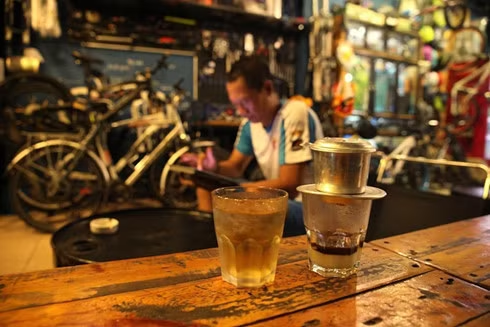
Many Vietnamese can’t survive a day without a few shots of "ca phe sua da", Vietnamese style iced coffee with concentrated milk. Photo by VnExpress

Not long after Starbucks entered Ho Chi Minh City, the country’s southern business hub where people drink coffee from sunrise to sundown, local chain Phuc Long stepped up its game and presented a direct challenge to the global giant.

At a main intersection at the heart of the city, a Starbucks shop is under fierce competition from two Phuc Long stores just a few steps away.

Phuc Long has shown a determined attempt to take on international brands like Starbucks by building up its presence in busy downtown areas across Ho Chi Minh City that are densely crowded with office buildings and shopping malls.

Where there's a Starbucks outlet, there’s a Phuc Long store to draw in those who otherwise would be Starbucks clients, mostly upper- middle class consumers willing to pay a few extra bucks for a cup of premium-branded coffee.

“We are not overwhelmed by international brands as we have targeted young consumers who enjoy international products at reasonable prices,” said a Phuc Long executive.

Phuc Long is definitely not the only local coffee chain going head-to-head with foreign players.

A survey conducted by Financial Times Confidential Research of 1,000 consumers in each of the five biggest economies in Southeast Asia found that Vietnam was the only country where Starbucks was not as frequently visited by local coffee lovers as local brands Trung Nguyen and Highlands Coffee.

There remains far more growth potential, with more homegrown chains entering the market.

Saigon Café opened its first shop in July last year. Since then the domestic chain has reportedly invested about US$50 billion (US$2.2 million), excluding rental costs, in 10 outlets across the city.

“Despite increasingly fierce rivalry from international brands, we started generating a net profit not long after our first store opened,” said a Saigon Café executive. “Currently, each outlet is reporting monthly revenues of VND1.5 billion on average. Our estimate is that net profit can range between 20% and 25%.”

Despite the fact international coffee chains such as Starbucks and The Coffee Bean & Tea Leaf have been well received in the Southeast Asian country, there has been a surge in the establishment of homegrown brands.

On one hand, local coffee chains are confident that locals will stick to the strong taste of Vietnamese coffee. On the other, they have been responsive to the demands of a growing upper-middle class urban population who are more interested in sampling the ambiance of the store than the taste of coffee.

According to Euromonitor International, a UK-based market research organization, annual growth of coffee franchises in Vietnam is currently standing at 7%.
VnExpress

Other News

Data-driven land valuation to curb speculation: Experts

Data-driven land valuation to curb speculation: Experts

From a property-market perspective, Do Thi Thu Giang, National Director of Valuation and Advisory at Savills Vietnam, said the orientations under Resolution No. 21-NQ/TW could make the market more transparent and efficient, with property values increasingly tied to actual development and use potential.

Resolution No. 19-NQ/TW sets new growth drivers for Vietnam

Resolution No. 19-NQ/TW sets new growth drivers for Vietnam

Science and technology, innovation, digital transformation and AI must be translated into higher productivity rather than pursued as ends in themselves. At the same time, people should be placed at the centre of development, not merely viewed as a resource but as the ultimate objective of development policies.

Expo to open door for Vietnamese suppliers to enter US market

Expo to open door for Vietnamese suppliers to enter US market

US retail giant Target is seeking Vietnamese suppliers of household goods, home textiles, children’s products, personal care and beauty products, with a focus on companies capable of manufacturing and developing products that meet requirements on quality, design and supply chain management.

2026 Banking Sector Digital Transformation to open in Hanoi

2026 Banking Sector Digital Transformation to open in Hanoi

The annual event, which will be held on August 18-19, 2026, at the ICE International Exhibition Centre, 91 Tran Hung Dao Street, Hanoi, is expected to attract around 324 delegates and feature 21 booths representing credit institutions, payment intermediary service providers, and technology companies.

Vietnam – one of most attractive destinations for leading US semiconductor companies: expert

Vietnam – one of most attractive destinations for leading US semiconductor companies: expert

Vietnam has built a solid semiconductor and electronics industry before joining ITSI, attracting major US semiconductor companies. Intel Products Vietnam is one of Intel's largest assembly and testing facilities worldwide, while chip design companies such as Synopsys, Cadence, Marvell and Qualcomm have established engineering and research centres in the Southeast Asian country.

Vietnam targets higher-quality FDI under Resolution 10

Vietnam targets higher-quality FDI under Resolution 10

During the first seven months of 2026, Vietnam attracted more than 38 billion USD in registered FDI, up nearly 58% year-on-year. More importantly, the increase was driven by large-scale, high-tech projects rather than a surge in the number of new investments, signalling a significant improvement in the quality of capital inflows.

Manufacturing, engineering drive hiring growth in H1: report

Manufacturing, engineering drive hiring growth in H1: report

Manufacturing and engineering posted the strongest recruitment growth, with hiring demand surging 70% year-on-year, driven by production expansion, supply chain restructuring and sustained investment inflows in high-tech manufacturing.

Government proposes special mechanisms to unblock APEC 2027 projects in Phu Quoc

Government proposes special mechanisms to unblock APEC 2027 projects in Phu Quoc

The projects in Phu Quoc have been implemented under tight deadlines. Since May 2025, the Prime Minister has directed preparations for APEC 2027, including accelerated infrastructure development on the special zone. An Giang province and investors have subsequently launched a number of major projects involving complex technical requirements and demanding construction schedules.

Financial market reform plan targets high, sustained growth through 2045

Financial market reform plan targets high, sustained growth through 2045

The plan seeks to develop a balanced and modern financial market that is closely integrated with regional and global markets, strengthens the mobilisation and allocation of domestic and foreign capital, and enhances the market’s role as a key provider of medium- and long-term capital for the economy and as a major driver of sustained high economic growth.

An Giang aims to become leading maritime economic hub

An Giang aims to become leading maritime economic hub

Under the province's master plan for 2021–2030 with a vision to 2050, An Giang will prioritise investment in five strategic sectors: strategic infrastructure; processing industries and clean energy; trade, services, logistics and border-gate economy; high-quality tourism; and high-tech agriculture, ecological development and the circular economy.