Vietnamese enterprises make the most of EVFTA

The Vietnam-EU Free Trade Agreement (EVFTA), a new-generation free trade agreement between Vietnam and 28 EU member countries, and the Comprehensive and Progressive Trans-Pacific Partnership Agreement (CPTPP) are two FTAs with the broadest scope and the highest level of commitment Vietnam has ever signed.
vietnamese enterprises make the most of evfta hinh 0

The deal offers Vietnamese businesses opportunities to increase and boost their growth but poses an urgent need to outline proper business strategies to fully tap the new opportunities.

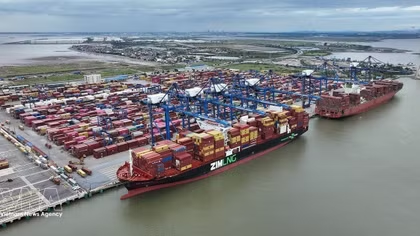
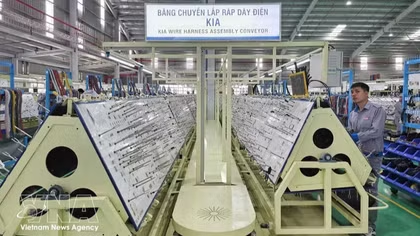
The EVFTA creates opportunity for Vietnamese enterprises to boost exports to potential markets and import equipment and materials of high quality at low prices. But domestic businesses must meet the regulations on origin and technical barriers, and change production models in order to improve competitiveness. 

Vu Tien Loc, Chairman of the Vietnam Chamber of Commerce and Industry (VCCI), said “Domestic businesses should re-orient their markets based on the new integration map in which we have defined with the most favorable tariffs. Vietnamese businesses must satisfy the standards set by these markets. Based on the market re-orientation plans, they should diversify to avoid potential risks.”

Under the EVFTA, 99% of tariffs will be eliminated. As soon as the trade deal comes into effect, many items will even enjoy a tax rate of zero.

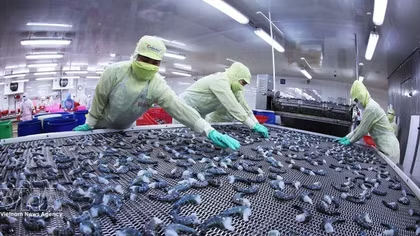
Agricultural products including seafood, rice, sugar, honey, and vegetables, are expected to benefit from the new export opportunities. But the deal will also require Vietnamese enterprises to strictly control the quality from the beginning to ensure the export regulations and standards are being met.

The EU is currently Vietnam’s second largest garment and textile market after the US with an annual growth between 7% and 10%. Last year Vietnam earned 4 billion USD from textiles and garment exports to the EU.

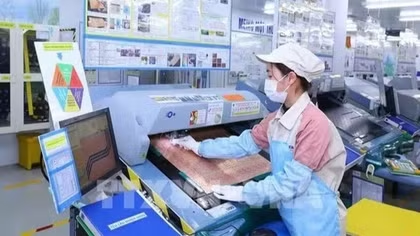
Phi Ngoc Trinh, Director General of the Ho Guom Garment Joint Stock Company, said the industry expects to see an export growth of 40 billion USD when the EVFTA takes effect. But Vietnam will face fiercer competition from foreign and FDI enterprises, and from the domestic market as well.

Trinh said “Once the EVFTA is approved, Vietnamese enterprises and the garment and textile industry in particular will have new opportunities to increase export to the European market. At that time, Vietnam’s garment and textile products will enjoy a tax rate of almost 0% against the current average rate of 9.6%. During the approval period, Vietnamese textile and apparel enterprises need to raise their competitiveness, attract workers, and improve standards to meet the EU’s quality control.”

Nguyen Hai Minh, Vice Chairman of Eurocham Vietnam, said “The textile, leather and footwear industries will benefit most from the EVFTA. But Vietnamese enterprises must pay special attention to the principles regarding origin of materials which include favorable provisions for Vietnamese enterprises.

These include the principle which states that if Vietnamese garment and textile enterprises use the fabrics made in Vietnam or in countries that sign trade deals with the EU such as the Republic of Korea, Vietnamese products can enjoy the tax incentives. This will help Vietnamese enterprises change their production model and become more attentive to the origin of materials.”

Vietnamese enterprises should study the agreement thoroughly to take advantages of opportunities created by new trade deals and keep updated as to the information on the tariff reduction schedule set by the EU and Vietnam.

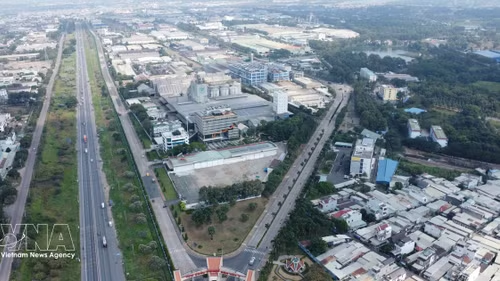
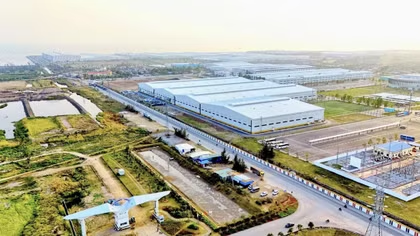
Through professional associations, domestic enterprises should strengthen cooperation with industrial clusters to make the most of the socio-technical infrastructure, save on logistics costs, improve product quality, and lower product costs to increase competitiveness in demanding markets like the EU.
VNA

Other News

Vietnam – one of most attractive destinations for leading US semiconductor companies: expert

Vietnam – one of most attractive destinations for leading US semiconductor companies: expert

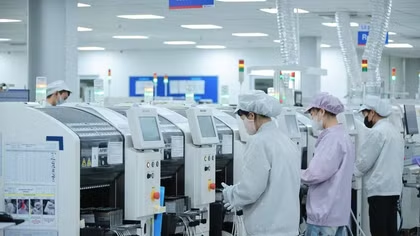
Vietnam has built a solid semiconductor and electronics industry before joining ITSI, attracting major US semiconductor companies. Intel Products Vietnam is one of Intel's largest assembly and testing facilities worldwide, while chip design companies such as Synopsys, Cadence, Marvell and Qualcomm have established engineering and research centres in the Southeast Asian country.

Vietnam targets higher-quality FDI under Resolution 10

Vietnam targets higher-quality FDI under Resolution 10

During the first seven months of 2026, Vietnam attracted more than 38 billion USD in registered FDI, up nearly 58% year-on-year. More importantly, the increase was driven by large-scale, high-tech projects rather than a surge in the number of new investments, signalling a significant improvement in the quality of capital inflows.

Manufacturing, engineering drive hiring growth in H1: report

Manufacturing, engineering drive hiring growth in H1: report

Manufacturing and engineering posted the strongest recruitment growth, with hiring demand surging 70% year-on-year, driven by production expansion, supply chain restructuring and sustained investment inflows in high-tech manufacturing.

Government proposes special mechanisms to unblock APEC 2027 projects in Phu Quoc

Government proposes special mechanisms to unblock APEC 2027 projects in Phu Quoc

The projects in Phu Quoc have been implemented under tight deadlines. Since May 2025, the Prime Minister has directed preparations for APEC 2027, including accelerated infrastructure development on the special zone. An Giang province and investors have subsequently launched a number of major projects involving complex technical requirements and demanding construction schedules.

Financial market reform plan targets high, sustained growth through 2045

Financial market reform plan targets high, sustained growth through 2045

The plan seeks to develop a balanced and modern financial market that is closely integrated with regional and global markets, strengthens the mobilisation and allocation of domestic and foreign capital, and enhances the market’s role as a key provider of medium- and long-term capital for the economy and as a major driver of sustained high economic growth.

An Giang aims to become leading maritime economic hub

An Giang aims to become leading maritime economic hub

Under the province's master plan for 2021–2030 with a vision to 2050, An Giang will prioritise investment in five strategic sectors: strategic infrastructure; processing industries and clean energy; trade, services, logistics and border-gate economy; high-quality tourism; and high-tech agriculture, ecological development and the circular economy.

Lien Khuong International Airport set to reopen on August 19

Lien Khuong International Airport set to reopen on August 19

Once operations stabilise, Lien Khuong International Airport in the Central Highlands province of Lam Dong is projected to serve approximately 6,800 passengers a day, nearly 1,000 more than before its temporary closure. Passenger throughput during the final four months of 2026 is forecast to reach around 816,000.

Global buyers turn to Ho Chi Minh City for sourcing

Global buyers turn to Ho Chi Minh City for sourcing

The growing number of international retailers and importers choosing Ho Chi Minh City as a sourcing destination underscores the city's transformation from a trade promotion venue into a regional procurement hub.

PM's conclusions set to clear bottlenecks, spur corporate growth

PM's conclusions set to clear bottlenecks, spur corporate growth

The PM called on the business community, business associations and the Vietnam Chamber of Commerce and Industry (VCCI) to strengthen self-reliance, innovation and competitiveness by improving governance, adopting advanced technologies, enhancing product quality and using capital more efficiently.

Incentive policies for high-tech agricultural zones

Incentive policies for high-tech agricultural zones

Under Decree No. 263/2026/ND-CP, qualified projects are given priority to participate in State support programmes as well as funds and policies on research and development, technological innovation, technology transfer, human resource training, investment promotion and trade promotion.