Vietnamese workers warned of ‘robot threat’

Millions of textile & garment and footwear workers could be replaced with robots in the future.

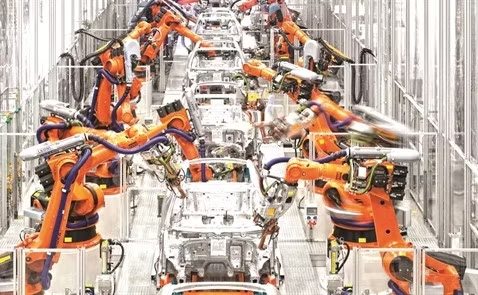
Robots are already being used at the 20-hectare Vinamilk actory in Binh Duong province. There are 19 robots and several workers. Everything runs on an automation process. Some robots carry packs to the filling room, while others take finished products to the storehouse.

When robots begin to lose power, they automatically go to the battery charging area, where they install full batteries without the assistance of workers.

Nguyen Chien Thang, director of Scan Pacific, an interior product manufacturer, who has received more orders from foreign partners in recent years, has decided to equip his newly built factory with an automated production line, which would help increase productivity by 4-5 times.

Other large furniture companies in Binh Duong have also spent money on automation technology. A representative of Vi Dai, a supplier of machines and equipment, said the company’s sales increased by 50% in 2016 because more wooden furniture manufacturers bought modern equipment to increase productivity and lower costs.

Thanks to the automation production line, which has been running in the last 10 years, Minh Long 1 Porcelain Company has cut the number of workers from 400 to 20. To date, it has imported seven robots with the value of no less than 40,000 euros.

Analysts commented that though it is costly to replace workers with intelligent robots, using robots in production lines is a growing tendency worldwide, including in developing countries like Vietnam.

The World Economic Forum predicted 5 million jobs would be lost by 2020 because of  artificial intelligence. The latest report from ILO shows that two-third of 9.2 million workers in the textile & garment and footwear industries in South East Asia are being threatened by robots.

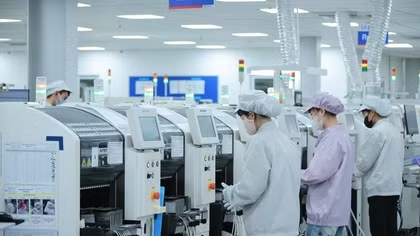
In Vietnam, ILO said 86% of textile & garment workers may lose jobs in the automation process, while three-fourth of workers in the electronics sector will be replaced with robots.

Pham Thi My Le, president of Le & Associates, predicted that 80% of works would be undertaken by robots by 2020.

The popularity of robots would prompt multi-national conglomerates to stop outsourcing to Asian countries and to make products in their home countries with automated production lines. If so, Asian countries, which now rely on doing the outsourcing for foreign companies, would suffer. 

Vietnam can attract foreign investments thanks to cheap labor. However,  once robots replace large numbers of workers, that advantage will diminish.

Vietnamnet

Other News

SBV raises short-term capital lending cap to 40%

SBV raises short-term capital lending cap to 40%

The new circular will help credit institutions have more room to provide capital to businesses and investment projects to support high economic growth in the next few years, while increasing flexibility in the SBV’s monetary policy management.

Business confidence in Vietnam rebounds strongly: UOB

Business confidence in Vietnam rebounds strongly: UOB

The study found that 85% of Vietnamese enterprises reported positive business sentiment, a sharp increase from 48% in 2025, when business confidence was weighed down by uncertainties surrounding US tariff policies and related trade developments.

Bac Ninh seeks high-quality foreign investment for sustainable growth

Bac Ninh seeks high-quality foreign investment for sustainable growth

According to Vice Chairman of the provincial People’s Committee Pham Van Thinh, the province aims to maintain stable and sustainable growth, improve the competitiveness of both the economy and local businesses, and make better use of free trade agreements (FTAs) to expand and diversify export markets.

Green building trend flourishes in Ho Chi Minh City's real estate landscape

Green building trend flourishes in Ho Chi Minh City's real estate landscape

The International Finance Corporation (IFC) highlighted the city's dominance in green-certified building floor space in Vietnam, reflecting the rapid expansion of the green building market with 780 completed green buildings encompassing over 18.69 million sq.m by 2025, predominantly certified by EDGE and LEED.

UK supports Vietnam in wind power and green finance development

UK supports Vietnam in wind power and green finance development

The United Kingdom officially announced two new climate cooperation initiatives to support Vietnam in its energy transition and green growth journey. These programs focus on offshore wind power development and the creation of a sustainable green financial ecosystem.

Ample room remains for Vietnam–India logistics cooperation

Ample room remains for Vietnam–India logistics cooperation

The GTTCI expert noted that alongside logistics and integrated warehousing, e-commerce is expected to be a particularly high-growth sector in the coming years. He described it as a multi-billion-dollar market with significant untapped opportunities for cooperation between Vietnam and India.

Exports gain momentum from high-tech growth drivers

Exports gain momentum from high-tech growth drivers

According to the Ministry of Industry and Trade, Vietnam’s exports reached 215.66 billion USD in the first five months of 2026, up 19.5% year-on-year. Twenty-six export items generated more than 1 billion USD in revenue each, including seven with turnover exceeding 10 billion USD.

Vietnam–China crossings see spike in ASEAN fresh produce

Vietnam–China crossings see spike in ASEAN fresh produce

Since the start of the summer harvest season, China's two major border gates with Vietnam, Youyi Guan in Pingxiang and Beilun 2 Bridge in Dongxing, have entered their peak period for handling imports of fresh agricultural and seafood products from member states of the Association of Southeast Asian Nations (ASEAN).

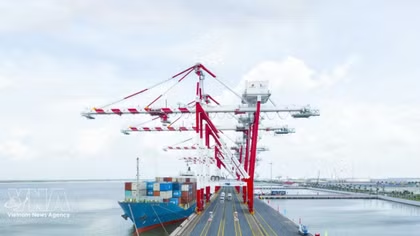
Cargo handling operations at Berths 3 and 4 of the Hai Phong International Gateway Port. (Photo: VNA)

AI reshapes logistics, raising bar for workforce skills

According to the Vietnam Logistics Business Association (VLA), the logistics sector will require around 2.2 million workers by 2030, including 1.6 million employees for logistics service providers and nearly 600,000 personnel supporting logistics operations in manufacturing and trading enterprises.

Robust dispute resolution framework key to Vietnam's IFC ambitions

Robust dispute resolution framework key to Vietnam's IFC ambitions

The development strategy for VIFC-HCMC envisions a comprehensive financial ecosystem encompassing green finance, carbon credits, financial technology (fintech), blockchain technology, digital assets, digital banking and other innovative business models. These highly internationalised sectors involve complex cross-border transactions and sophisticated legal structures.