- Vietnam wants World Bank’s support in food safety
- World Bank Group announces new strategy in Vietnam
- World Bank suggestions to resolve Vietnam’s bad debts
“Vietnam’s high economic growth in 2017 and in the first quarter of 2018 is impressive and gives the country a firm foundation to move forward,” said Ousmane Dione, the World Bank Country Director for Vietnam. “This period of robust economic activity is a great opportunity to invest in human capital, so that the country can address the challenge of maintaining this growth momentum. The World Bank stands ready to provide any support to Vietnam to achieve the country’s aspiration for long-term sustainable growth.”
Real GDP expanded nearly 7.4 percent during the first quarter of 2018, benefiting from a favorable external environment, with global GDP growth expected to peak at 3.1 percent in 2018. Growth in the East Asia and Pacific region is expected to slow down slightly to 6.3 percent this year, reflecting a continued slowdown in China.
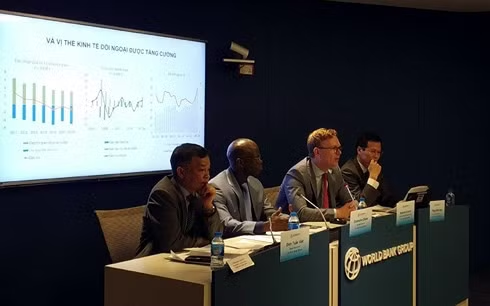 |
Vietnam’s trade balance continued to improve owing to strong trade performance and FDI inflows, contributing to the overall current account surplus, estimated at 6.8 percent of GDP (Q1 2018). The exchange rate has been relatively stable while reserves continued to rise, reaching about US$63 billion in the first 4 months of 2018, equal to around 3.6 months of imports.
Against the backdrop of low inflation, monetary policy remains accommodative. Vietnam’s consumer price index has been ticking up slightly at 2.8 percent (year on year) in the April 2018, driven by electricity and health services price hikes. Rapid credit growth and abundant liquidity could worsen volatility in Vietnam's financial markets, especially against the anticipated tightening of global monetary conditions. Public debt has stabilized since 2017, with an overall fiscal deficit of 4.5 percent of GDP, and the public-debt-to-GDP ratio declined to 61.4 percent in 2017 from 63.6 percent in 2016.
Vietnam’s medium-term outlook has improved further since the last Taking Stock release in December 2017. Real GDP is projected to expand by 6.8 percent this year (up from 6.5 percent in the previous forecast) before moderating to 6.6 percent in 2019 and 6.5 percent in 2020, due to an expected slowdown in global demand. Inflation is expected to remain around the 4 percent government target. The current account balance is projected to remain in surplus, but could start narrowing next year, reflecting widening deficits on the income and services accounts. Fiscal deficits and public debt are expected to be under control.
“The current favorable economic conditions with high growth and low inflation offer a unique opportunity to push ahead with reforms,” said Sebastian Eckardt, Lead Economist for the World Bank in Vietnam. “Prudent macroeconomic policies should be accompanied by comprehensive and deep structural reforms, including regulatory reforms to remove barriers to and reduce the cost of private sector activity, human capital and high-quality infrastructure investments, and further reforms to enhance productivity of state-owned enterprises.”
Despite improved short term prospects, risks remain significant. Domestically, slower progress in restructuring state-owned enterprises and banking sectors could adversely impact the macro-financial situation, undermine growth prospects, and create large public-sector liabilities. External risks include escalating trade protectionism, heightened geopolitical tensions and faster-than-expected monetary tightening which could lead to disorderly financial market movements.
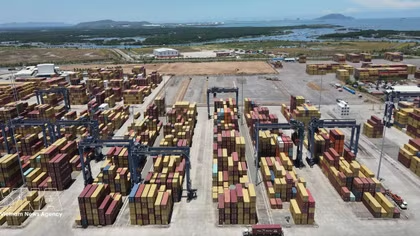
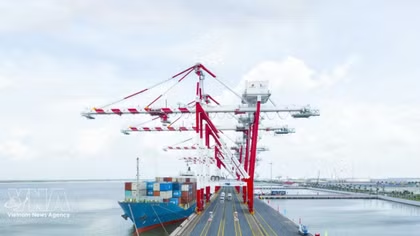
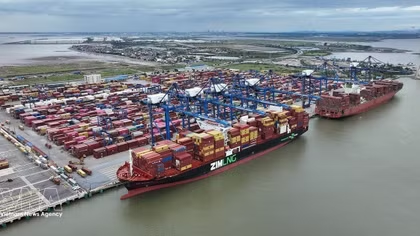
The report’s special section looks at reform priorities for reducing trade costs and enhancing competitiveness in Vietnam. While Vietnam has made great progress in reducing tariffs, there remains significant potential to reduce trade cost through rationalization of non-tariff measures or specialized controls, more efficient border management and logistics. This can be achieved by a comprehensive program comprising four pillars: Reducing trade cost – related to time to comply with specialized control measures and procedures before and at the border; Improving trade-related infrastructure and the quality of connectivity; Building a competitive logistics service sector; Strengthening interagency coordination and partnership with the private sector.
The report argued that the National Logistics Action Plan has been issued as an initial effort to put forward effective arrangements to implement integrated reform priorities on trade facilitation and logistics, but it can be further improved to best reflect an integrated approach.