Vietnam’s road sector forecast to grow 7.2 pct in 2019

The expansion of Vietnam’s road network would continue in the next decade in order to support growing freight transport volumes due a projected increase in economic activity, Fitch Group’s Fitch Solutions Macro Research forecast in a report released on May 14.
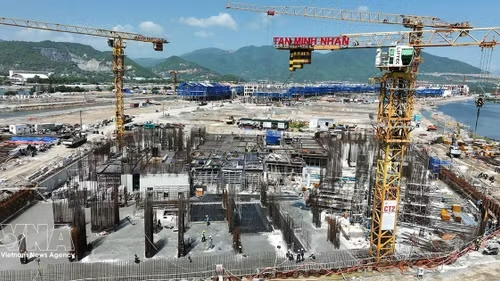
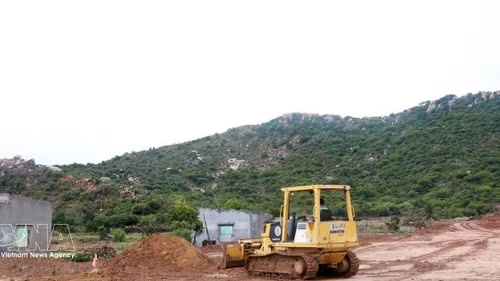
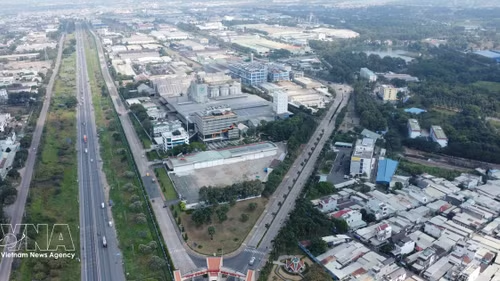
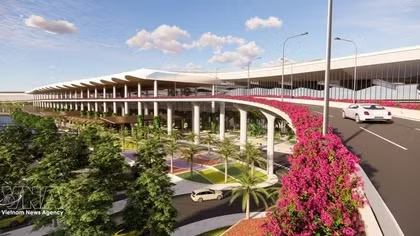
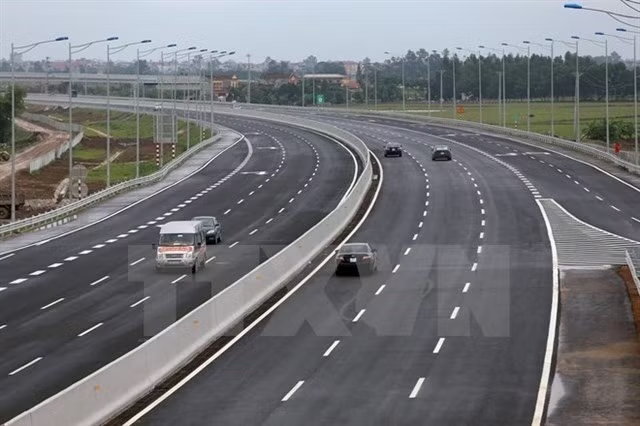
Growth of Vietnam’s road sector will mainly be supported by the construction of expressways (Photo: VNA)

Growth of Vietnam’s road sector will mainly be supported by the construction of expressways (Photo: VNA)

In the report on the outlook for Vietnam’s road infrastructure, Fitch predicted the country’s road and bridges sector to grow by 7.2 percent, in real terms, in 2019, and at an annual average of 6.7 percent from 2020 to 2028, driven by a large number of road projects. According to Fitch's key projects database (KPD), there are a total of 137 road projects currently in the planning or construction phases, representing 60 percent of all pipeline projects.

"We are positive that most of these projects will be implemented progressively given a projected surge in demand for road infrastructure supported by sustained, robust economic growth, averaging 6.5 percent annually till 2028, as projected by our Country Risk team," Fitch said in the report.

According to Fitch, growth of Vietnam’s road sector will mainly be supported by the construction of expressways. The government plans to expand the current network by more than five times to 7,000km by 2030, which is an upward revision of the target set in 2016 (6,400km).

The plan will include the construction of new expressways linking the northern and southern regions, several ring routes that will circle existing urban cores to enhance suburban connectivity, and the expansion of existing expressways by extending routes and increasing the number of lanes.

"Given the high number of roads which are unpaved, we expect a wave of road modernisation to take place over the next decade, as currently unpaved roads are upgraded to asphalt or concrete roads. However, we note that some expressway projects are likely to face land acquisition issues, which may delay project timelines and result in cost inflation."

Also, Fitch said, as most expressway projects are likely procured via public-private partnership (PPP), the pace of expansion of Vietnam’s expressway network will depend on the level of private interest, which will pick up if the PPP framework, legal and financial institutions are strengthened.

The inclusion of sovereign guarantees and the implementation of a robust legal framework would increase interest in PPPs and provide tailwinds to road sector growth, Fitch noted.

Current PPP laws do not have minimum return guarantees by the government, which means that the burden of project-related financial risks are tilted towards private investors. 

As a result, low investor interest in PPP projects often leads to longer implementation times and in some cases, cancellation of PPPs. Such a scenario is best exemplified by the Dau Giay-Phan Thiet Expressway project, where many investors expressed interest and withdrew at a later date due to financing uncertainties.

According to Fitch, legal barriers have also deterred potential investors from the road sector. The lack of a strong legal framework has caused concerns over site clearance, price fixing and concessions. Fitch's KPD showed out of 87 road projects in the pre-construction phase, 61 are earmarked as PPPs.

"We believe the progress of these projects will pick up once the legal environment in the country improves, and reforms to the current PPP law are made to include guarantees. The more balanced risk profile of the projects will make them a more attractive investment proposition to private investors," Fitch concluded.
VNS/VNA

Other News

Data-driven land valuation to curb speculation: Experts

Data-driven land valuation to curb speculation: Experts

From a property-market perspective, Do Thi Thu Giang, National Director of Valuation and Advisory at Savills Vietnam, said the orientations under Resolution No. 21-NQ/TW could make the market more transparent and efficient, with property values increasingly tied to actual development and use potential.

Resolution No. 19-NQ/TW sets new growth drivers for Vietnam

Resolution No. 19-NQ/TW sets new growth drivers for Vietnam

Science and technology, innovation, digital transformation and AI must be translated into higher productivity rather than pursued as ends in themselves. At the same time, people should be placed at the centre of development, not merely viewed as a resource but as the ultimate objective of development policies.

Expo to open door for Vietnamese suppliers to enter US market

Expo to open door for Vietnamese suppliers to enter US market

US retail giant Target is seeking Vietnamese suppliers of household goods, home textiles, children’s products, personal care and beauty products, with a focus on companies capable of manufacturing and developing products that meet requirements on quality, design and supply chain management.

2026 Banking Sector Digital Transformation to open in Hanoi

2026 Banking Sector Digital Transformation to open in Hanoi

The annual event, which will be held on August 18-19, 2026, at the ICE International Exhibition Centre, 91 Tran Hung Dao Street, Hanoi, is expected to attract around 324 delegates and feature 21 booths representing credit institutions, payment intermediary service providers, and technology companies.

Vietnam – one of most attractive destinations for leading US semiconductor companies: expert

Vietnam – one of most attractive destinations for leading US semiconductor companies: expert

Vietnam has built a solid semiconductor and electronics industry before joining ITSI, attracting major US semiconductor companies. Intel Products Vietnam is one of Intel's largest assembly and testing facilities worldwide, while chip design companies such as Synopsys, Cadence, Marvell and Qualcomm have established engineering and research centres in the Southeast Asian country.

Vietnam targets higher-quality FDI under Resolution 10

Vietnam targets higher-quality FDI under Resolution 10

During the first seven months of 2026, Vietnam attracted more than 38 billion USD in registered FDI, up nearly 58% year-on-year. More importantly, the increase was driven by large-scale, high-tech projects rather than a surge in the number of new investments, signalling a significant improvement in the quality of capital inflows.

Manufacturing, engineering drive hiring growth in H1: report

Manufacturing, engineering drive hiring growth in H1: report

Manufacturing and engineering posted the strongest recruitment growth, with hiring demand surging 70% year-on-year, driven by production expansion, supply chain restructuring and sustained investment inflows in high-tech manufacturing.

Government proposes special mechanisms to unblock APEC 2027 projects in Phu Quoc

Government proposes special mechanisms to unblock APEC 2027 projects in Phu Quoc

The projects in Phu Quoc have been implemented under tight deadlines. Since May 2025, the Prime Minister has directed preparations for APEC 2027, including accelerated infrastructure development on the special zone. An Giang province and investors have subsequently launched a number of major projects involving complex technical requirements and demanding construction schedules.

Financial market reform plan targets high, sustained growth through 2045

Financial market reform plan targets high, sustained growth through 2045

The plan seeks to develop a balanced and modern financial market that is closely integrated with regional and global markets, strengthens the mobilisation and allocation of domestic and foreign capital, and enhances the market’s role as a key provider of medium- and long-term capital for the economy and as a major driver of sustained high economic growth.

An Giang aims to become leading maritime economic hub

An Giang aims to become leading maritime economic hub

Under the province's master plan for 2021–2030 with a vision to 2050, An Giang will prioritise investment in five strategic sectors: strategic infrastructure; processing industries and clean energy; trade, services, logistics and border-gate economy; high-quality tourism; and high-tech agriculture, ecological development and the circular economy.