WB announces US$200 billion for Climate Action

The World Bank Group has announced a major new set of climate targets for 2021-2025, doubling its current 5-year investments to around US$200 billion in support for countries to take ambitious climate action.

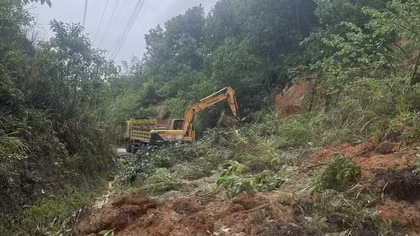
The new plan significantly boosts support for adaptation and resilience, recognizing mounting climate change impacts on lives and livelihoods, especially in the world’s poorest countries.

The plan also represents significantly ramped up ambition from the World Bank Group, sending an important signal to the wider global community to do the same.

“Climate change is an existential threat to the world’s poorest and most vulnerable. These new targets demonstrate how seriously we are taking this issue, investing and mobilizing US$200 billion over five years to combat climate change,” says World Bank Group President, Jim Yong Kim.

“We are pushing ourselves to do more and to go faster on climate and we call on the global community to do the same. This is about putting countries and communities in charge of building a safer, more climate-resilient future.”
The US$200 billion across the Group is made up of approximately US$100 billion in direct finance from the World Bank (IBRD/IDA), and approximately US$100 billion of combined direct finance from the International Finance Corporation (IFC) and the Multilateral Investment Guarantee Agency (MIGA) and private capital mobilized by the World Bank Group.

A key priority is boosting support for climate adaptation, recognizing that millions of people across the world are already facing the severe consequences of more extreme weather events. By ramping up direct adaptation finance to reach around US$50 billion over FY21-25, the World Bank will, for the first time, give this equal emphasis alongside investments that reduce emissions.

“People are losing their lives and livelihoods because of the disastrous effects of climate change. We must fight the causes, but also adapt to the consequences that are often most dramatic for the world’s poorest people,” World Bank Chief Executive Officer, Kristalina Georgieva said.

“This is why we at the World Bank commit to step up climate finance to US$100 billion, half of which will go to build better adapted homes, schools and infrastructure, and invest in climate smart agriculture, sustainable water management and responsive social safety nets.”

The new financing will ensure that adaptation is undertaken in a systematic fashion, and the World Bank will develop a new rating system to track and incentivize global progress. Actions will include supporting higher-quality forecasts, early warning systems and climate information services to better prepare 250 million people in 30 developing countries for climate risks.

In addition, the expected investments will build more climate-responsive social protection systems in 40 countries, and finance climate smart agriculture investments in 20 countries.

“There are literally trillions of dollars of opportunities for the private sector to invest in projects that will help save the planet,” says IFC CEO Philippe Le Houérou.

“Our job is to go out and proactively find those opportunities, use our de-risking tools, and crowd in private sector investment. We will do much more in helping finance renewable energy, green buildings, climate-smart agribusiness, urban transportation, water, and urban waste management.”

The new targets build on the World Bank Group’s 2016 Climate Change Action Plan. In 2018, the World Bank Group provided a record-breaking US$20.5 billion in finance for climate action: doubling delivery from the year before the Paris Agreement and meeting its 2020 target two years ahead of schedule.

The World Bank Group will continue to integrate climate considerations into its work, including screening projects for climate risks and building in appropriate risk mitigation measures, disclosing both gross and net greenhouse gas emissions, and applying a shadow carbon price for all material investments.

To increase system-wide impact for countries, the World Bank Group will support the integration of climate considerations in policy planning, investment design, implementation and evaluation.

It will also support at least 20 countries implement and update Nationally Determined Contributions and increase engagement with Ministries of Finance in the design and implementation of transformative low-carbon policies.


VOV/WB

Other News

Vietnam steps up implementation of ethnic affairs strategy through 2030

Vietnam steps up implementation of ethnic affairs strategy through 2030

To accelerate the implementation of the the Ethnic Affairs Strategy by 2030, with a vision toward 2045, the Prime Minister requested ministries, agencies and local authorities to continue thoroughly carrying out the Party and State’s policies on ethnic affairs, enhancing the effectiveness of State management and strengthening oversight of policy implementation.

Security preparations reviewed for APEC 2027 in Phu Quoc

Security preparations reviewed for APEC 2027 in Phu Quoc

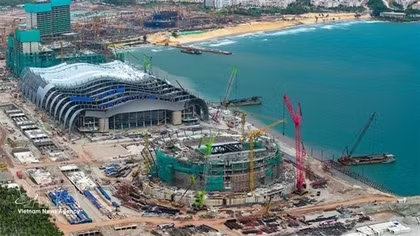
The team examined the APEC 2027 Convention Centre, where main conference activities are scheduled; Sun Serenia Hospital, designated to provide healthcare and emergency medical services for delegates; provincial road DT.975, which connects Phu Quoc International Airport to the convention centre; and the area surrounding Phu Quoc International Airport.

Hanoi accelerates seven Red River bridge projects, many exceed 70% completion

Hanoi accelerates seven Red River bridge projects, many exceed 70% completion

According to the municipal Transport Construction Investment Project Management Board, the city is simultaneously implementing seven projects, namely Tu Lien, Ngoc Hoi, Tran Hung Dao, Thuong Cat, Van Phuc, Hong Ha and Me So bridges. Construction is being carried out on multiple fronts, focusing on bored piles, pile caps, piers and superstructure works.

Dien Bien battlefield legacy powers tourism revival

Dien Bien battlefield legacy powers tourism revival

Seventy-two years after the Dien Bien Phu Victory, its legacy still reverberates. The unity, self-reliance, and resilience forged in that historic triumph remain a powerful internal engine, now propelling Dien Bien toward fast and sustainable development.

Hanoi accelerates shift to green buses, targets 100% by 2030

Hanoi accelerates shift to green buses, targets 100% by 2030

In the 2027–2030 period, the city will accelerate the transition towards the complete phase-out of fossil fuel-powered buses. The share of electric and green energy-fueled buses is projected to reach 79–89% by 2029 and 100% by 2030.

36 fishermen safely rescued after boat breaks down near Truong Sa

36 fishermen safely rescued after boat breaks down near Truong Sa

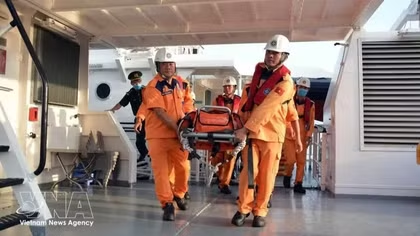
At 8:00 the same day, KN475 began towing the disabled fishing boat toward Da Tay A island. The towing operation was carried out safely, and by 18:30 both the vessel and its crew had arrived at the island without incident, where repairs and additional support procedures were arranged.

Vietnamese language contest in Laos strengthens youth ties, bilateral friendship

Vietnamese language contest in Laos strengthens youth ties, bilateral friendship

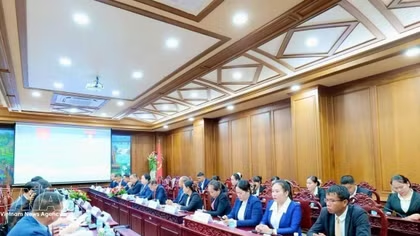
Held in response to the launch of the Vietnamese Language Day among overseas Vietnamese communities, the event aimed to enhance the quality of Vietnamese language teaching and learning in Laos while contributing to the great friendship, special solidarity, comprehensive cooperation and strategic cohesion between the two countries.

Vietnamese language contest in Laos strengthens youth ties, bilateral friendship

Vietnamese language contest in Laos strengthens youth ties, bilateral friendship

Held in response to the launch of the Vietnamese Language Day among overseas Vietnamese communities, the event aimed to enhance the quality of Vietnamese language teaching and learning in Laos while contributing to the great friendship, special solidarity, comprehensive cooperation and strategic cohesion between the two countries.

Hanoi launches 10 electric bus routes from April 1

Hanoi launches 10 electric bus routes from April 1

By the end of April, the number of buses using electricity and other green energy sources in the city is expected to reach 822, including 683 electric buses and 139 compressed natural gas (CNG) buses, representing 42.1% of the total number of vehicles.