WB predicts Vietnamese economy to grow by 6.3% in 2023

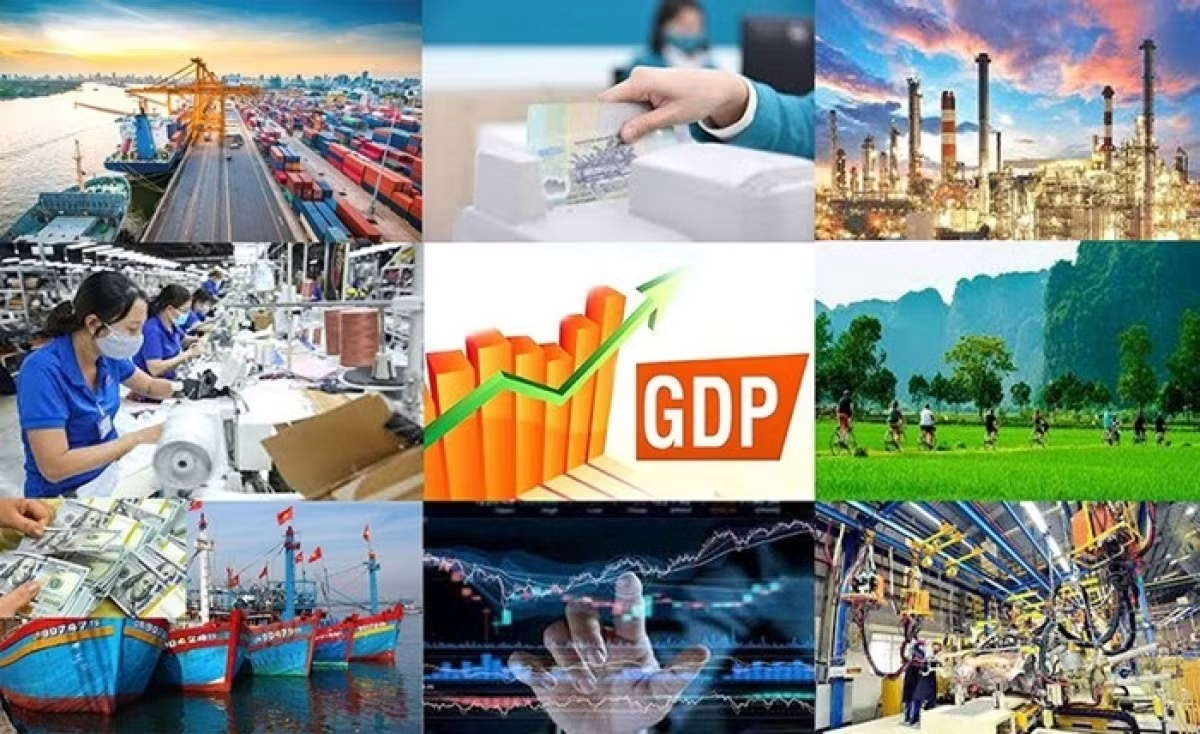
Vietnamese economic growth is projected to ease to 6.3% in 2023 from a robust figure of 8% last year, as services growth eases and higher prices and interest rates weigh on households and investors, according to details given by the World Bank (WB)’s latest Taking Stock report released on March 13.

Growth is expected to pick up to 6.5% ahead in 2024 as the economies of the country’s main export markets gain strength, the report says.
WB predicts Vietnamese economy to grow by 6.3% in 2023 -0
WB predicts Vietnamese economy to grow by 6.3% in 2023

The outlook for the nation reflects the heightened uncertainty that exists in terms of the global economy. Downside risks include weaker-than-expected growth in major Vietnamese export markets such as the United States, China and the Eurozone; tightening financial conditions; higher domestic inflation; weaknesses in the balance sheets of corporate, banking, and household sectors, along with financial sector vulnerabilities.

Domestic and external headwinds therefore warrant increased vigilance and data-driven policy responses, the report outlines.

These include managing the trade-off between growth and inflation, as well as strengthening the supervisory framework for the financial sector. On the upside the stronger than expected recovery of global growth could lift exports and lead to growth above the baseline projection.

“Vietnam has the fiscal space to implement measures to boost growth, unlike many other countries,” said Carolyn Turk, country director for Vietnam of the WB, adding, “Effective implementation of priority public investments is key to support growth, both in the short-term and in the longer-term. Also, fiscal and monetary policies must be synchronized to ensure that support to the economy and macroeconomic stability are achieved effectively.”

The report’s special section on the Vietnamese services sector identifies four key reforms that could unlock the potential of a sector that can deliver substantial employment and added value. For the nation to achieve its objective of becoming a high-income economy by 2045, it should more effectively leverage its diversified services sector as a means of securing more sustained productivity growth. Indeed, according to the analysis it should seek to “Harness the potential of the services sector for future growth”.

This would entail undertaking reforms aimed at enhancing the services sector’s productivity and its cross-sectoral contributions to manufacturing and agriculture productivity growth.

Despite the local services sector growing as a share of the economy, employing a greater share of workers, and enjoying labour productivity increasing in the decade before 2019, Vietnamese performance in this area lags behind peer countries such as Malaysia, the Philippines, and Indonesia.

Exports of knowledge-rich services known as “global innovator services” constitute only 9% of total services exports, whilst only 6.4% of total employment in the services sector is in this sub-sector. This includes information and communications technology, finance, and professional services, which are among the most productive services areas in the economy. The small scale of firms, restrictions to services trade, low technology adoption, and scarcity of inter-sectoral linkages affect productivity, suggesting that there remains room for improvement through appropriate policy actions.

As a means of accelerating growth of this sector, the country could consider reducing restrictions to services trade and foreign investment in this area, thereby implementing reforms to enhance competition and gaining access to finance for domestic firms.

This is addition to encouraging firm-level product and process innovation and technology adoption, strengthening skills and capabilities of workers and managers, as well as focusing on services that can promote further growth of other sectors, particularly manufacturing.


VNA/VOV

Other News

SBV raises short-term capital lending cap to 40%

SBV raises short-term capital lending cap to 40%

The new circular will help credit institutions have more room to provide capital to businesses and investment projects to support high economic growth in the next few years, while increasing flexibility in the SBV’s monetary policy management.

Business confidence in Vietnam rebounds strongly: UOB

Business confidence in Vietnam rebounds strongly: UOB

The study found that 85% of Vietnamese enterprises reported positive business sentiment, a sharp increase from 48% in 2025, when business confidence was weighed down by uncertainties surrounding US tariff policies and related trade developments.

Bac Ninh seeks high-quality foreign investment for sustainable growth

Bac Ninh seeks high-quality foreign investment for sustainable growth

According to Vice Chairman of the provincial People’s Committee Pham Van Thinh, the province aims to maintain stable and sustainable growth, improve the competitiveness of both the economy and local businesses, and make better use of free trade agreements (FTAs) to expand and diversify export markets.

Green building trend flourishes in Ho Chi Minh City's real estate landscape

Green building trend flourishes in Ho Chi Minh City's real estate landscape

The International Finance Corporation (IFC) highlighted the city's dominance in green-certified building floor space in Vietnam, reflecting the rapid expansion of the green building market with 780 completed green buildings encompassing over 18.69 million sq.m by 2025, predominantly certified by EDGE and LEED.

UK supports Vietnam in wind power and green finance development

UK supports Vietnam in wind power and green finance development

The United Kingdom officially announced two new climate cooperation initiatives to support Vietnam in its energy transition and green growth journey. These programs focus on offshore wind power development and the creation of a sustainable green financial ecosystem.

Ample room remains for Vietnam–India logistics cooperation

Ample room remains for Vietnam–India logistics cooperation

The GTTCI expert noted that alongside logistics and integrated warehousing, e-commerce is expected to be a particularly high-growth sector in the coming years. He described it as a multi-billion-dollar market with significant untapped opportunities for cooperation between Vietnam and India.

Exports gain momentum from high-tech growth drivers

Exports gain momentum from high-tech growth drivers

According to the Ministry of Industry and Trade, Vietnam’s exports reached 215.66 billion USD in the first five months of 2026, up 19.5% year-on-year. Twenty-six export items generated more than 1 billion USD in revenue each, including seven with turnover exceeding 10 billion USD.

Vietnam–China crossings see spike in ASEAN fresh produce

Vietnam–China crossings see spike in ASEAN fresh produce

Since the start of the summer harvest season, China's two major border gates with Vietnam, Youyi Guan in Pingxiang and Beilun 2 Bridge in Dongxing, have entered their peak period for handling imports of fresh agricultural and seafood products from member states of the Association of Southeast Asian Nations (ASEAN).

Cargo handling operations at Berths 3 and 4 of the Hai Phong International Gateway Port. (Photo: VNA)

AI reshapes logistics, raising bar for workforce skills

According to the Vietnam Logistics Business Association (VLA), the logistics sector will require around 2.2 million workers by 2030, including 1.6 million employees for logistics service providers and nearly 600,000 personnel supporting logistics operations in manufacturing and trading enterprises.

Robust dispute resolution framework key to Vietnam's IFC ambitions

Robust dispute resolution framework key to Vietnam's IFC ambitions

The development strategy for VIFC-HCMC envisions a comprehensive financial ecosystem encompassing green finance, carbon credits, financial technology (fintech), blockchain technology, digital assets, digital banking and other innovative business models. These highly internationalised sectors involve complex cross-border transactions and sophisticated legal structures.