Why carp hotpot sells like hot cakes in Vietnam

In all major Vietnamese cities, one dish becomes ubiquitous after emerging as a new trend a decade or so ago – the hotpot.

The variety of hotpot dishes are many, and one “imported” from Thailand, using tom yum as the broth to cook various vegetables and meat in, has achieved great popularity.

But there is one that stands out from all the hotpots, not just for its taste, but for its cultural, even religious significance.

The carp hotpot — a specialty from the north of the country, is one that people look forward most to sharing with loved ones, particularly during the Lunar New Year, because it is believed to bring good luck.
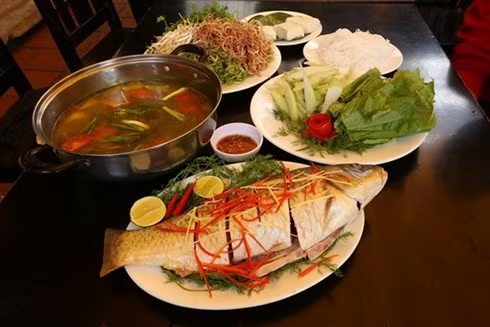
So, if you have never had a lau rieu ca chep (carp sour soup hotpot), now, Spring, is the time.

A Vietnamese-Canadian woman, Tran Le Hang, who was visiting her native county with her family, recounted her experience of having a sour soup carp hotpot at the famous Quan An Ngon Restaurant in Hanoi’s Phan Boi Chau street.

“When we arrived, the restaurant was already crowded with both locals and foreigners, and many of them had opted for the carp hotpot to warm themselves in the slightly chilly spring weather.

“We ordered one, too. It was such a great feeling to sit together and enjoy the broth with tomatoes, dill and many other ingredients, most importantly the fatty, fresh carp pieces. The aromas that came out of the hotpot woke up our taste buds,” Hang said.

Le Kim Chi, who runs Quan An Ngon, told the Canadian guests that her restaurant serves hundreds of dishes from the country’s three regions, but the carp hotpot is the most wanted at this time of the year.

People believe that eating a carp with eggs in its belly at the Lunar New Year brings them good luck, Chi said.

Hang was guided to dip the first piece of fatty carp eggs into the yellow colour of saffron-flavoured broth, which everyone, children and adults, find attractive.

“The hotpot will be less tasty if it lacks the carp eggs,” Chi said as she advised the diners to let the carp pieces cook in the broth for several minutes while soaking fresh dill and removing it much sooner, just enough time for the broth to get its fragrance, flavour and light sweetness.

“Oh.. this is superb. I could feel the soft texture and fragrance of the carp, and taste the flavours of banana inflorescense, Indian taro and celery stems,” Hang said.

The hot, sour-sweet broth with the added flavour of fresh fennel was tasty beyond anything she’s ever tried since her family resettled in Canada more than 30 years ago, she added.

Healthy, too

Herbalist Nguyen Van Tuat, 62, who runs a traditional medicine centre in Hanoi, said carp is a nutritious dish cooked regularly by housewives, but a carp hotpot is the most delicious that can be made with it.

Tuat said his 90-year-old mother can make 12 different dishes with carp, but her best was the rieu ca chep (carp sour soup) as well. All the ingredients were made at home, he said. Carp was caught from her own pond, fresh dills and taro stems from her garden and homemade me (fermented rice, a key ingredient, made with rice kept in a corner of the kitchen for at least three months to ferment.)

Using organic, raw vegetables and naturally fermented me is the secret of many tasty dishes made in the north, and the carp sour soup was an unforgettable dish, Tuat said.

“I still remember the taste of the dish my mother cooked in the kitchen with straw (as fuel).

The dish has been cooked in Vietnam for hundreds of years in both rural and urban areas. Vietnamese housewives like Tuat’s mother who cooked the soup very well, made family meal special during war time, when the country was very poor.

Chi said that to cook a hotpot like Tuat’s mother, housewives should know how to choose a carp naturally raised without industrial feed.

The naturally-raised carp is fragrant, sweet and crispy, unlike that raised with industrial-feed, which often as starchy meat, Chi said.

With naturally-raised carp not easy to get these days, gourmets and those harking for a taste of the old days can visit one of the Quan An Ngon restaurants in Hanoi.
VNA

Other News

Vietnam secure berth at FIFA U17 World Cup 2026 for first time

Vietnam secure berth at FIFA U17 World Cup 2026 for first time

Vietnam national U17 football team secured a place at the FIFA U17 World Cup 2026 for the first time after defeating United Arab Emirates national U17 football team 3-2 on in the final Group C match of the AFC U17 Asian Cup 2026 in Saudi Arabia on early May 14 (Vietnam time).

Vietnam’s most beautiful railway station twins with French counterpart

Vietnam’s most beautiful railway station twins with French counterpart

A twinning agreement between Da Lat Railway Station in Vietnam and Trouville-Deauville Railway Station in France was signed at the French Embassy in Vietnam on May 7, creating new opportunities for cooperation in station management and operations, as well as cultural and tourism promotion between the two sides.

Hanoi gains two more craft villages in World Crafts Cities network

Hanoi gains two more craft villages in World Crafts Cities network

The recognition of Chuyen My and Son Dong craft villages as members of the World Crafts Cities network represents international acknowledgement of the cultural value, artisanal techniques, creativity and sustainable vitality of Vietnam’s traditional craft villages, he said.

Thang Long - Hanoi Festival 2026 to return in September

Thang Long - Hanoi Festival 2026 to return in September

Co-hosted by the municipal People’s Committee, the Department of Culture and Sports, and domestic and foreign agencies, the whole spectacle is meant to honour the city’s millennia-old heritage while reafffirming its strategy of establishing culture as a development engine.

Spreading Vietnamese cultural identity in digital space

Spreading Vietnamese cultural identity in digital space

In the context of deep international integration, cultural identity serves as both a “shield” against assimilation and a defining marker of a nation’s image. Protecting and promoting uniquely Vietnamese cultural values has therefore become a pressing task, particularly in an increasingly complex digital environment.

ITE HCMC 2026 to promote Vietnam’s tourism on global map

ITE HCMC 2026 to promote Vietnam’s tourism on global map

With its large scale, the ITE HCMC 2026 aims to promote tourism cooperation between Vietnam and priority markets such as Northeast Asia, Western Europe, North America, Southeast Asia, and Oceania while also boosting visitor arrivals from the Indian market

Vietnamese puppetry seeks renewal amid preservation challenges

Vietnamese puppetry seeks renewal amid preservation challenges

Although widely regarded as a cultural “speciality” attracting tourists, Vietnamese puppetry is facing multiple challenges in preservation and development, requiring renewed efforts to both safeguard its identity and adapt to contemporary cultural currents.

Project on digital transformation in cultural sector approved

Project on digital transformation in cultural sector approved

By 2030, the project targets the establishment of shared digital platforms across 100% of cultural sectors. All digitised cultural heritage will be standardised under the national data framework and shared in accordance with regulations, while 80% of public digital heritage assets are expected to receive digital identifiers to clarify ownership and management, encouraging organisations and individuals to do the same and support market development.

Vietnam eyes becoming region’s leading tourism destination

Vietnam eyes becoming region’s leading tourism destination

Vietnam has in recent years undergone a notable transformation in its tourism development strategy, placing a strong emphasis on nature-based and eco-tourism. This shift is not merely aligned with global trends, but represents a necessary step towards safeguarding valuable natural resources, while appealing to a growing segment of environmentally conscious travellers.