ASOSAI 14: Strengthening commitment to high-level public audit standards

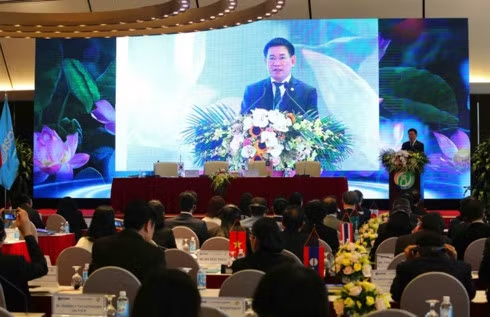
The 52nd Governing Board Meeting as part of the 14th Assembly of the Asian Associations of Supreme Audit Institutions (ASOSAI 14) was held in Hanoi on September 18 under the chair of Madinah Binti Mohamad, General Auditor of Malaysia- Chair of ASOSAI 13.

At the meeting, Madinah Binti Mohamad said, Supreme Audit Institutions (SAIs) of member countries pin all high hopes on ASOSAI 14, especially on the implementation of the 2016-2021 ASOSAI strategic plan. Therefore, along with programs for capacity building and cooperation with ASOSAI, the Governing Board will spare no efforts to come up with a strategy to deal with public audit-related issues with higher quality.

The ASOSAI 13 Chair highlighted ASOSAI as an opportunity for the Governing Board to better understand the challenges and difficulties faced by SAI members.

One of the challenges facing public auditors today is how to achieve a high level of accountability, prevention, and settlement of thorny problems while ensuring the confidence of the public and society, from which they will cooperate with SAIs in providing information about wastage, frauds or wrongdoings.  This will help to pinpoint causes and propose measures to solve existing difficulties, said Madinah Binti Mohamad.

The Malaysian Auditor General stated that the responsibility of public auditors for public opinion is more important than ever, requiring SAI members to step up cooperation and commitment on public audit standards to the highest level to serve the common interests of members.

General Auditor of Vietnam Ho Duc Phoc assured the State Audit of Vietnam (SAV)’s desire to continue working closely with SAI members across diverse fields in the years to come in order to strengthen capacity building and knowledge sharing to deal with current challenges which is adversely affecting transparency, accountability and good governance.

 "With all of our great efforts, I strongly believe that ASOSAI will grow and flourish to a new height," he emphasized.

At the meeting, SAV Deputy Auditor General Doan Xuan Tien presented the Hanoi Declaration- an important official document of the 14th Assembly of ASOSAI- which aims to convey the most important message of the 14th ASOSAI and the seventh symposium themed “Environmental Auditing for Sustainable Development”, which reflects ASOSAI's ideas and proposals for public audit to the regional and global communities.

The Hanoi Declaration summarizes the most important working results of the event and reflects the commitment and action of the ASOSAI community for the organisation’s development objectives for the 2016-2021 period, focusing on the sharing of knowledge among its supreme audit institutions.

It also affirms the interest, efforts, and practical contributions of the ASOSAI community to pursuing sustainable development goals for the world in general and dealing with global environmental challenges in particular.

The Hanoi Declaration reaffirms the desire to achieve economic growth in harmony with sustainable development through a score of measures: increasing knowledge and experience sharing, disseminating standards and instruction documents on environmental audit of SAI members, organizing training courses on environmental audit, encouraging the implementation of joint national audits in accordance with mandates of SAIs, and pledging to develop mechanisms and processes to support these activities.

The Hanoi Declaration underlines that over the 40 years of development since the ASOSAI Charter was set out, ASOSAI established itself as a leading multilateral cooperation organization in Asia, however, the difference between SAI members have long since existed and are still one of the issues that need to be resolved. Asian state auditors of SAIs from 46 countries will continue to carry out ASOSAI's mission to promote knowledge sharing and capacity development of SAI members with a particular focus on developing environmental audit for the sustainable development of regional nations.

Additionally, member states are encouraged to build legal regulations and documents on environmental management, thereby creating a legal corridor for SAIs to play a role in monitoring the implementation of these regulations as well as making regional reports on environmental audit.
VOV

Other News

SBV raises short-term capital lending cap to 40%

SBV raises short-term capital lending cap to 40%

The new circular will help credit institutions have more room to provide capital to businesses and investment projects to support high economic growth in the next few years, while increasing flexibility in the SBV’s monetary policy management.

Business confidence in Vietnam rebounds strongly: UOB

Business confidence in Vietnam rebounds strongly: UOB

The study found that 85% of Vietnamese enterprises reported positive business sentiment, a sharp increase from 48% in 2025, when business confidence was weighed down by uncertainties surrounding US tariff policies and related trade developments.

Bac Ninh seeks high-quality foreign investment for sustainable growth

Bac Ninh seeks high-quality foreign investment for sustainable growth

According to Vice Chairman of the provincial People’s Committee Pham Van Thinh, the province aims to maintain stable and sustainable growth, improve the competitiveness of both the economy and local businesses, and make better use of free trade agreements (FTAs) to expand and diversify export markets.

Green building trend flourishes in Ho Chi Minh City's real estate landscape

Green building trend flourishes in Ho Chi Minh City's real estate landscape

The International Finance Corporation (IFC) highlighted the city's dominance in green-certified building floor space in Vietnam, reflecting the rapid expansion of the green building market with 780 completed green buildings encompassing over 18.69 million sq.m by 2025, predominantly certified by EDGE and LEED.

UK supports Vietnam in wind power and green finance development

UK supports Vietnam in wind power and green finance development

The United Kingdom officially announced two new climate cooperation initiatives to support Vietnam in its energy transition and green growth journey. These programs focus on offshore wind power development and the creation of a sustainable green financial ecosystem.

Ample room remains for Vietnam–India logistics cooperation

Ample room remains for Vietnam–India logistics cooperation

The GTTCI expert noted that alongside logistics and integrated warehousing, e-commerce is expected to be a particularly high-growth sector in the coming years. He described it as a multi-billion-dollar market with significant untapped opportunities for cooperation between Vietnam and India.

Exports gain momentum from high-tech growth drivers

Exports gain momentum from high-tech growth drivers

According to the Ministry of Industry and Trade, Vietnam’s exports reached 215.66 billion USD in the first five months of 2026, up 19.5% year-on-year. Twenty-six export items generated more than 1 billion USD in revenue each, including seven with turnover exceeding 10 billion USD.

Vietnam–China crossings see spike in ASEAN fresh produce

Vietnam–China crossings see spike in ASEAN fresh produce

Since the start of the summer harvest season, China's two major border gates with Vietnam, Youyi Guan in Pingxiang and Beilun 2 Bridge in Dongxing, have entered their peak period for handling imports of fresh agricultural and seafood products from member states of the Association of Southeast Asian Nations (ASEAN).

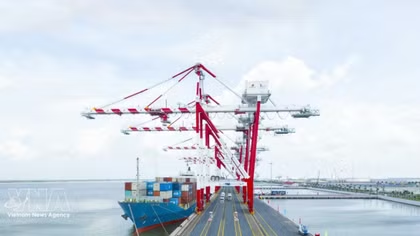
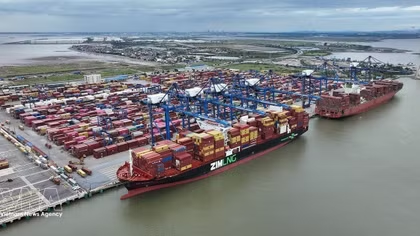
Cargo handling operations at Berths 3 and 4 of the Hai Phong International Gateway Port. (Photo: VNA)

AI reshapes logistics, raising bar for workforce skills

According to the Vietnam Logistics Business Association (VLA), the logistics sector will require around 2.2 million workers by 2030, including 1.6 million employees for logistics service providers and nearly 600,000 personnel supporting logistics operations in manufacturing and trading enterprises.

Robust dispute resolution framework key to Vietnam's IFC ambitions

Robust dispute resolution framework key to Vietnam's IFC ambitions

The development strategy for VIFC-HCMC envisions a comprehensive financial ecosystem encompassing green finance, carbon credits, financial technology (fintech), blockchain technology, digital assets, digital banking and other innovative business models. These highly internationalised sectors involve complex cross-border transactions and sophisticated legal structures.