HCM City develops knowledge economy

The development of a knowledge-based economy is expected to help Ho Chi Minh City realise its ambition of becoming a major centre of economics, finance-trade and science-technology in Southeast Asia.

According to Vice Chairman of the municipal People’s Committee Le Thanh Liem, more than 400,000 Vietnamese residing abroad work in hi-tech fields, making up close to 10% of the number of Vietnamese expatriates.

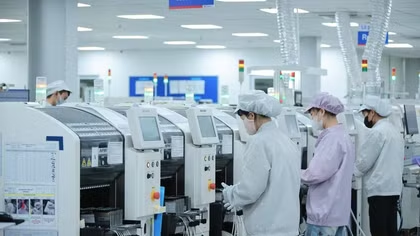
The city is placing a premium on high technology, the support industry and biotechnology while focusing financial resources to develop startups.

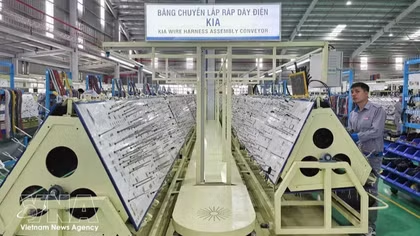
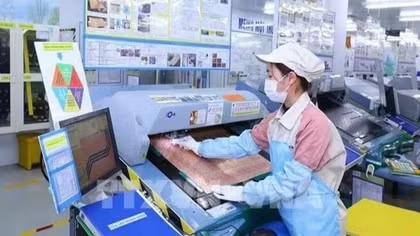
Positive outcomes have been recorded in the chip industry development programme that began in 2013, such as successfully designing and producing 8-bit and 32-bit chips. The SG8V1 chip was the first to be sold commercially in Vietnam and is replacing foreign chips in electronic devices.
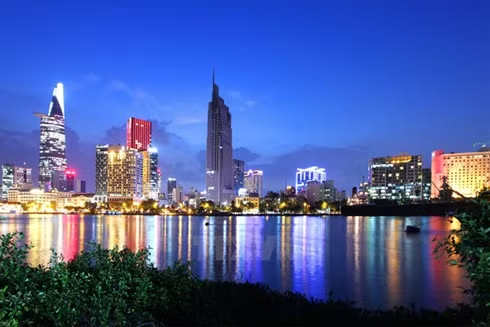
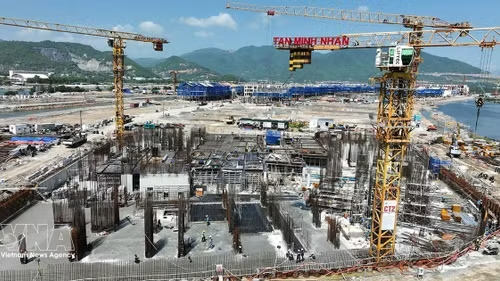
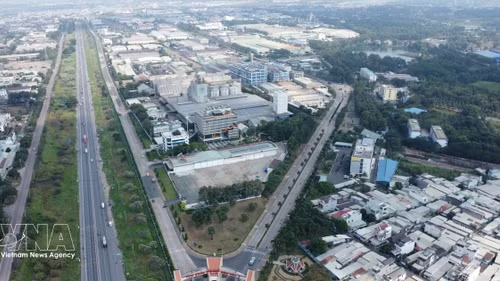
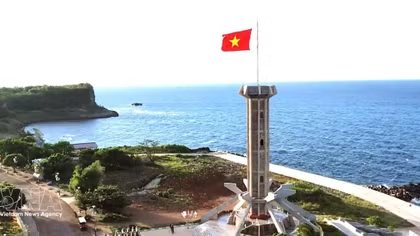
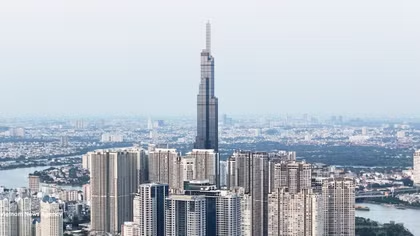
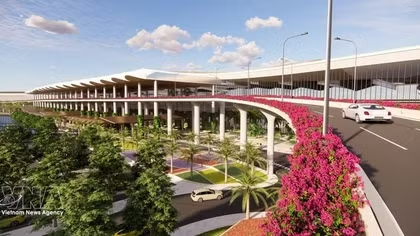
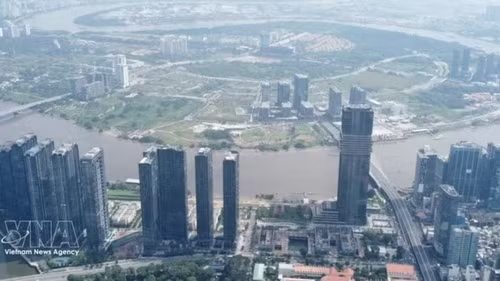
A corner of Ho Chi Minh City
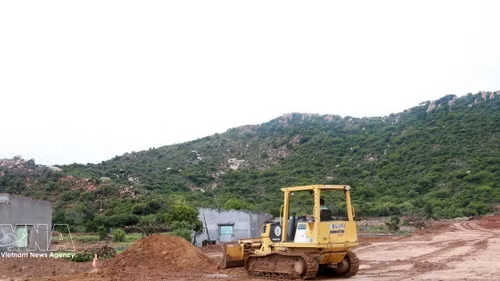
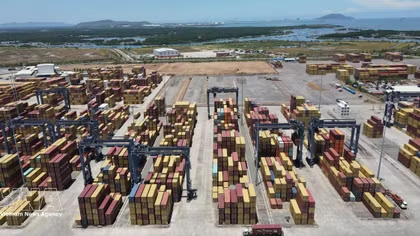
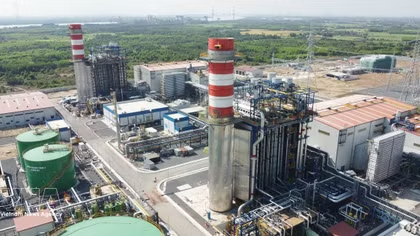
A corner of Ho Chi Minh City 

The Biotechnology Center of Ho Chi Minh City is cross-breeding new varieties and studying different vaccines for the agricultural sector.

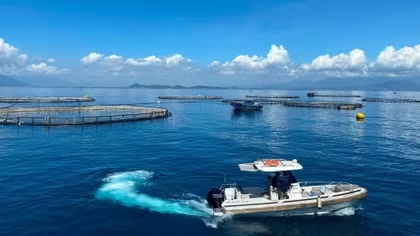
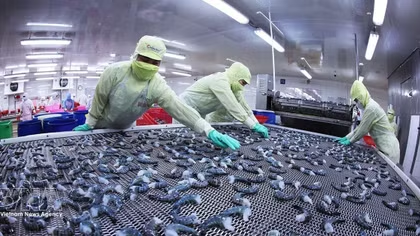
The center successfully produced vaccines for tra fish.

Dr. Nguyen Quoc Binh, an overseas Vietnamese in Canada, said a successful vaccine for fish could bring profit of over US$100 million for farmers annually.

Meanwhile, the Saigon Hi-tech Park (SHTP) has attracted over 300 Vietnamese from abroad to work from 2002-2016, including leading experts in hi-tech fields such as semiconductor chips, nanotechnology, new material technologies, mechanics, biology and medicine.

The Saigon Silicon City project has been carried out by a group of overseas Vietnamese investors from the US Silicon Valley since 2015. With a total investment of about US$40 million, the project is expected to lure some US$1.5 billion in investment when fully operational.

Nguyen Minh Hieu, a Vietnamese American and Chairman of the Silicon Saigon Park JSC, said the project aims to forge connectivity between Vietnamese expats and international groups to promote innovation and technological transfer and create a healthy investment climate.

Vice Chairman Liem said the project holds significant meaning to boost hi-tech fields in the city in addition to encouraging overseas Vietnamese to return home to invest.

The project is expected to help Vietnam and the SHTP create products with high added value, he added.

Per capita labour productivity at the park reached US$196,000 in 2015, 9.8 times higher than that in other export processing and industrial zones in the city.

Another IT park, namely Quang Trung Software Park, has attracted nine businesses and 60 Vietnamese expatriates, who are expected to connect the local business community with foreign markets, especially North America.

The Vietnam IT Outsourcing Alliance also gathers businesses at home and abroad to embrace links with major software export markets such as the US and Japan.

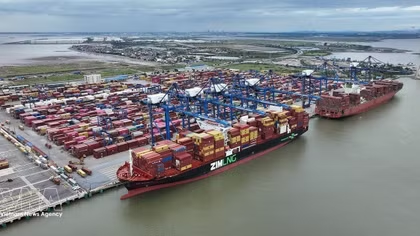
The southern economic hub earned US$26.6 billion from exports in January - October, up 6.5% year on year, while that of the same period of 2015 declined 3.8%, according to the municipal Department of Planning and Investment.

Shipments to some countries have risen considerably, including Indonesia (up 61.1%), India (52.6%), China (36.5%), Thailand (31.5%) and the Republic of Korea (26.4%).

About US$30.3 billion worth of goods were imported into HoChi Minh City from January to October, climbing 10.7% from a year earlier. The rate was 8% in the corresponding period last year.

As many as 29,899 businesses were set up during the 10 months with a total registered capital of over VND242.16 trillion (nearly US$10.9 billion), increasing by 15.9% in the business number and 46.1% in capital.

The city granted the investment registration certificate to 668 foreign invested projects, up 44% year on year, with a combined capital of US$798.7 million. About US$477.3 million was also added to 145 existing projects over the period.

Authorities also allowed foreign investors to contribute capital to and buy stakes in local companies, at some US$1.23 billion in total. It attracted US$2.5 billion in overall foreign investment in the first 10 months.

VNA

Other News

SBV raises short-term capital lending cap to 40%

SBV raises short-term capital lending cap to 40%

The new circular will help credit institutions have more room to provide capital to businesses and investment projects to support high economic growth in the next few years, while increasing flexibility in the SBV’s monetary policy management.

Business confidence in Vietnam rebounds strongly: UOB

Business confidence in Vietnam rebounds strongly: UOB

The study found that 85% of Vietnamese enterprises reported positive business sentiment, a sharp increase from 48% in 2025, when business confidence was weighed down by uncertainties surrounding US tariff policies and related trade developments.

Bac Ninh seeks high-quality foreign investment for sustainable growth

Bac Ninh seeks high-quality foreign investment for sustainable growth

According to Vice Chairman of the provincial People’s Committee Pham Van Thinh, the province aims to maintain stable and sustainable growth, improve the competitiveness of both the economy and local businesses, and make better use of free trade agreements (FTAs) to expand and diversify export markets.

Green building trend flourishes in Ho Chi Minh City's real estate landscape

Green building trend flourishes in Ho Chi Minh City's real estate landscape

The International Finance Corporation (IFC) highlighted the city's dominance in green-certified building floor space in Vietnam, reflecting the rapid expansion of the green building market with 780 completed green buildings encompassing over 18.69 million sq.m by 2025, predominantly certified by EDGE and LEED.

UK supports Vietnam in wind power and green finance development

UK supports Vietnam in wind power and green finance development

The United Kingdom officially announced two new climate cooperation initiatives to support Vietnam in its energy transition and green growth journey. These programs focus on offshore wind power development and the creation of a sustainable green financial ecosystem.

Ample room remains for Vietnam–India logistics cooperation

Ample room remains for Vietnam–India logistics cooperation

The GTTCI expert noted that alongside logistics and integrated warehousing, e-commerce is expected to be a particularly high-growth sector in the coming years. He described it as a multi-billion-dollar market with significant untapped opportunities for cooperation between Vietnam and India.

Exports gain momentum from high-tech growth drivers

Exports gain momentum from high-tech growth drivers

According to the Ministry of Industry and Trade, Vietnam’s exports reached 215.66 billion USD in the first five months of 2026, up 19.5% year-on-year. Twenty-six export items generated more than 1 billion USD in revenue each, including seven with turnover exceeding 10 billion USD.

Vietnam–China crossings see spike in ASEAN fresh produce

Vietnam–China crossings see spike in ASEAN fresh produce

Since the start of the summer harvest season, China's two major border gates with Vietnam, Youyi Guan in Pingxiang and Beilun 2 Bridge in Dongxing, have entered their peak period for handling imports of fresh agricultural and seafood products from member states of the Association of Southeast Asian Nations (ASEAN).

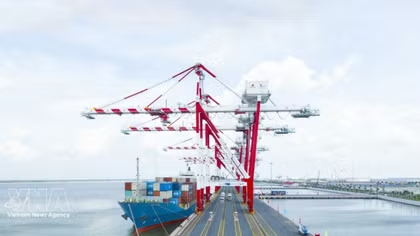
Cargo handling operations at Berths 3 and 4 of the Hai Phong International Gateway Port. (Photo: VNA)

AI reshapes logistics, raising bar for workforce skills

According to the Vietnam Logistics Business Association (VLA), the logistics sector will require around 2.2 million workers by 2030, including 1.6 million employees for logistics service providers and nearly 600,000 personnel supporting logistics operations in manufacturing and trading enterprises.

Robust dispute resolution framework key to Vietnam's IFC ambitions

Robust dispute resolution framework key to Vietnam's IFC ambitions

The development strategy for VIFC-HCMC envisions a comprehensive financial ecosystem encompassing green finance, carbon credits, financial technology (fintech), blockchain technology, digital assets, digital banking and other innovative business models. These highly internationalised sectors involve complex cross-border transactions and sophisticated legal structures.