Removing barriers to facilitate women start-ups

Start-ups have become an important strategy in economic development and job creation in Vietnam, which is also one of solutions to help women generate jobs and develop their economy in a sustainable manner.

Women now account for nearly 50% of the labour force in almost all industries and sectors in Vietnam, and also boast great potential for carrying out start-ups, but they are given little attention due to both subjective and objective barriers.

According to data from the Women's Union of Vietnam (WUV), women-owned enterprises in Vietnam are mainly small and micro-sized with limited accessibility to support programmes or policies. To start a business, women have to overcome a series of challenges including a lack of self-confidence, gender prejudice, limited access to resources and markets and a lack of business management skills.
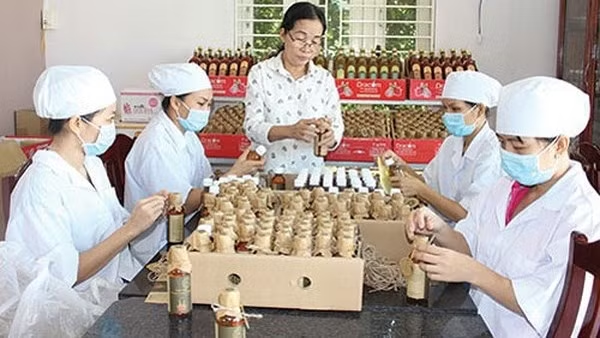
Women-owned businesses and households have created significant sources of income and material wealth for the country.

The facts show that women-owned businesses and households have created significant sources of income and material wealth for the country, contributing to creating jobs for millions of workers, while effectively performing their obligations to the State and responsibility to society and the community.

According to the World Bank, 71% of women working in Vietnam are self-employed and agriculture and services are the two sectors that use the highest number of female labourers. In recent decades, feminisation in agriculture has become more prominent, particularly in the north and women undertake most of the work in many agricultural value chains. Thus, if barriers facing women when starting a business are not removed, potential opportunities for economic development will be missed.

The national strategy on gender equality in the 2011-2020 period has set the targets that the ratio of women-owned businesses will rise from the current 25% to 35% and the ratio of rural workers under 45 years old that are provided with vocational and technical training will reach 50%. In addition, 100% of women in poor, rural, and ethnic minority areas, who have demand for loans to start a business, will be given preferential loans from employment programmes, poverty reduction funds and other official credit sources.

The WUV has also set the target of having 35% of women-owned enterprises by 2020. However, in order to achieve these goals, more specific support policies are needed including financial and non-financial support policies. Non-financial sources include the internal capacity and competitiveness to support women to develop and effectively manage their businesses without depending on external support.

The WUV stated that, it requires the joint efforts of the local political system and WUV members at all levels to help realise the innovative ideals of women to facilitate their start-ups. It is also advisable to enhance the competitiveness of newly established enterprises while developing link activities and trade promotion networks.

In Vietnam, co-operative development is an appropriate form of production to support small-scale household business to compete in the market economy in accordance with the collective economic development direction of the Party and State. The promulgation of policies and mechanisms to support women start-ups and develop enterprises is an urgent need in the near future.

On the other hand, activities in support of women start-ups and businesses must be carried out on different scales and levels which are suitable for specific types of production and business operations. Sustainable business development requires close links between three types of economies including household economy, cooperative economy and corporate economy. Solutions in support of women start-ups must be implemented synchronously in order to promote the general development of the household, cooperative and corporate economies through the participation in the value chains.

The WUV’s project in support of women start-sup in the 2017-2025 period, which was approved by the Government, will encourage women to be confident in starting business in the form of household or cooperative economies and companies or through the application of scientific and technological advances to create products and services of high value. Creativity and connectivity are considered the most important factors for women start-ups, which is also a way for enterprises to escape from scattered and unplanned production and business. Furthermore, the learning from experience and successful models will be the key to women achieving success.

Ministries and sectors need to combine their support activities with related projects and programmes to assist women in starting a business. In addition, female entrepreneurs need to be proactive and active to learn and innovate, while accepting changes to create products and services that meet the increasingly demanding requirements of the domestic and international markets, as well as ensuring environmental protection and public health.

NDO

Other News

Private economic sector poised for breakthrough growth

Private economic sector poised for breakthrough growth

More than a year after the Politburo's Resolution No. 68-NQ/TW on private sector development came into effect, expectations now extend beyond increasing the number of enterprises. The goal is to build a stronger business community with greater resilience, larger ambitions and the capacity to compete in global supply chains.

Vietnam remains ASEAN growth leader in 2026 despite global headwinds: WB

Vietnam remains ASEAN growth leader in 2026 despite global headwinds: WB

Vietnam is expected to remain one of ASEAN’s fastest-growing economies in 2026, supported by resilient exports, strong investment inflows and an ambitious reform agenda, despite mounting global uncertainties, according to the World Bank’s latest Vietnam Economic Update released on May 15.

Ministry establishes monitoring framework for carbon market

Ministry establishes monitoring framework for carbon market

Under a new circular, the exchange of greenhouse gas emission quotas and carbon credits is conducted on the domestic carbon credit exchange through the carbon trading system, which is interconnected with the national registration system.

Biofuel ready for nationwide rollout

Biofuel ready for nationwide rollout

For biofuels, particularly E10, to develop successfully, stronger and more coordinated policies are needed, especially pricing mechanisms capable of creating a sufficiently attractive gap between E10 and mineral-based petrol, an expert has said.

Vietnamese farm produce promoted at African investment, trade forum

Vietnamese farm produce promoted at African investment, trade forum

The 12th Africa Forum for Investment & Commerce (AFIC 12) opened in Algiers, the capital of Algeria, on May 9, drawing around 2,000 participants, including officials, economists, businesses, financial and development organizagtions from 43 African countries and international partners, including Vietnam.

Int'l medical, pharmaceutical expo opens in Hanoi

Int'l medical, pharmaceutical expo opens in Hanoi

The exhibition, which runs until May 9 at the Hanoi International Centre for Exhibition, showcases advanced products and technologies across a range of fields, including pharmaceuticals, drug manufacturing machinery and equipment, medical devices, hospital and clinic services and dental equipment.

Mega projects to transform Ho Chi Minh City urban landscape

Mega projects to transform Ho Chi Minh City urban landscape

Leading the charge in this massive building spree is the new central city square in the core of the Thu Thiem new urban area. Spanning more than 20 ha, it’s the crown jewel of the Central Square and new administrative center complex.

Vietnam establishes itself as one of region’s most dynamic manufacturing and supply bases

Vietnam establishes itself as one of region’s most dynamic manufacturing and supply bases

The country’s stable political and economic environment provides a critical foundation for long-term sourcing strategies. At the same time, Vietnam has demonstrated a strong ability to scale up manufacturing, supported by a continuously expanding industrial base capable of meeting both high-volume demand and increasingly complex technical and quality requirements.

Vietnamese pomelos gain broader access to Australian market

Vietnamese pomelos gain broader access to Australian market

The update by Australia’s Department of Agriculture, Fisheries and Forestry to its Biosecurity Import Conditions system (BICON) on April 10, officially setting out import conditions for Vietnamese pomelos, is regarded as a major milestone in market access efforts.

Vietnam's industry spearheads transition to circular economy

Vietnam's industry spearheads transition to circular economy

The circular economy is no longer just a policy choice. It has become an inevitable trend for delivering sustainable and green growth, sharpening competitiveness at home and abroad, and meeting Vietnam’s net-zero emissions target by 2050. It is now a prerequisite to sustain long-term economic expansion, particularly in industrial production and supporting industries.

Nearly 100 tonnes of Vietnamese fruits, vegetables airlifted to UAE

Nearly 100 tonnes of Vietnamese fruits, vegetables airlifted to UAE

Vietnamese fresh produce and processed foods are increasingly recognised for their quality, with items such as cashew nuts, coffee and spices gaining popularity among Middle East consumers. In 2025, Vietnam’s farm produce exports to the UAE exceeded 445 million USD, up nearly 24% year-on-year.