WEF brings investment opportunities for Vietnam

Nearly 30 years after Vietnam joined the World Economic Forum (WEF), the WEF has become an important venue for the Vietnamese Government to hold dialogues with world leading economic groups, thus bringing investment opportunities for the country.

Bilateral meetings between Vietnamese leaders and foreign counterparts as well as with executives of world economic groups provide the chances for discussion on development directions for Vietnam’s economy, thus assisting with the country’s building of development guidelines and policies. 

WEF Managing Director Philipp Roesler visited Vietnam in three consecutive years of 2014, 2015 and 2016. Vietnam’s senior officials regularly attend the WEF’s annual meetings in Davos and East Asia. Former Prime Minister Nguyen Tan Dung’s participation at the WEF Davos Conference in 2007 and 2010 resulted in important outcome, opening a new period of the ties between Vietnam and the Swiss-based non-profit organisation.
Last year, the Vietnamese delegation to Davos led by Prime Minister Nguyen Xuan Phuc continued to deliver the country’s message on its economic prospects and resolve for comprehensive reforms and active international integration. Vietnam’s commitment to building an action-oriented and development-facilitating Government suited the conference’s theme of Responsive and Responsible Leadership. At the event, the two sides signed a partnership agreement on the development of Vietnam’s economy in the future. The WEF also approved Vietnam’s hosting of the WEF on ASEAN in 2018.

Vietnam has been active in the WEF’s activities in recent years. The two sides have expanded cooperation to other fields, such as national competitiveness, industry and agriculture.

Vietnam played an active role in the WEF’s initiatives. It was one of the key partners in the WEF’s New Vision for Agriculture initiative.

Since 2016, Minister of Industry and Trade Tran Tuan Anh has served in the coordination board of the WEF’s Future of Production System project. He also joined the ASEAN Regional Strategy Group in 2017.

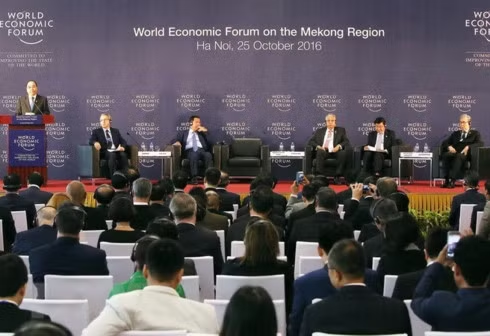
Vietnam also hosted several regional WEF meetings. It put forth the idea for a WEF on the Mekong region and successfully organised the event in October 2016 in Hanoi, promoting the sub-region to world leading groups.

Besides, Vietnamese enterprises have gradually got involved in the WEF’s activities. Such groups as Viettel, FPT, VinGroup, VinaCapital, VNPT, SIG or Hoa Sen, to name just a few, have used the WEF to build their partner networks and share experience in operation.

The WEF on ASEAN will take place in Hanoi from September 11-13 under the theme “ASEAN 4.0: Entrepreneurship and the Fourth Industrial Revolution”. 

The presidents and prime ministers of eight countries have confirmed their attendance at the event. The forum will see the participation of 50 ministerial-level representatives, 800 heads of regional- and world-leading corporations, as well as some 120 reporters from world and regional media outlets to cover the event.

The WEF was established in 1971 as a non-profit foundation and is headquartered in Geneva, Switzerland. The forum engages the foremost political, business, and other leaders of society to shape global, regional, and industry agendas.
VNA

Other News

Vietnam accelerates innovation to boost growth, competitiveness

Vietnam accelerates innovation to boost growth, competitiveness

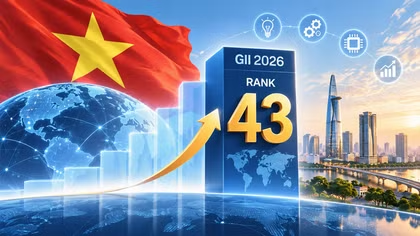
By 2030, Vietnam aims to rank among the world’s top 40 in the GII; raise total social investment in R&D to at least 2% of GDP, with non-State funding accounting for over 60%; increase international scientific publications by an average of 10% annually; and raise the number of patent applications and granted patents by an average of 16-18% annually.

Vietnam sees high growth prospects

Vietnam sees high growth prospects

Experts from the Institute of Vietnam and World Economy under the Vietnam Academy of Social Sciences noted the quality of recent growth as the high growth rate has been recorded against an increasingly higher comparative base.

Vietnam seeks bigger share of global Halal market

Vietnam seeks bigger share of global Halal market

Vietnam's Halal exports remain modest at around 900 million USD a year, accounting for less than 1% of the global market. Most exports are still raw agricultural and seafood products. Only around 1,000–1,300 Vietnamese businesses obtained or maintained Halal certification during 2024–2026.

Hanoi sets up inter-agency mechanism to operate carbon market

Hanoi sets up inter-agency mechanism to operate carbon market

Under a decision of the municipal People’s Committee on establishing an inter-agency working group, departments and agencies are responsible for identifying facilities subject to greenhouse gas inventories, developing emissions-reduction plans and studying projects capable of generating carbon credits.

Shrimp exports reach 3.3 billion USD in eight months

Shrimp exports reach 3.3 billion USD in eight months

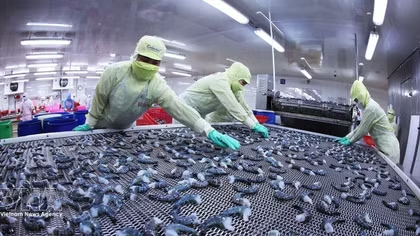
According to data from the Vietnam Customs cited by the Vietnam Association of Seafood Exporters and Producers (VASEP), shrimp exports reached 478.5 million USD in August, up 4.2% from the same month last year. The eight-month total stood at 3.3 billion USD, representing a year-on-year increase of 12%.

Russian investors explore opportunities in Vietnam's real estate market

Russian investors explore opportunities in Vietnam's real estate market

Vietnam is seen as a potential market, with considerable room for growth in real estate, particularly commercial property, compared with some regional markets. Strong Vietnam-Russia ties and opportunities to establish foreign-invested enterprises are also considered favourable for Russian investors.

Phu Quoc airport planning adjusted to serve APEC 2027

Phu Quoc airport planning adjusted to serve APEC 2027

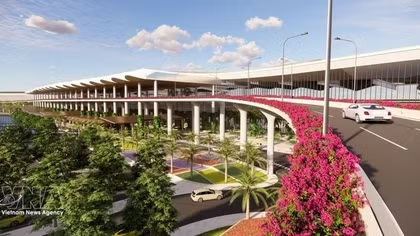
For 2021-2030, the Civil Aviation Authority of Vietnam proposed bringing forward the investment in a parallel taxiway system and a connecting taxiway north of Runway No. 2 at Phu Quoc International Airport, in order to connect with the aircraft maintenance and repair facility (hangar) planned for the northern area of ​​the airport.

Policy, infrastructure emerge as new advantages in FDI attraction

Policy, infrastructure emerge as new advantages in FDI attraction

From policy and infrastructure to industrial real estate, Vietnam’s FDI advantages are broadening towards a more integrated production ecosystem, offering investors a stronger combination of conditions for high-value, technology-intensive and long-term projects.

Logistics upgrade vital to 1-trillion-USD trade target: experts

Logistics upgrade vital to 1-trillion-USD trade target: experts

As trade expands, systemic bottlenecks across transport networks, warehousing, ports, border gates, and industrial zones are becoming more apparent. Experts emphasise the need to shift from a fragmented, project-by-project approach toward strategic management structured around trade corridors and integrated supply chains.

Ample room for Vietnam, US to deepen cooperation

Ample room for Vietnam, US to deepen cooperation

Do Ngoc Hung, Trade Counsellor and head of the Vietnam Trade Office in the US, said what stands out is not only the growth in trade volume but also the increasingly deep economic ties between the two countries.

Flexible fiscal policy helps drive economic growth

Flexible fiscal policy helps drive economic growth

According to the Ministry of Finance, State budget revenue in the first eight months of 2026 was estimated at 2.02 quadrillion VND (77.7 billion USD), equivalent to 80% of the annual estimate and up 16% year-on-year. Domestic revenue reached 1.75 quadrillion VND, accounting for 86.6% of total revenue and rising 16.6%.

Electronic components are produced at a factory in Hanoi. (Photo: VNA)

Hanoi's imports surge 41% in first eight months of 2026

Hanoi aims to achieve average annual export growth of at least 12% during 2026-30, with the city seeking to diversify export markets, boost high-tech and value-added products and reduce reliance on traditional markets.