AI and Cybercrime: The good and bad news

Artificial intelligence could soon reset the murky world of cybercrime – and the news is both good and bad. “We have AI, but so do the bad guys,” says Ann Johnson, Microsoft’s Vice President, Enterprise & Cybersecurity. 

She thinks it is inevitable that the criminal use of AI will result in more sophisticated threats – such as “malware becoming adaptive in the wild, which I don’t think is that far off.” But she is also optimistic that companies and crimefighters, armed with AI, will be able to catch threats faster, and use analytics to predict when something is going to happen.
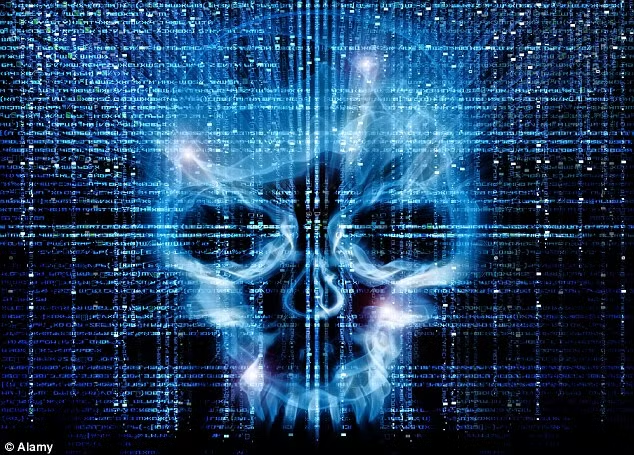
"When we see malware, we will be able to analyse it much more quickly by using artificial intelligence and machine learning," she said in an interview on the sidelines of the Interpol World 2017 Congress in Singapore recently.

Threat intelligence remains fundamental to keeping networks safe – here in Asia and across the rest of the world. In a keynote address to the Interpol gathering, Johnson said that organisations with good threat intelligence have an advantage because it points to what hackers might do in the future. It also offers indicators of potential compromises. This anticipatory approach means organisations can patch their security before problems emerge.
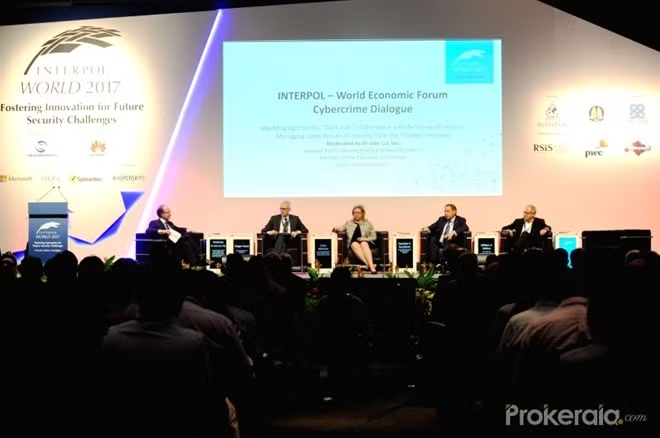
Interpol World 2017 Congress in Singapore. Photo: Interpol

This is where Microsoft’s  Intelligent Security Graph steps in. It gathers and analyses billions of signals and authentications from across Microsoft’s more than 200 global services – including emails, Bing and Internet Explorer –  constantly watching for signs of trouble and then alerting customers.

New technologies, like security chatbots, and HoloLens, let you interact with the graph to get insight and help on how to deal with a security incident. “You can say: ‘I am seeing this scenario. Who else in my organization is affected?’ Johnson explains, And, it comes back and says: ‘Based our analysis, here is a list of affected persons, how they got infected and their hierarchy in the organization.”

Johnson further sees a time when machine-learning will make cybersecurity “a lot more intelligent”, predictive even. Imagine a security environment that warns of for example: “10 computers in a data centre are going to go down, or a network connection can potentially be compromised.”

Her watchwords are: “Assume Breach”. “You always have to assume that you have been compromised. In Asia, compromises are not detected on average for about 500 days – compared with 100 days in the U.S. Think about someone being in your network for 500 days and the amount of damage they can do.”

Johnson says the world must now accept that cybercrime is here to stay. “It is not going to stop. It is going to get worse. We will have to act faster, but we are not going to ‘stop’ it. It’s like saying we are not going to have another murder or another bank robbery. 
PSNews

Other News

SK Group partners to build AI ecosystem in Vietnam

SK Group partners to build AI ecosystem in Vietnam

SK Innovation and SK Telecom signed MoUs with Nghe An province and the National Innovation Centre of Vietnam to advance AI ecosystem development and support the country’s long-term growth strategy.

Vietnam Research Excellence Fellowship for 2026-2030 approved

Vietnam Research Excellence Fellowship for 2026-2030 approved

Under the Vietnam Research Excellence Fellowship (VREF) for the 2026–2030 period, PhD students are identified as a core research force directly contributing to breakthroughs in sci-tech and innovation. Investing in top-tier doctoral candidates is more than workforce development, but a high-stakes strategic bet to forge a cohort of world-class scientists and technologists who can power Vietnam’s long-term economic ambitions.

Strategic tech must address practical challenges: PM

Strategic tech must address practical challenges: PM

Prime Minister Pham Minh Chinh on March 28 said strategic technologies must tackle Vietnam’s practical challenges, while chairing a meeting of the Government’s Steering Committee for science and technology, innovation, digital transformation, and Project 06.

Ho Chi Minh City sets sights on becoming semiconductor hub

Ho Chi Minh City sets sights on becoming semiconductor hub

Ho Chi Minh City is stepping up efforts to attract investment from global leading groups and companies in the fields of electronic components, semiconductors and chip manufacturing as it seeks to position itself as a leading semiconductor industry hub in both the region and the world. 

Ho Chi Minh City launches upgraded technology exchange platform

Ho Chi Minh City launches upgraded technology exchange platform

The upgraded platform represents a comprehensive shift from a simple information-sharing model to a managed online technology trading system, enabling monitoring and measurement of real transaction outcomes. It is built on three pillars, namely new tradable technology products, a modern digital platform, and an improved operational model.

AI – unmissable opportunity for Vietnam: Experts

AI – unmissable opportunity for Vietnam: Experts

AI also emerges as a key enabler for Vietnam's ambition to build financial and technology hubs. Applications can boost efficiency, automate workflows, cut costs, and sharpen data analytics, which are essential pillars of a modern financial system.

PM calls for accelerated space technology development in Vietnam

PM calls for accelerated space technology development in Vietnam

Vietnam aims by 2030 to achieve a mid-level position in space science and technology development within Southeast Asia, and after 2030 to build national capabilities to independently develop satellite technologies and apply space data to address global challenges and national security needs.

High-level forum advances Vietnam–US technological cooperation

High-level forum advances Vietnam–US technological cooperation

A high-level executive leadership forum focusing on strengthening Vietnam - US relations through technology cooperation was jointly held in Washington D.C. on March 11 by the Embassy of Vietnam in the US, the Weatherhead East Asian Institute of Columbia University, and the US -ASEAN Business Council (USABC). 

AI Law takes effect, anchors national governance framework

AI Law takes effect, anchors national governance framework

While many countries are still drafting policy blueprints or issuing non-binding guidance, Vietnam has moved ahead with a standalone Law on Artificial Intelligence (AI), effective from March 1, placing it among a select group of nations to adopt dedicated AI legislation at the parliamentary level. 

Vietnam International Defence Expo 2026 preparations move into high gear

Vietnam International Defence Expo 2026 preparations move into high gear

Vietnam International Defence Expo 2026, themed “Peace, Friendship, Cooperation and Development,” will be organised on a larger scale, featuring a wide array of weapons and technical equipment alongside product exhibitions, seminars and panel discussions, drills, live field demonstrations, and business networking activities.

Ministry requests urgent measures to counter UAVs threatening aviation safety

Ministry requests urgent measures to counter UAVs threatening aviation safety

Ministry of Construction requested the Ministry of National Defence, the Ministry of Public Security and provincial and municipal steering committees for counter-terrorism to strengthen the management, inspection and supervision of UAVs and other aerial devices, ensuring strict compliance with Decree No. 288/2025/ND-CP and relevant legal regulations.