- Microsoft president calls for 'urgent collective action' after major cyberattack
- Facebook, Twitter, Google and Microsoft team up to tackle extremist content
Business leaders in Asia Pacific’s Financial Services Industry (FSI) are embracing the 4th Industrial Revolution, according to a Microsoft Study. 81% of them believe that they need to transform to a digital business to enable future growth but only 31% said that they have a full digital strategy in place today.
These are some of the key findings of the Microsoft Asia Digital Transformation Survey, commissioned to understand how business leaders in FSI organisations are embracing the digital era.
 |
81% respondents agreed that cloud computing is now an essential part of their digital transformation strategy, and same percentage of respondents agreed that new data insights can lead to new revenue streams.
Technology advancements have ushered in the 4th Industrial Revolution, where cutting-edge technologies such as Internet of Things (IoT), artificial intelligence (AI), advanced data analytics, and mixed reality are powered by cloud computing to create limitless possibilities in transforming the way people work, live and play.
This revolution, together with rapid urbanization, emergence of the millennial workforce and a fragile global economic climate, is ushering societal and economic changes at an unprecedented pace.
The Microsoft Asia Digital Transformation Study surveyed 1,494 business leaders across five industries from Asia Pacific working in organizations with more than 250 employees from 13 Asia Pacific markets: Australia, China, Hong Kong, Indonesia, India, Japan, Korea, Malaysia, New Zealand, Philippines, Singapore, Taiwan and Thailand.
All respondents were pre-qualified as being involved in shaping their organizations’ digital strategy. 335 respondents were from the Financial Services Industry.
Even as majority of business leaders are aware of the urgent need to transform digitally to address the changing business climate, the study found that the transformation journey for most organisations in Asia is still at its infancy.
In fact, only 31% of business leaders indicated that they have a full digital transformation strategy in place and 53% are in progress with specific digital transformation initiatives for selected parts of their business. 16% still have very limited or no strategy in place.
According to Capgemini's World Retail Banking Report, 15% of banking customers are likely to leave their banks due to ease of use and service levels; and banks have to do more to transition customers from physical branches to digital channels. In addition, Avanade found that 80% consider personalized services as a key driver for customers to switch insurers.
The Study shows how business leaders in FSI are prioritizing their digital transformation strategies:
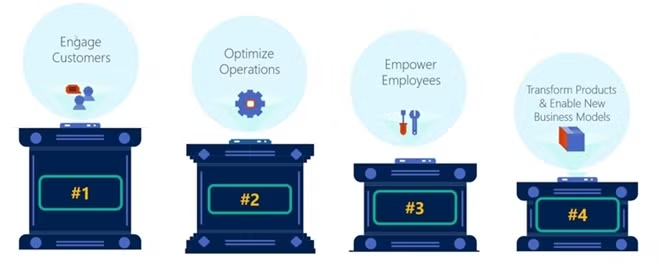 |
| Prioritization of Digital Transformation pillars among Asia’s business leaders today |
In fact, according to Cagemini, less than 50% of Gen Y customers globally are likely to remain with their primary banks, which makes customers a priority in the digital age.
Emerging Technologies in Demand
Cloud computing and the decreasing cost of devices have made it more affordable for organizations to transform digitally, according to 83% of FSI business leaders surveyed.
However, in the next 12 to 18 months, business leaders in Asia Pacific’s FSI space are interested to explore a range of emerging technologies to accelerate and achieve digital transformation.
The top five technologies identified by business leaders as being relevant to them are: Internet of Things (IoT): Network of sensors embedded into devices that can collect data or be remotely controlled. Examples include IoT applications used in ATM machines for predictive maintenance; Artificial intelligence (AI): Intelligent machines or software that can learn and perform tasks independently. These are solutions that can see, hear, speak and understand needs and emotions, using natural methods of communication which is enhanced by vast amount of data from various sources; Next-generation computing experiences: Computers and software that can process natural languages, gestures and visuals. Examples include chatbots and Microsoft’s Skype Translator; Predictive analytics: Modern cloud-based applications and tools which enable organisations to find actionable insights through data mining and predictive analytics in real time; and Quantum computing: Next-generation computers using different computation systems to solve data equations much faster than traditional computers.
Barriers to Digital Transformation in Asia Pacific
While there is no doubt that digital transformation will bring significant benefits for both businesses and employees, the path to digital transformation has been slow, given that only 31% have a full digital strategy in place.
According to business leaders in the study, the top barriers to digital transformation in FSI are, in order of priority:
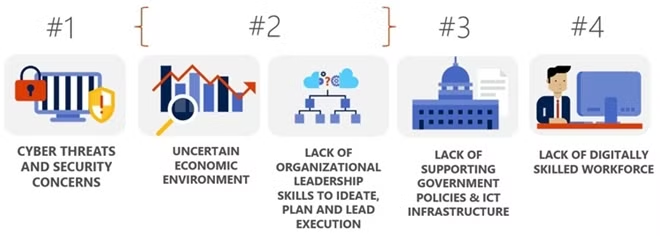 |
| Top barriers faced by FSI business leaders in their digital transformation journey today |
Increasing security threats in today’s digital economies is real and cannot be ignored. Cyber attack and fraud are top of mind for banks today. Banks are under continuous pressure of meeting regulatory, anti-money laundering compliance requirements, according to Morgan Stanley, there are USD 280b paid in bank fines since 2009.
There is a continued perception among business leaders that the cloud is less secure. However, they may be less privy to the advances being made in the cloud on security and privacy and need more exposure on how, with the current threat environment, it will be safer being in the cloud than relying on tradition forms of IT.
In fact, a recent Microsoft Asia Pacific survey of 1,200 IT leaders conducted in September 2016 found that 87% believe that in the longer term, the cloud will be safer.