Energy Drinks Linked to Aggression, Hurt PTSD Therapy in Soldiers - Study

The US military’s addiction to energy drinks like Rip-It and Wild Tiger is exacerbating mental health issues soldiers acquire during deployment, a new medical study has found. The study found that people who drink more high-caffeine drinks are also less responsive to Post-Traumatic Stress Disorder (PTSD) treatments.

The US military has a bad addiction to powerful energy drinks, with soldiers using the high-caffeine beverages to stave off sleep and retain awareness during long deployments and patrols, the Military Times noted. 

Being cheap, omnipresent, useful and addictive, nearly half of troops down at least one can of what they colloquially call "crack" each day. Energy drinks now seem as much of a necessity for mission success as body armor and adequate armament.
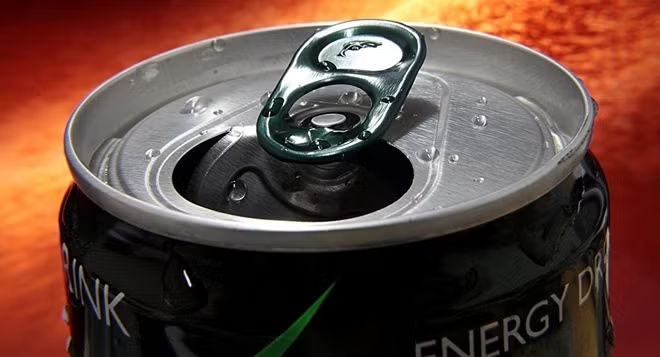
Photo: CC0
Photo: CC0 

A study published in Military Medicine in late August found that soldiers who drank multiple energy drinks per day displayed more aggressive behaviors and were also more likely to suffer from mental health problems after the end of their deployment, Task and Purpose reported Tuesday.

The authors defined high energy drink use as consuming two or more drinks per day, which they associated with a higher rate of "mental health problems, aggressive behaviors and fatigue." The number of soldiers found to meet the high use threshold, Military Times noted, was five times higher than previous studies that analyzed the consumption patterns of airmen and non-military youth.

For example, Army Staff Sergeant Matthew Riker told Thrillist that he'd "caught privates filling their CamelBaks with the stuff in lieu of water and sipping it through a straw."

What's worse, a frat-party attitude has developed about who can drink the most — a challenge called a "case race," which is, as Shane Snell, a US Army Ranger-turned blogger put it, when "you and your squad, fire team, gun team, or any other team, try to finish an entire case/24 pack of Rip-Its the fastest."

This, Snell says, "is a really bad idea."

The authors of the study, titled "Energy Drink Use in US Service Members After Deployment: Associations With Mental Health Problems, Aggression, and Fatigue," would likely agree with Snell's sentiment.

For the study, the authors surveyed 627 male infantry soldiers, most of them junior enlisted men between the ages of 18 and 24, seven months after returning from combat deployment, and noted some worrisome trends. For example, 66 percent displayed extreme irritability, while 35 percent had sleep issues, and 29.8 percent suffered from alcohol abuse; 9.6 percent suffered from depression, and 11.2 percent suffered higher rates of PTSD. Soldiers who drank less than one energy drink per week did not show these symptoms at such a high rate.

The authors noted that 75 percent of the surveyed soldiers consumed energy drinks leading up to the month of the survey and that 16 percent "reported continuing to consume two or more energy drinks per day in the post-deployment period."

The authors attributed many of these problems to long-term sleep deprivation caused by high caffeine intake. "Interestingly, energy drink use was associated with fatigue," the authors noted. "This relationship suggests that energy drink use may potentially exacerbate, rather than alleviate, fatigue."

Sputnik News

Other News

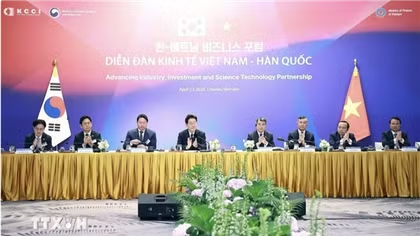
SK Group partners to build AI ecosystem in Vietnam

SK Group partners to build AI ecosystem in Vietnam

SK Innovation and SK Telecom signed MoUs with Nghe An province and the National Innovation Centre of Vietnam to advance AI ecosystem development and support the country’s long-term growth strategy.

Vietnam Research Excellence Fellowship for 2026-2030 approved

Vietnam Research Excellence Fellowship for 2026-2030 approved

Under the Vietnam Research Excellence Fellowship (VREF) for the 2026–2030 period, PhD students are identified as a core research force directly contributing to breakthroughs in sci-tech and innovation. Investing in top-tier doctoral candidates is more than workforce development, but a high-stakes strategic bet to forge a cohort of world-class scientists and technologists who can power Vietnam’s long-term economic ambitions.

Strategic tech must address practical challenges: PM

Strategic tech must address practical challenges: PM

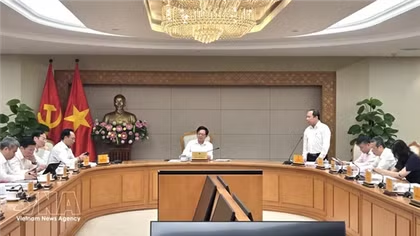
Prime Minister Pham Minh Chinh on March 28 said strategic technologies must tackle Vietnam’s practical challenges, while chairing a meeting of the Government’s Steering Committee for science and technology, innovation, digital transformation, and Project 06.

Ho Chi Minh City sets sights on becoming semiconductor hub

Ho Chi Minh City sets sights on becoming semiconductor hub

Ho Chi Minh City is stepping up efforts to attract investment from global leading groups and companies in the fields of electronic components, semiconductors and chip manufacturing as it seeks to position itself as a leading semiconductor industry hub in both the region and the world. 

Ho Chi Minh City launches upgraded technology exchange platform

Ho Chi Minh City launches upgraded technology exchange platform

The upgraded platform represents a comprehensive shift from a simple information-sharing model to a managed online technology trading system, enabling monitoring and measurement of real transaction outcomes. It is built on three pillars, namely new tradable technology products, a modern digital platform, and an improved operational model.

AI – unmissable opportunity for Vietnam: Experts

AI – unmissable opportunity for Vietnam: Experts

AI also emerges as a key enabler for Vietnam's ambition to build financial and technology hubs. Applications can boost efficiency, automate workflows, cut costs, and sharpen data analytics, which are essential pillars of a modern financial system.

PM calls for accelerated space technology development in Vietnam

PM calls for accelerated space technology development in Vietnam

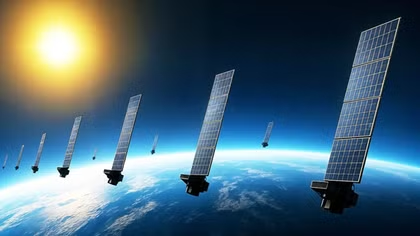
Vietnam aims by 2030 to achieve a mid-level position in space science and technology development within Southeast Asia, and after 2030 to build national capabilities to independently develop satellite technologies and apply space data to address global challenges and national security needs.

High-level forum advances Vietnam–US technological cooperation

High-level forum advances Vietnam–US technological cooperation

A high-level executive leadership forum focusing on strengthening Vietnam - US relations through technology cooperation was jointly held in Washington D.C. on March 11 by the Embassy of Vietnam in the US, the Weatherhead East Asian Institute of Columbia University, and the US -ASEAN Business Council (USABC). 

AI Law takes effect, anchors national governance framework

AI Law takes effect, anchors national governance framework

While many countries are still drafting policy blueprints or issuing non-binding guidance, Vietnam has moved ahead with a standalone Law on Artificial Intelligence (AI), effective from March 1, placing it among a select group of nations to adopt dedicated AI legislation at the parliamentary level. 

Vietnam International Defence Expo 2026 preparations move into high gear

Vietnam International Defence Expo 2026 preparations move into high gear

Vietnam International Defence Expo 2026, themed “Peace, Friendship, Cooperation and Development,” will be organised on a larger scale, featuring a wide array of weapons and technical equipment alongside product exhibitions, seminars and panel discussions, drills, live field demonstrations, and business networking activities.

Ministry requests urgent measures to counter UAVs threatening aviation safety

Ministry requests urgent measures to counter UAVs threatening aviation safety

Ministry of Construction requested the Ministry of National Defence, the Ministry of Public Security and provincial and municipal steering committees for counter-terrorism to strengthen the management, inspection and supervision of UAVs and other aerial devices, ensuring strict compliance with Decree No. 288/2025/ND-CP and relevant legal regulations.